



Today, trading performance is no longer the only factor that determines growth in the foreign exchange market. Operational scalability and transparency become equally important as profitability as businesses grow their investor base, implement additional strategies, and operate across geographies. Many foreign exchange companies have been forced to reevaluate how they handle investor relationships and pooled capital because of this change.
Related articles:
In this context, one question is becoming increasingly prevalent: is a PAMM platform necessary for expanding FX firms, or can growth proceed without one?
To answer that question, this article looks at what a PAMM platform does, when it’s needed, and how FX companies should assess its long-term worth.
What a PAMM Platform Really Solves for FX Firms?
The intricacy of managing numerous investors under shared trading strategies is essentially addressed by a PAMM platform. Growth rapidly causes operational strain in the absence of structured systems.
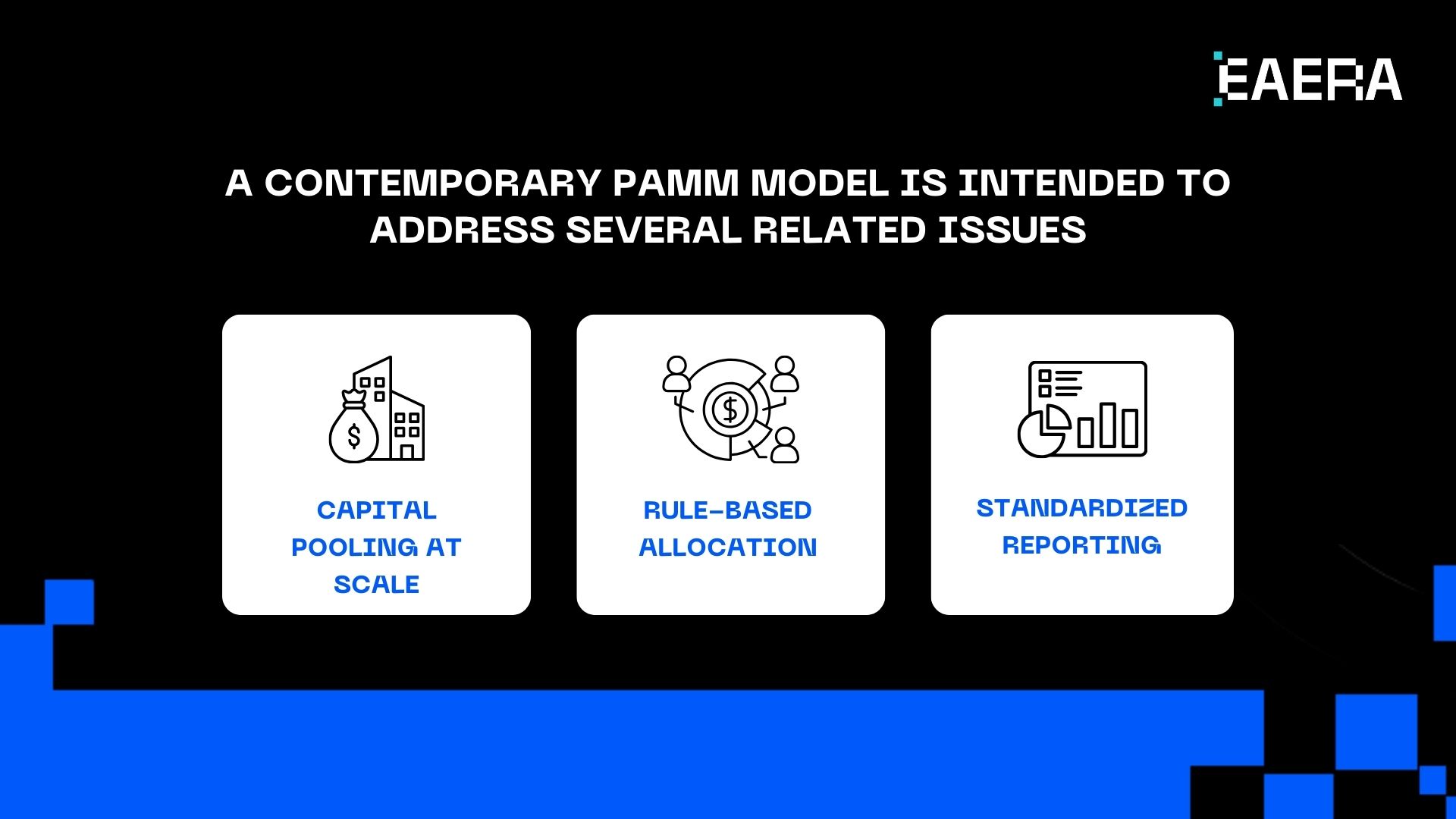
A contemporary PAMM model is intended to address several related issues:
- Capital pooling at scale: combining money from multiple investors into managed strategies without the need for human intervention
- Rule-based allocation: allocating profits, losses, and fees uniformly among all participants
- Standardized reporting: giving investors timely, clear performance information
This signifies a change for FX companies from handling accounts on an as-needed basis to using a system-driven operating model. The PAMM platform uses predetermined logic to enforce consistency rather than spreadsheets or manual reconciliation.
Crucially, raising trading sophistication is not the goal of PAMM. Its main function is to make operations simpler as complexity increases, preventing chaos from being introduced by scale.
Growth Pressures FX Firms Face Without a PAMM Platform
Manual or semi-automated managed account structures are the starting point for many FX firms. Although this strategy is effective in the beginning, as the company expands, it becomes more brittle.
Common pressure points consist of:
- Allocating profit and loss manually
- Calculating fees using a spreadsheet
- Delayed investor reporting
- Increasing dependency on operational personnel
Growth becomes linear and ineffective without a PAMM platform. Error exposure, reconciliation effort, and operational workload all increase with each new investor.

The risks compound quickly:
- Investor trust is damaged by allocating errors
- Reporting delays damage credibility
- Operational bottlenecks slow onboarding
FX companies that don’t have a PAMM platform frequently hit a ceiling where demand is present, but internal systems can’t sustain additional growth without taking a big risk.
How a PAMM Platform Supports Scalable Growth?
A PAMM platform’s primary benefit is its capacity to reduce growth from operational headcounts.
FX firms scale systems rather than people.
When a PAMM platform is implemented correctly, it allows:
- One manager to effectively manage numerous investors
- Automated distribution among all involved accounts
- Centralized computation of fees and performance
Operationally, this results in:
- Lower reconciliation effort
- Reduced manual intervention
- Faster investor onboarding
Strategically, it allows firms to focus on:
- Trading performance
- Strategy development
- Investor acquisition and retention
As volume rises, the PAMM platform serves as an infrastructure layer that absorbs complexity. This infrastructure is frequently what makes expansion sustainable rather than stressful for FX firms aiming for regional or global growth.

This scalability also speeds up time-to-market. Because operational procedures are already standardized, FX firms can introduce new strategies, onboard new investors, or enter new markets more quickly. As investor expectations rise and competition heats up, this agility becomes more valuable.
Risk, Transparency, and Control in Managed Account Models
Risk and transparency shift from operational concerns to strategic imperatives as managed capital increases. At higher volumes, errors that are manageable on a small scale may become systemic problems.
Control is improved by a strong PAMM platform by:
- Allocation and fee logic based on rules
- Predetermined limits for exposure and drawdown
- Consistent execution across all managed accounts
Transparency is equally critical. Investors increasingly expect:
- Real-time performance visibility
- Clear explanations of allocation logic
- Accurate, auditable reporting
This level of transparency fosters long-term investor relationships, lowers conflict, and increases trust.
Contemporary fintech platforms prioritize centralized governance, traceability, and structured data. Systems like those created by EAERA show how reliable reporting, standardized rules, and real-time data processing are beneficial to financial operations – concepts that are directly applicable to PAMM settings.
Transparency is essential to risk management and brand credibility for FX firms, not just a compliance requirement.
When a PAMM Platform Is Not the Right Choice?
A PAMM platform is not always suitable, despite its benefits. Early adoption of PAMM can result in needless complexity and expense.
PAMM might not be appropriate in:
- Only a few investors are managed by the company.
- Trading strategies are still being tested
- Internal reporting and compliance procedures are still in their infancy.
Simpler managed account models or hybrid structures might be more useful in these circumstances. Before committing to a complete PAMM infrastructure, these enable businesses to verify demand and improve operations.
Before adopting a PAMM platform, FX firms should critically assess:
- The consistency of their trading strategies
- The stability of investor inflows
- Their readiness for increased regulatory and reporting requirements
PAMM can accelerate growth, but only if the company is structurally ready for it.
Additionally, some businesses underestimate the amount of change management needed to implement PAMM. Internal teams have to adjust to new reporting requirements, controls, and workflows. Even a technically sound PAMM platform might not provide the desired results without adequate planning.
Choosing the Right PAMM Platform for Long-Term Expansion
For companies that are ready, choosing the right PAMM platform is an important long-term strategy. This evaluation process has to reach an apparent level.
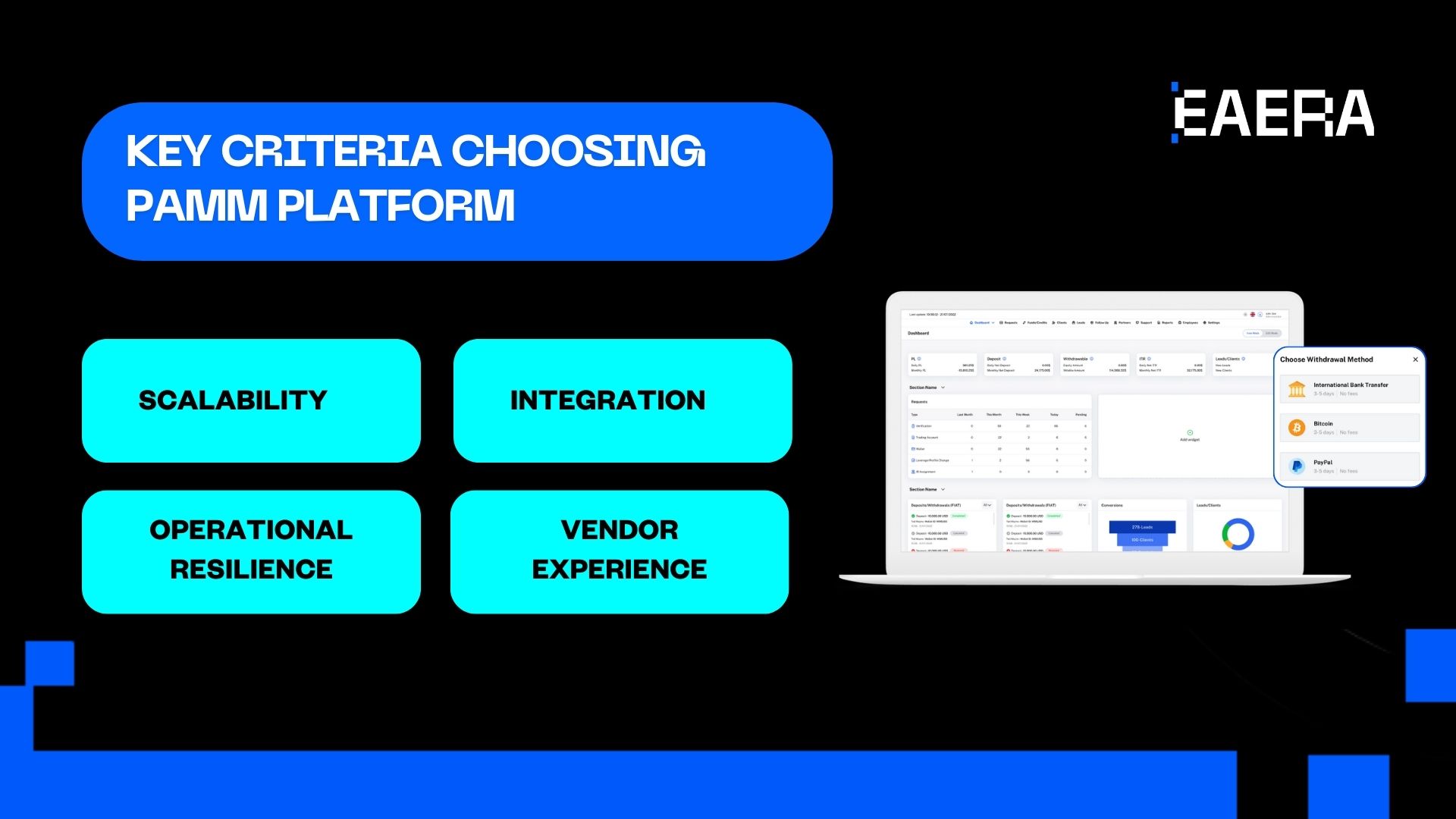
Key criteria include:
- Scalability: handling growing investment volumes
- Integration: compatibility with trading systems, CRM, or reporting tools
- Operational resilience: stability under peak demand
- Vendor experience: pragmatic knowledge of the FX market
Long-term factors are equally important:
- Can the platform adapt to regulatory changes?
- Is there a clear and credible product roadmap?
- Does operational complexity decrease as scale increases?
Enterprise-level fintech solutions and platforms like EAERA emphasize the role of highly dynamic and, more importantly, not necessarily short-term deployment. For the FX firms, selecting a PAMM, with a long-term strategy for growth in mind, means a smoother transition down the line.
A PAMM platform is not a requirement for all FX companies. However, as a tool that can help companies scale their managed funds, increase transparency, and be more efficient in the current digital environment, its role as an enabler should not be underestimated.
By automating allocation, enforcing consistency, and improving investor visibility, PAMM transforms managed accounts from an operational burden into a scalable business model. The key lies in timing, readiness, and choosing a platform designed for long-term growth rather than short-term convenience.