



Success in prop trading is frequently misinterpreted as identifying profitable traders. Risk management is the only factor that determines survival. Because prop firms are directly impacted by trader performance, poor risk control can rapidly deplete capital. Complexity rises as businesses grow, and only those with organized, system-driven risk management can maintain expansion without losing control.
Related articles:
- Risk Management in Trading: How Brokers & Prop Firms Control Risk at Scale?
- Software for Brokers: What Growing Firms Need in 2026
Why Risk Management Defines Prop Firm Survival?
At its core, a prop firm is a risky enterprise. It absorbs the loss and distributes capital to traders. Even profitable times cannot compensate for long-term exposure in the absence of effective risk management.
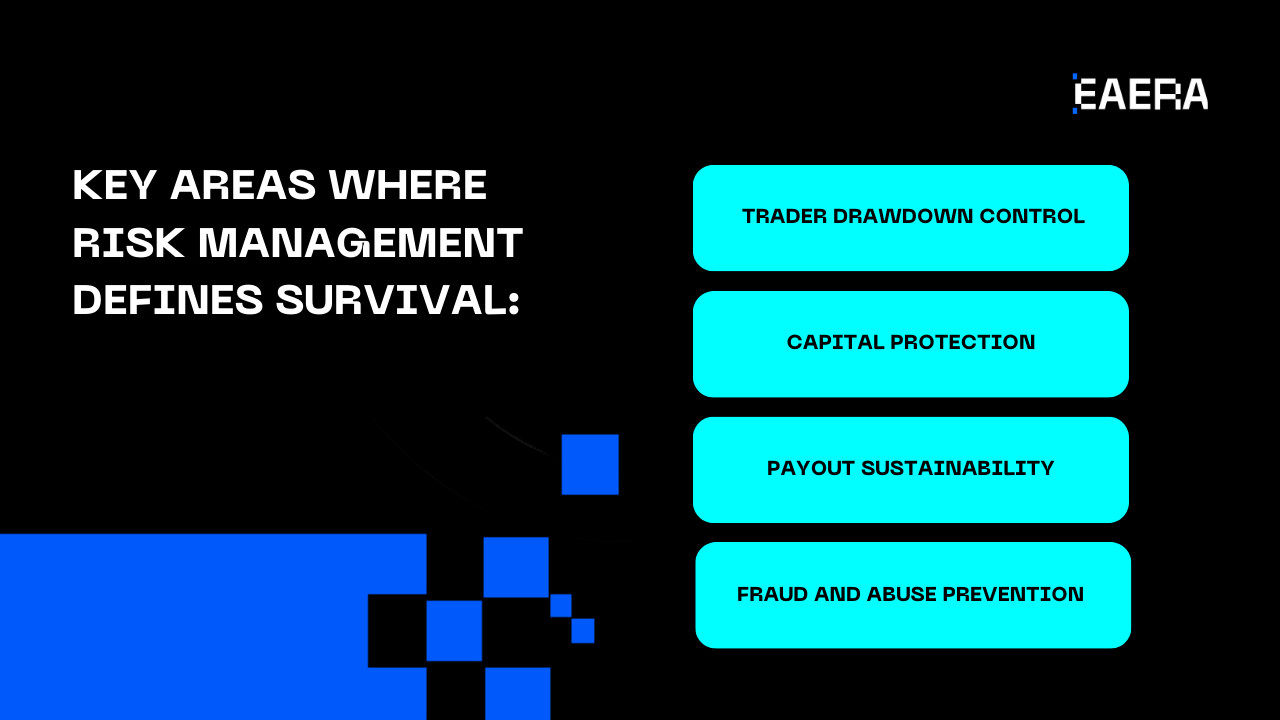
Key areas where risk management defines survival:
- Trader drawdown control: Prevents catastrophic losses from individual accounts
- Capital protection: Ensures the firm’s overall balance is preserved
- Payout sustainability: Maintains a balance between trader rewards and firm profitability
- Fraud and abuse prevention: Detects rule exploitation and system gaming
A single trader or group of traders cannot cause the company to become unstable if risk is effectively managed. Additionally, it shields the company from cumulative hidden exposure. Growth becomes hazardous instead of advantageous without it.
Core Risk Management Layers in a Prop Firm
A single set of rules is not the foundation of effective risk management. It functions across several tiers that collaborate to manage risk at various levels.
Boundaries are the focus of risk control at the trader level. Limits like profit consistency, total drawdown, and maximum daily loss are intended to stop individual accounts from causing substantial harm. The first line of defense is provided by these controls.
Risk management moves from individuals to the system as a whole at the portfolio level. If many traders take similar positions, the company may still be at risk even if every trader abides by the rules. It becomes crucial to keep an eye on concentration, correlation, and overall exposure.
System-related risks are handled by operational risk management. Multiple accounts may be impacted simultaneously by execution delays, platform instability, and liquidity problems. These risks are frequently underestimated, but if left unchecked, they could have significant effects.
The focus of behavioral risk control is on traders’ long-term behavior. Overleveraging and rule exploitation are examples of patterns that can indicate future risk. Early detection of these behaviors enables businesses to take action before losses worsen.

Common Risk Management Failures That Kill Prop Firms
Most prop firms don’t fail due to a single error. Weak risk management techniques build up over time, which is why they fail.
Relying on static rules is a common problem. Fixed rules do not change as markets do. The absence of real-time monitoring is another significant flaw. When businesses take a long time to respond, exposure has already increased uncontrollably.
Common failure patterns include:
- Static rules only: No adaptation to market conditions
- Lack of real-time monitoring: Delayed reaction to risk exposure
- Weak enforcement: Rules exist but are not consistently applied
- No aggregated visibility: Inability to see total firm exposure
- Reactive decision-making: Action taken only after losses occur
These failures highlight a key issue: risk management cannot depend on manual processes at scale. As volume increases, gaps in risk control become systemic risks.
Technology-Driven Risk Management: From Rules to Systems
Manual procedures are no longer sufficient for modern prop firms. Real-time systems need to incorporate risk management.
Continuous exposure monitoring across all accounts is made possible by technology. Additionally, it eliminates the need for human intervention by enabling rules to be automatically enforced. This guarantees uniformity and removes decision-making delays.
Dynamic thresholds are another feature of advanced risk control systems. Risk parameters can change in response to volatility and market conditions rather than having set limits. As a result, the framework becomes more robust.
Behavioral analytics is another essential skill. Businesses can detect risk before it results in losses by examining trading patterns. By initiating prompt reactions to crucial circumstances, event-based monitoring enhances control even more.
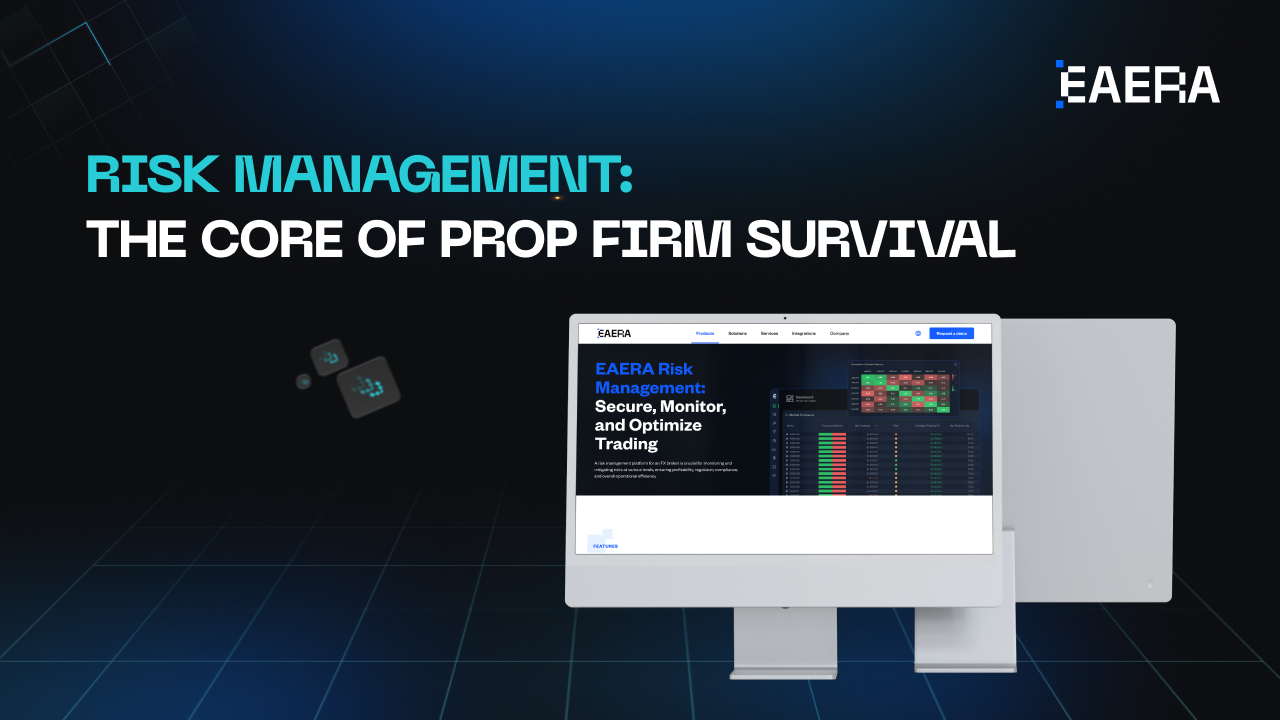
Systems such as EAERA show how fragmented processes can be replaced by system-driven risk management. Risk control is made scalable and dependable by combining monitoring, enforcement, and analytics into a single system.
How to Build a Scalable Risk Management Framework?
A change in perspective is necessary to develop effective risk control. Establishing rules is insufficient; systems must be used to consistently enforce them.
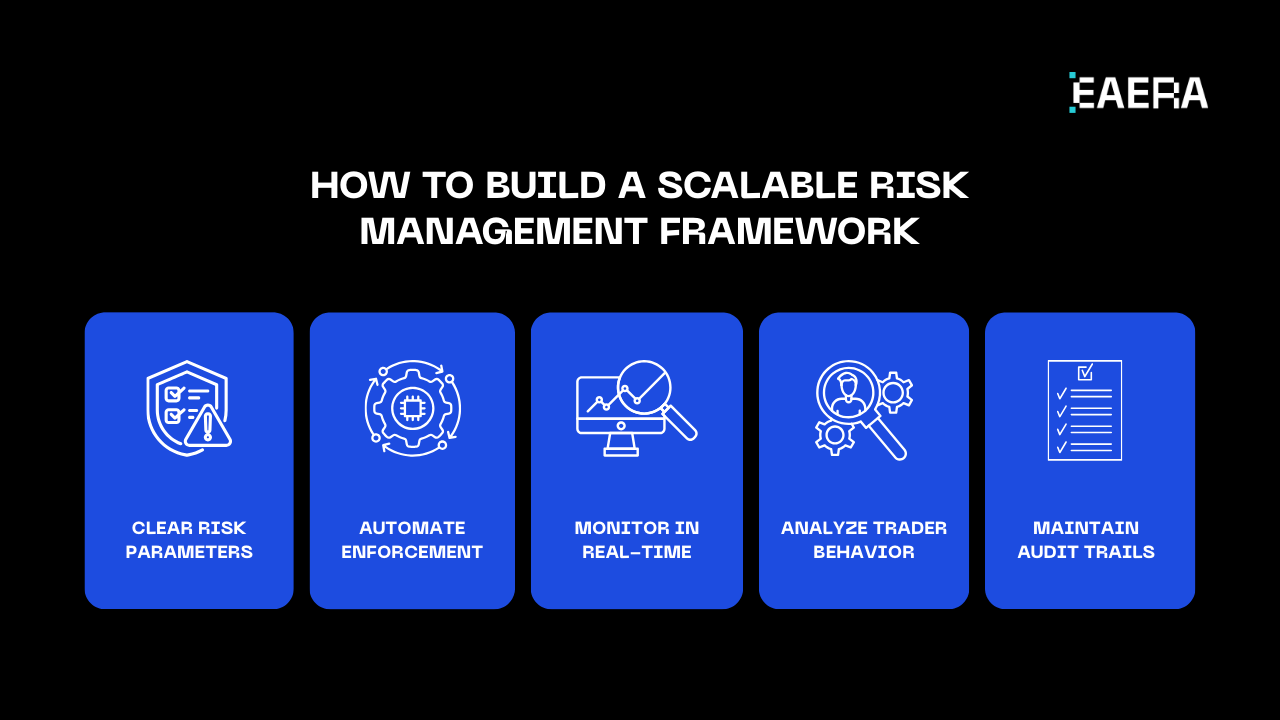
Establishing precise risk parameters, such as exposure thresholds, leverage limitations, and drawdown limits, is the first step. These regulations need to be clear and in line with the company’s risk tolerance.
Automation is the next stage. Risk management shouldn’t depend on human intervention or approval. Rules must be consistently and instantly enforced by systems.
Monitoring in real time is equally crucial. To make wise decisions, businesses require constant visibility into exposure and trader behavior.
Also, looking at behavior over time helps businesses find patterns that show future risk. This makes risk control more proactive by adding a predictive layer.
Finally, keeping audit trails makes sure that every choice and action can be traced. This not only helps with compliance, but it also makes operational control stronger.
Risk management needs to change as businesses get bigger. If a framework is not made to grow, it will not work on a small scale.
The Future of Risk Management in Prop Trading
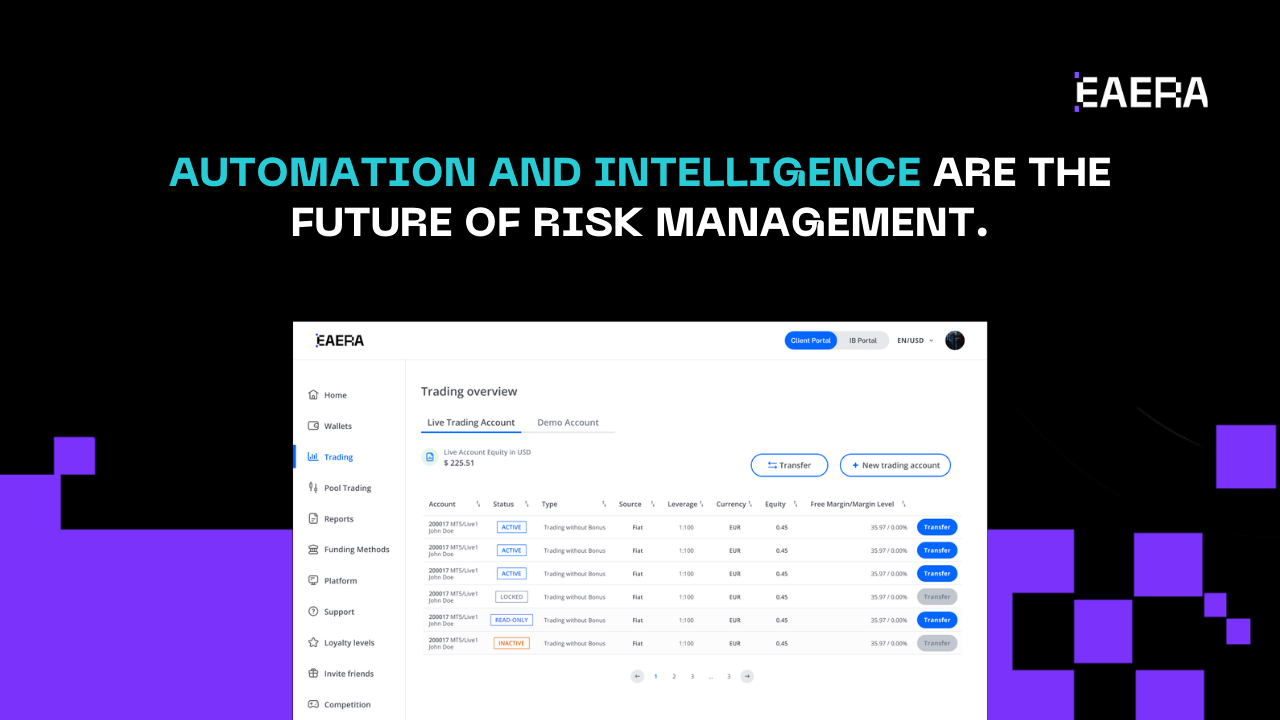
Automation and intelligence are the future of risk management. In markets that are getting more complicated, static rules and manual oversight won’t be enough.
Emerging trends include:
- AI-driven risk models that adapt in real time
- Predictive analytics to anticipate trader behavior
- Adaptive thresholds based on market volatility
- Fully automated dealing and risk systems
More people are also using fully automated systems for dealing and managing risk. These systems lower latency, make things more consistent, and give everyone more control over the whole operation.
This approach, in which risk management is integrated into the fundamental system architecture, is being adopted by platforms like EAERA. Prop firms can grow using this strategy without taking on more operational risk.
Risk management is a must in prop trading. It is the basis for survival. Companies that view risk management as a secondary function will ultimately fail.
System-driven risk management that upholds regulations, tracks exposure, and adjusts to scale is necessary for sustainable growth. Businesses that make structured, technology-based risk management investments will be the ones that survive as the industry changes.