



Forex CRM is no longer just a tool for managing leads; it now controls the whole life cycle of a client, from onboarding to keeping them. Brokers can no longer rely on broken systems to manage relationships in a market where there is a lot of competition, and client expectations are always rising.
Related articles:
With a unified forex CRM, brokers can automate tasks, see what’s going on in real time, and create long-term value for their clients. This article looks at how modern CRM systems turn every step of the client journey into a structured, scalable process.
Why Client Lifecycle Management Is Broken in Forex Brokerage?
Most forex brokers use systems that don’t talk to each other. One tool keeps track of leads, another tracks trading activity, and a third handles support interactions. Each system can work on its own, but when they work together, they make things more complicated.
This leads to several critical issues:
- Lack of visibility across the full client journey
- Inconsistent communication between teams
- Delays in responding to client behavior
- Poor retention due to disconnected engagement strategies
The main issue is that brokers lose control after the purchase. When a lead becomes a client, it is common for there to be no single view of their activity, preferences, or stage in their life cycle.
Brokers work reactively when they don’t have a centralized CRM. They deal with problems as they come up instead of planning them. This leads to missed chances, lower conversion rates, and more people leaving.
Modern brokerages need a system that links all parts of the lifecycle into one smooth process.
What Forex CRM Covers Across the Full Lifecycle?
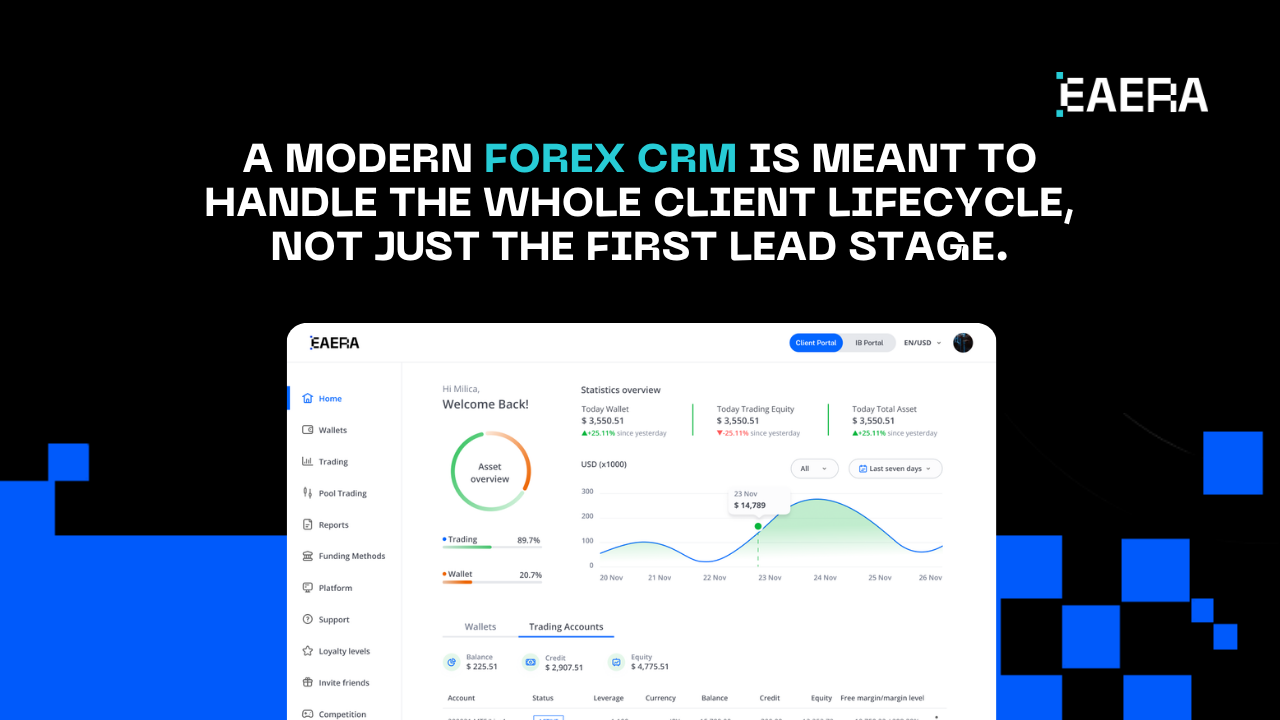
A modern forex CRM is meant to handle the whole client lifecycle, not just the first lead stage. It brings together all the activities and interactions into one system.
The lifecycle typically includes:
- Lead acquisition: Capturing leads from multiple channels
- Onboarding: Verifying identity and setting up accounts
- Activation: Encouraging first deposits and trades
- Trading: Monitoring ongoing activity and engagement
- Retention: Maintaining long-term relationships
A forex CRM gives you a full picture of each client by combining these steps.
For instance, a broker can see where a lead came from, how they responded to marketing campaigns, whether they finished onboarding, and how often they trade. This visibility makes it possible to engage in a more focused and effective way.
Brokers can handle the whole journey as a single flow instead of treating each stage separately. This is what changes CRM from a tool to a working system.
Automating Onboarding and Lead Conversion
One of the most important parts of the client lifecycle is onboarding. At this point, any delays or problems can greatly lower conversion rates.
A modern CRM speeds up and makes onboarding and lead management easier by automating them.
Key capabilities include:
- KYC automation: Verifying client information and documents automatically
- Lead routing: Assigning leads to the appropriate sales agents
- Follow-up workflows: Triggering emails, calls, and reminders based on predefined rules
- Conversion tracking: Monitoring progress from lead to active client
Automation makes sure that every lead is handled the same way and on time. It gets rid of the need for manual processes, which are often slow and make mistakes.
The impact is clear:
- Faster onboarding increases conversion rates
- Consistent follow-ups improve engagement
- Reduced manual work lowers operational costs
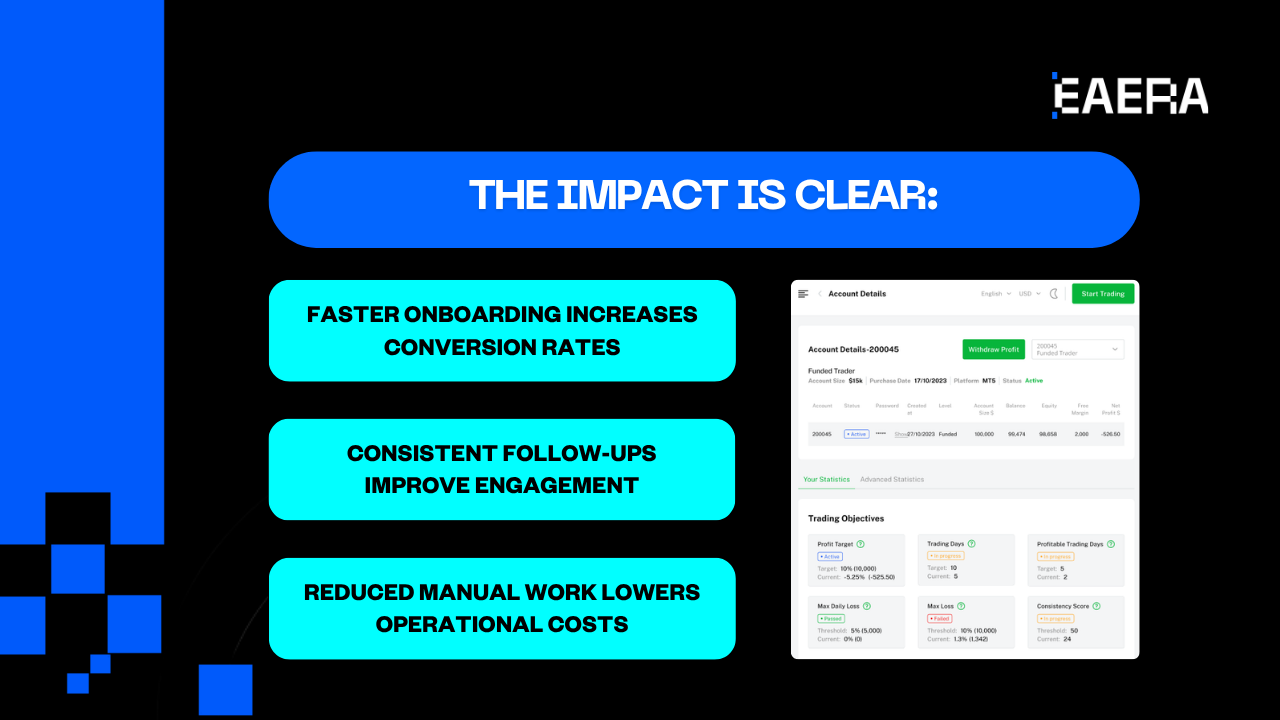
With a forex CRM, brokers can turn onboarding into a streamlined, predictable process that maximizes conversion opportunities.
Managing Active Traders with Real-Time Insights
Once clients start trading, the focus changes to how engaged they are and how well they do. To give clients the right support and offers, brokers need to know how they use the platform.
A forex CRM gives you real-time information about how clients are trading and what they are doing.
Key features include:
- Monitoring trading volume and frequency
- Segmenting clients based on activity levels
- Tracking engagement across multiple channels
Brokers can find patterns in this data and act on them. For instance, premium support or personalized incentives might help very active traders, while inactive clients might need strategies to get them to start trading again.
Platforms like EAERA show how combining trading data with CRM systems makes it easier to make decisions. Brokers learn more about their clients by putting together operational and behavioral data.
This makes communication more personal and improves the overall experience for clients.
Retention Strategies Powered by Forex CRM
Retention is the process of making long-term value. Getting new clients is expensive and losing them because they don’t engage with you can have a big effect on your bottom line.
A forex CRM lets brokers use structured strategies to keep clients.
Key capabilities include:
- Automated re-engagement campaigns: Targeting inactive clients with personalized messages
- Lifecycle-based communication: Delivering relevant content at each stage of the journey
- Retention tracking: Measuring client activity and identifying churn risks
These features help brokers stay in touch with their clients all the time.
For instance, if a trader stops trading, the system can start a campaign that offers rewards or educational content. Clients can get personalized recognition or rewards when they reach certain trading goals.
A CRM for forex changes retention from a reactive process to a proactive strategy by using data and automation.
This leads to higher lifetime value for clients and stronger relationships over time.
Scaling Broker Operations with Integrated CRM Systems
As brokers get bigger, it gets harder to handle more clients and interactions. Scaling can lead to inefficiency and loss of control if the system isn’t set up correctly.
By connecting with other core systems, a forex CRM makes it possible to grow your business.
Key integrations include:
- Trading platforms for real-time activity tracking
- Payment systems for deposits and withdrawals
- Support tools for client communication
This makes a single ecosystem where all operations are linked.
EAERA and other solutions show how important it is to integrate when scaling. Brokers can handle growth without making things more complicated by putting all their CRM, trading, and operational data on one platform.
The benefits include:
- Improved coordination between teams
- Faster response times
- Consistent client experience across all touchpoints
Managing the full client journey—from onboarding to retention—is essential for modern forex brokerages. A forex CRM provides the structure and automation needed to achieve this.