



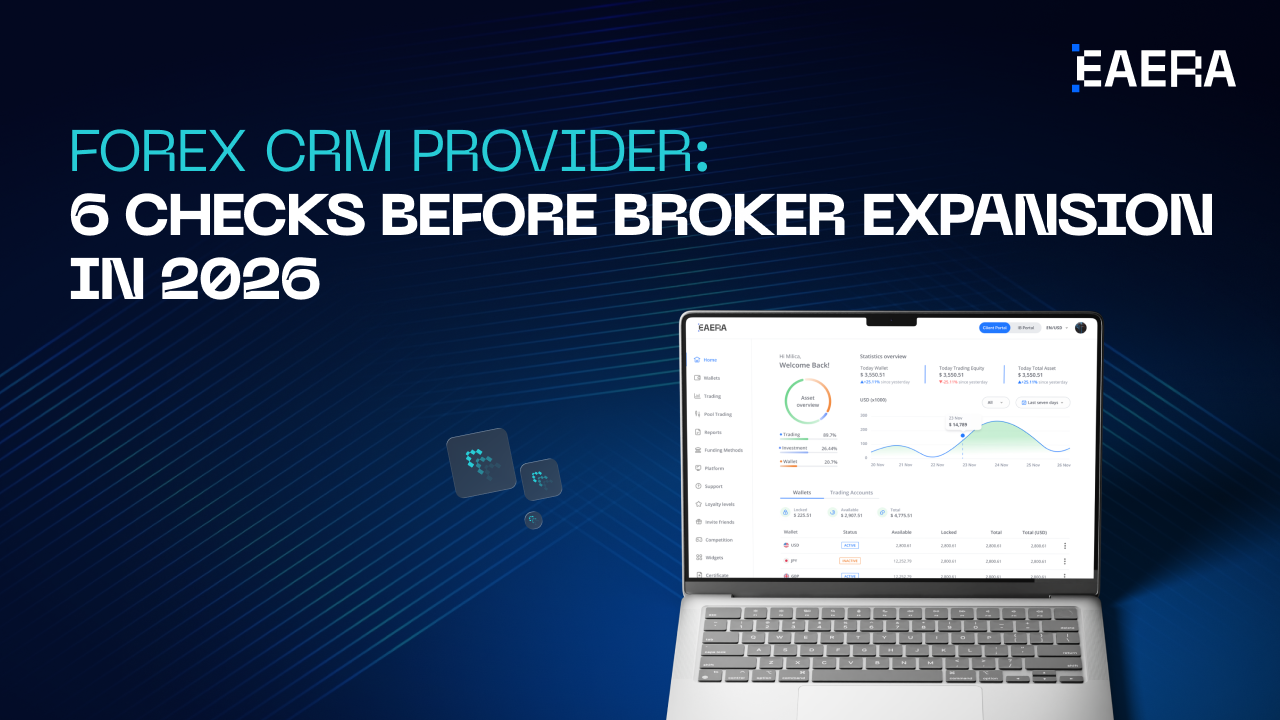
Broker expansion in 2026 is going to take more than just additional acquisition spend, bigger sales teams and new regional campaigns. The operational complexity grows substantially when brokerages enter new markets, client segments, payment routes, partner networks, and internal teams.
Related articles:
- 10 Crucial Aspects for Selecting a Forex CRM Provider in 2025
- Forex CRM Provider for AI-Ready Broker Teams in 2026
A forex CRM provider should give brokers the infrastructure to scale with lifecycle visibility, KYC control, payment activation, workflow automation, reporting, and governance.
Check 1: Multi-Region Lifecycle Scalability
The typical broker expansion means new regions, languages, client segments, account types, onboarding expectations, payment preferences, and service models. A CRM that is good enough for one market may not be good enough for a larger operating footprint.
A forex CRM provider should support end-to-end lifecycle visibility across:
- Lead capture
- Registration
- Profile completion
- KYC submission
- Approval or rejection
- Deposit attempt
- Wallet funding
- Trading account creation
- First trade
- Active or dormant status
- Retention workflow
Broker leaders should be able to see how clients are doing in different markets while also ensuring operational consistency. A client acquired via an IB campaign in one market may have a different onboarding flow compared to a client acquired via a paid campaign in another market. The CRM should make both journeys visible, measurable, and manageable.
As teams, regions, brands, or partner channels grow, lifecycle tracking should remain clear. Without this visibility, the management team may see overall growth in registrations, but not where clients are delayed, blocked, or dropping off.
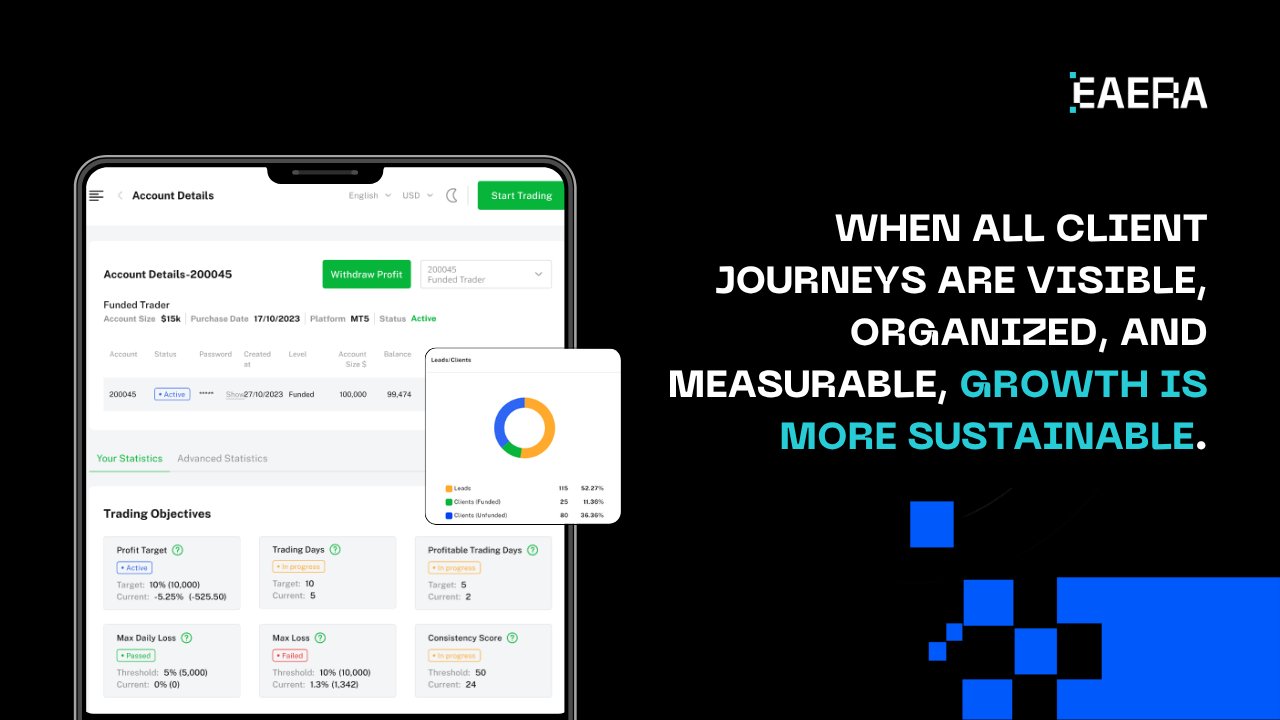
When all client journeys are visible, organized, and measurable, growth is more sustainable.
Check 2: KYC, Permissions, and Operational Governance
As brokers grow, so do the onboarding and governance requirements. Different markets may have different profile fields, document requirements, risk classifications, access restrictions, review logic, or approval of workflows.
Forex CRM provider should support operational governance in required profile fields, document status tracking, reasons for missing documents, approval and rejection records, manual review queues, regional restrictions, risk category visibility, trading account access rules, withdrawal eligibility status, role-based permissions and audit trails.
Governance isn’t only for compliance teams. It affects sales visibility, support communication, finance decisions, account access, and management reporting.
As the number of internal users grows, brokers must set up controlled permissions, so teams can continue to do their jobs without unnecessary exposure to sensitive data. A CRM should allow various teams to get the information they need, while keeping a tight rein on documents, approvals, financial information and account actions.
A scalable CRM should enable brokers to scale operations while maintaining visibility, accountability, and controlled access.

Check 3: Payment, Wallet, and Trading Activation Connectivity
Expansion has no commercial value if new clients don’t fund or trade. The client lifecycle needs to be linked to wallet visibility and payment workflows, internal transfers, trading account setup, and first-trade activation.
A forex CRM provider should be capable of giving insight into the available payment methods, deposit request status, reason for failed deposit, wallet balance, internal transfer status, withdrawal request status, finance approval status, trading account creation, trading account funding, account restrictions, first trade status.
A growth-ready forex CRM provider helps brokers identify if a client is verified, deposit-ready, payment-blocked, wallet-funded, trade-ready, active or restricted.
This level of visibility is important because growth often increases transaction volume and payment complexity. Payment methods may need to be different in a new region. A larger customer base can translate into more failed deposits, withdrawal reviews, and wallet-to-account transfer issues. If these events are not visible within the CRM, teams might react too slowly.
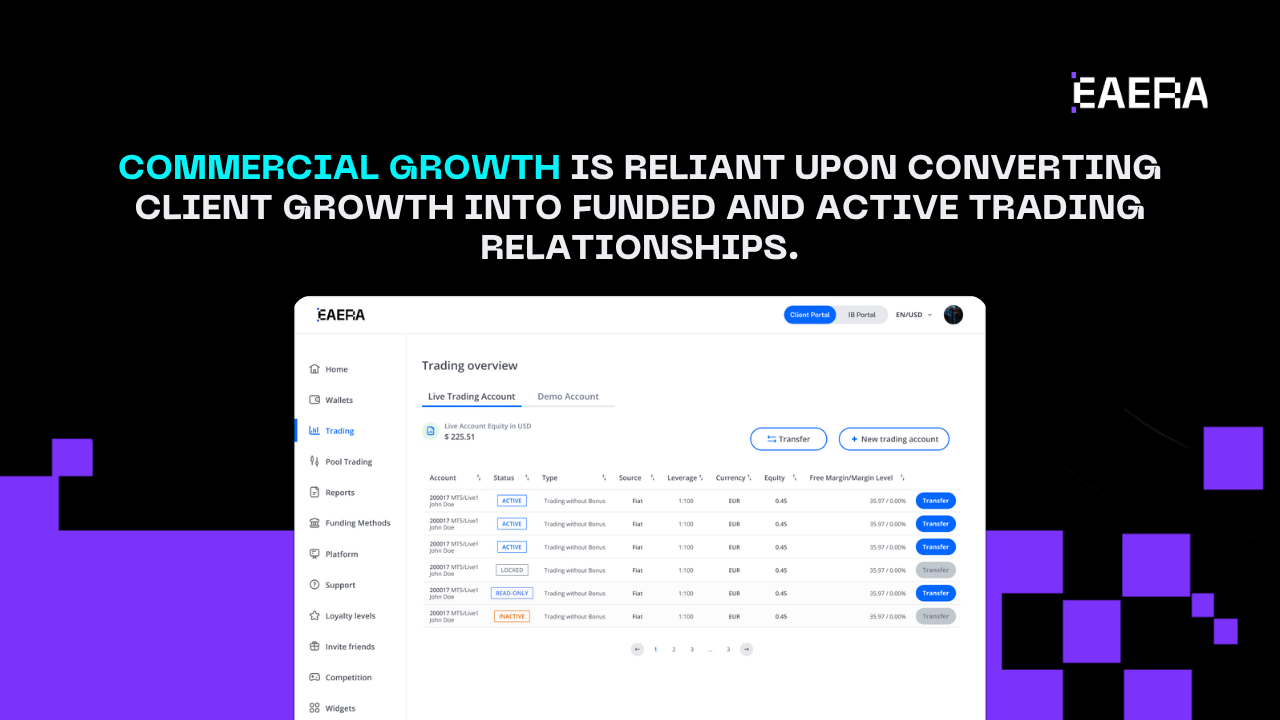
Commercial growth is reliant upon converting client growth into funded and active trading relationships.
Check 4: IB, Affiliate, and Partner Network Scalability
Many brokers depend on IBs, affiliates, and referral partners to accelerate regional growth. However, partner growth can contribute to operational risk when attribution, hierarchy, commission logic, and payout visibility are not handled through a controlled system.
A forex CRM provider should assist brokers with IB onboarding, referral links, client attribution, partner hierarchies, campaign tracking, commission profiles, CPA or volume-based commission rules, payout statuses, adjustment records, and partner performance reporting.
Broker leaders should be looking at the quality of their partners, not just the quantity of registrations. A partner can generate a lot of leads, but not many verified or funded clients. Another partner may yield fewer clients, but stronger activation, trading activity, and long-term value. Connected reporting helps management to put money in the right partner channels.
Partner transparency also cuts down internal workload. Finance teams need accurate records of commissions and payouts. Performance visibility is a must for IB managers. Support teams may need referral context when responding to client questions. Management needs to know which partners are delivering sustained growth.
A scalable partner infrastructure enables brokers to expand distribution, while reducing disputes, manual reconciliation and payout delays.
Check 5: Workflow Automation with Oversight
Operational workload increases with expansion. Teams are required to allocate more leads, review more documents, follow up on more payment issues, handle more trading account tasks, keep watch on more inactive clients and address more partner requests.
Forex CRM providers should have workflow automation capabilities for lead assignment, first response reminders, reminders for missing KYC documents, review escalation, KYC approval-to-deposit tasks, failed deposit alerts, wallet-to-account setup tasks, first-trade follow-up, IB commission reports and manager notifications.
Governance shouldn’t be automated. It will enhance operational discipline by ownership, alerts, approval records, task history, and audit visibility. The best automation frameworks allow teams to scale repeatable work with management oversight intact.
When KYC is approved, for instance, the system may trigger a funding follow-up task. If a deposit fails, support can get an alert with transaction context. Operations can receive an account setup task if a wallet is funded, but there is no trading account.
Sustainable expansion requires automation that accelerates execution without weakening control.
Check 6: Executive Reporting and Expansion Readiness
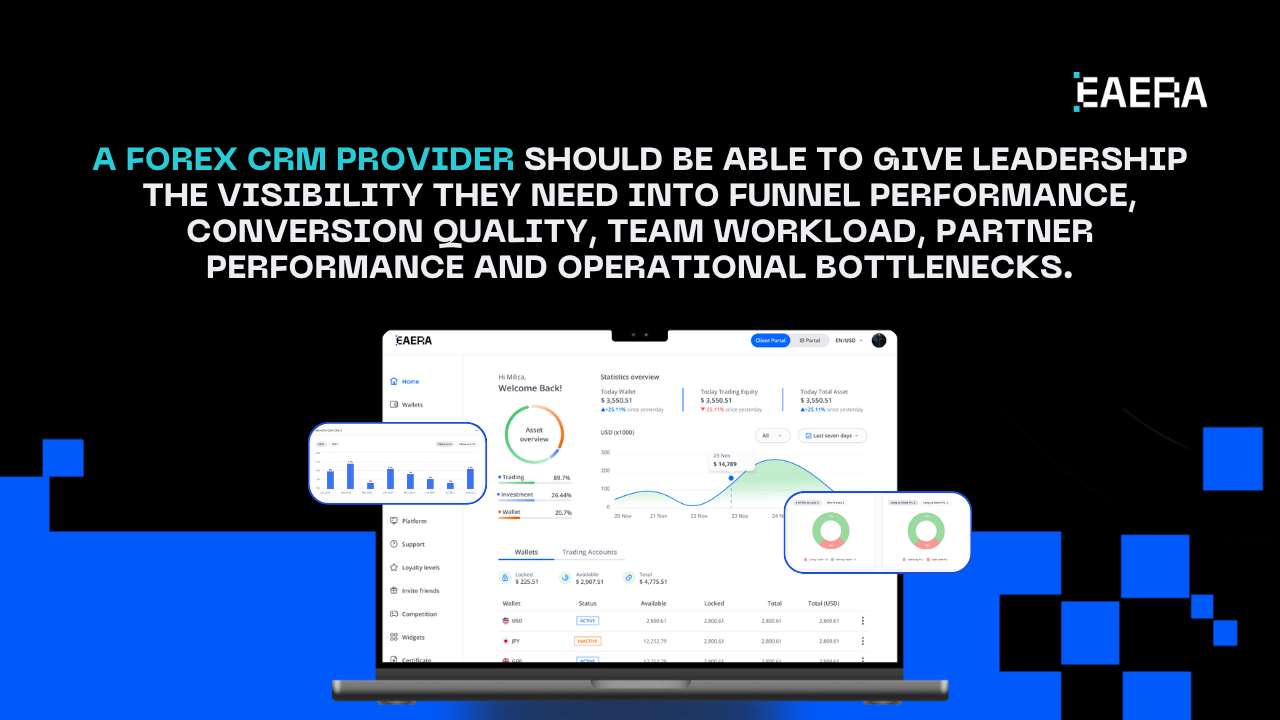
Before expanding, management needs to be confident that the existing operating model can handle the increased volume. A forex CRM provider should be able to give leadership the visibility they need into funnel performance, conversion quality, team workload, partner performance and operational bottlenecks.
Key reporting areas include:
- Lead response time
- Lead-to-registration conversion
- Registration-to-KYC completion
- KYC review time
- KYC-to-deposit conversion
- Failed deposit recovery
- Wallet-to-account activation
- Deposit-to-first-trade conversion
- Active versus dormant clients
- IB performance
- Commission payout status
- Support workload
- Withdrawal aging
- Team productivity
- Manual approval volume
EAERA helps brokers with integrated CRM, client portal, back office, funding, trading account workflows, affiliate management, reporting, alerts and automation.
EAERA can support a connected operating environment for brokerages ready to expand in 2026 in the areas of lifecycle management, KYC, funding, trading activation, partner operations, workflow automation, reporting and team control.