



Many people believe that upgrading a CRM is essential for expanding forex brokers. Businesses are inevitably driven to search for “a better system” by an increase in leads, clients, regulations, and trading data. However, a lot of CRM upgrades fall short of producing noticeable gains. Decision-making, not technology, is the cause.
Related articles:
- 10 Benefits You Get from Forex Back Office Software 2026
- Top Features Every CRM for Forex Brokers Needs in 2026
A poorly selected forex broker CRM can impede operations, raise risk, and force the company into years of inefficiency. The 6 most frequent and costly mistakes brokers make before updating their CRM are broken down in this article, along with advice on how to avoid them before they become structural issues.
Why CRM Upgrades Fail for Forex Brokers?
In the forex sector, CRM failures seldom occur overnight. As volume and complexity rise, they gradually become apparent. When real-time risk, compliance requirements, and multi-platform integrations become inevitable, what worked for a small brokerage with little trading activity starts to fall apart.
A forex broker CRM is more than just a sales database. It is located where trading activity, funding operations, internal reporting, and compliance workflows converge. Brokers replace one bottleneck with another when they treat CRM upgrades as feature purchases rather than system decisions. Prior to analyzing specific errors, it is necessary to comprehend this context.
Mistake #1–2: Choosing the Wrong CRM Foundation and Scope
Mistake #1: Choosing a CRM That Is Not Built for Forex
Using a generic CRM meant for traditional sales teams is one of the most common errors. Native concepts like trading accounts, margin, equity, drawdown, and multi-platform synchronization are often absent from these platforms.
Because of this, brokers rely on custom scripts, manual exports, or workarounds to maintain data consistency. As a result, operations become unstable over time, making it impossible to rely on reporting accuracy and risk visibility. A forex broker CRM must be built with trading realities in mind, not after the fact.
Domain logic is the foundation of forex-native architectures, like those developed by platforms like EAERA, which lowers operational risk and long-term complexity.

Mistake #2: Treating CRM as a Sales Tool Only
Giving sales or marketing teams complete control over CRM is another common mistake. Although lead management is crucial, forex operations go well beyond acquiring new customers.
Data fragmentation occurs when workflows for operations, finance, and compliance exist outside of the CRM. Decisions are made more slowly, teams function in silos, and accountability deteriorates. A modern forex broker CRM must support the entire organization, not just front-office activity.
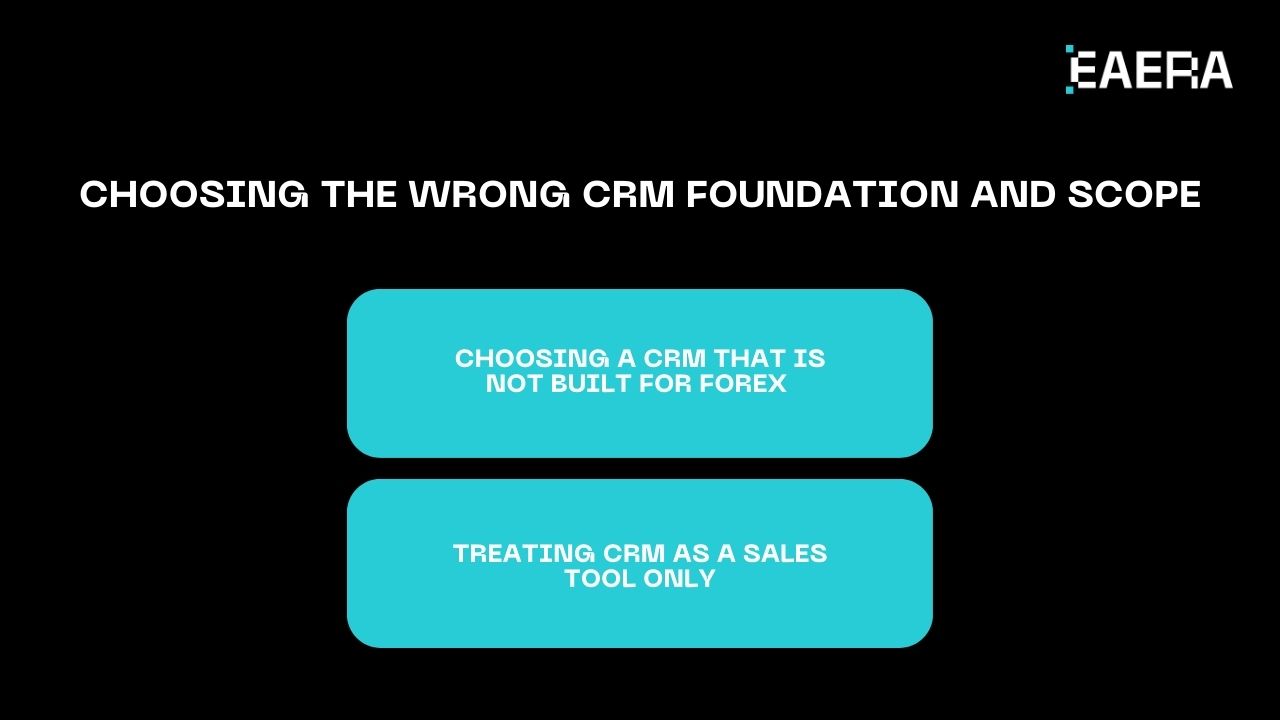
Mistake #3–4: Ignoring Real-Time Data and Risk Logic
Mistake #3: Accepting Delayed or Partial Data Synchronization
Data latency is a risk multiplier in forex, not just a small annoyance. Assuming a few-minute delay is acceptable, many brokers accept “near real-time” synchronization between trading platforms and CRM systems.
Drawdowns, equity exposure, and margin levels are all subject to constant change. Timely intervention is impeded by delayed data, which also transforms manageable problems into financial incidents. Trading activity must be reflected in a proper forex broker CRM as it occurs, not after the fact.
Mistake #4: Underestimating Risk and Compliance Workflows
Disconnected tools or manual checks are frequently used to manage risk and compliance. This method results in blind spots, shoddy audit trails, and uneven rule enforcement.
Brokers face difficulties during audits and risk regulatory fines in the absence of centralized control. Risk logic and compliance workflows must be directly integrated into everyday operations in contemporary CRM systems. Platforms such as EAERA emphasize this alignment, ensuring risk and compliance are not treated as afterthoughts.
Mistake #5: Over-Customization That Creates Technical Debt
Particularly when brokers try to duplicate every internal procedure within the CRM, customization seems appealing. Over-customization, however, frequently turns into a long-term liability.
Highly customized systems are costly to maintain, challenging to upgrade, and highly reliant on particular vendors or developers. Innovation eventually slows down because each change runs the risk of defying accepted logic. A sustainable forex broker CRM strikes a balance between standardization and configuration, enabling flexibility without compromising maintainability.
Mistake #6: Failing to Plan for Scale and Team Adoption
Many CRM choices are made based on the broker’s present size rather than its potential future size. Limitations quickly emerge when businesses grow into new areas, add brands, or hire more employees.
Adoption is hampered by complicated user interfaces, inadequate multi-entity support, and a lack of role-based access. Teams that don’t use the CRM see a decline in data quality and a loss of visibility for leadership. A forex broker CRM must be intuitive, scalable, and designed for long-term organizational growth.
The Hidden Long-Term Costs of Getting CRM Decisions Wrong
Apart from immediate concerns, a poor choice of a forex broker CRM system often means additional long-term expenses. These are not always evident in their first operation. In effect, these additional expenses silently pile up over time, which becomes increasingly hard to reverse.
Decision fatigue can be one of the most prevalent hidden costs. When the data is fragmented and not trustworthy, the leadership teams end up wasting their time on verifying the reports, rather than taking actions on the reports. This leads to postponement of decisions, missed opportunities, and a lack of faith in their own systems.
The other long-run consequence could be the dependency on manual workarounds developed by the organizational teams because they can’t rely entirely on the CRM system. The organizational teams resort to using spreadsheets or personal knowledge to compensate for the CRM system’s inadequacies, which later becomes a single point of failure that hinders the process of adding new employees to the system because everyone knows the same manual workaround.
Finally, a poor forex broker CRM constrains the firm’s ability to adapt to changes in regulatory ỏ market conditions. As compliance rules change or new products are developed, rigid systems demand expensive redevelopment rather than rapid, easy configuration. What looked like a cost-saving decision at the outset becomes a source of higher operational risk and slower innovation.
It’s imperative to note the underlying effects before embarking on any upgrade for the CRM system, particularly within an industry where flexibility and control are determinants of success.
How to Upgrade Your Forex Broker CRM the Right Way?
To prevent these errors, a structured methodology must be adopted. Prior to the upgrade, brokers should:
- Begin with operational workflows, and avoid feature lists
- Call for enduring real-time data accuracy
- Choose forex-native architectures
- Embed risk and compliance at the core
- Design for scalability and usability from day one
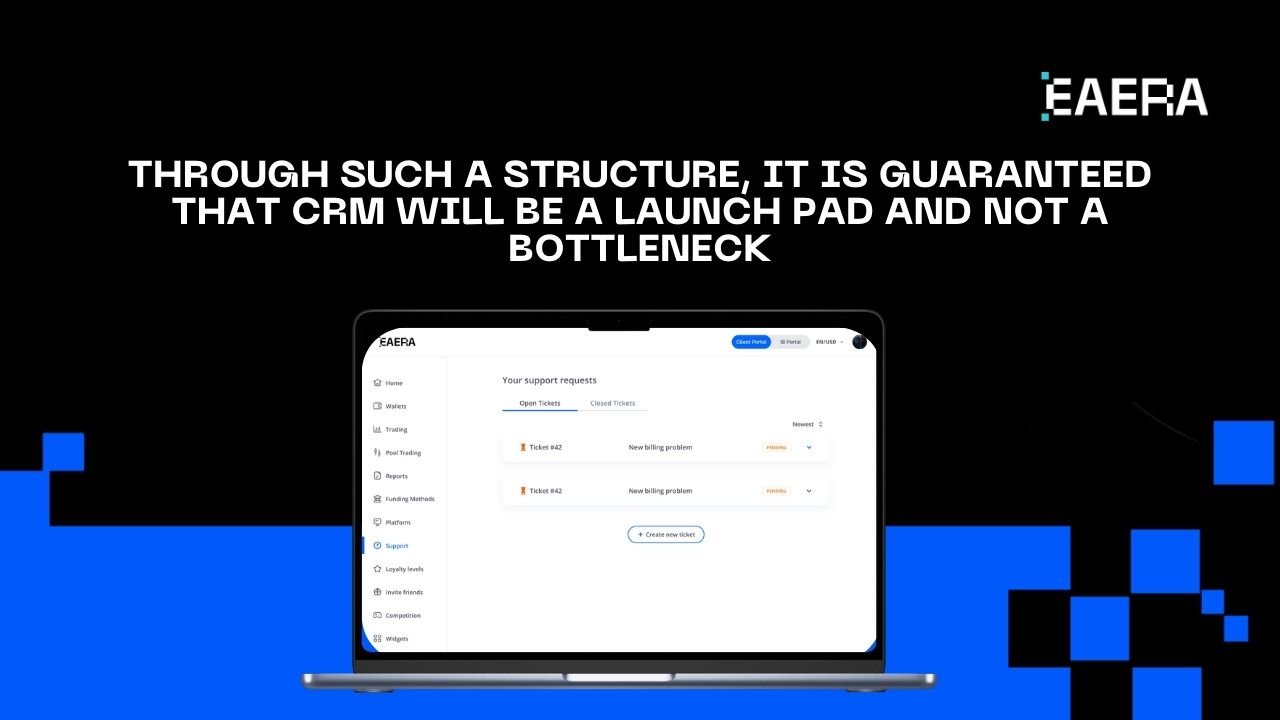
Through such a structure, it is guaranteed that CRM will be a launch pad and not a bottleneck.
CRM failure in the forex market can be prevented in most cases. With the knowledge not to make the following 6 errors, the broker can upgrade to something much smarter.
An effective forex broker CRM system does far more than simply manage a clientele. It allows for control, risk reduction, and optimization of the business. In an arena that continues to experience rising levels of complexity with time, the decision to use the right CRM system will shape future success.