



A forex CRM (for brokers) is usually connected to trading platforms and payment rails, which is a CRM plus back-office operations layer that manages the client’s lifecycle from start to finish. This includes lead conversion, KYC/AML, deposits and withdrawals, introducing broker (IB) management, trading account provisioning, and reporting.
Related articles:
- Forex CRM Explained: What It Is and How It Benefits Your Brokerage
- The Role of Quality Forex CRM Software in Managing Broker Operations
1. What is Forex CRM? (Broker-focused definition)
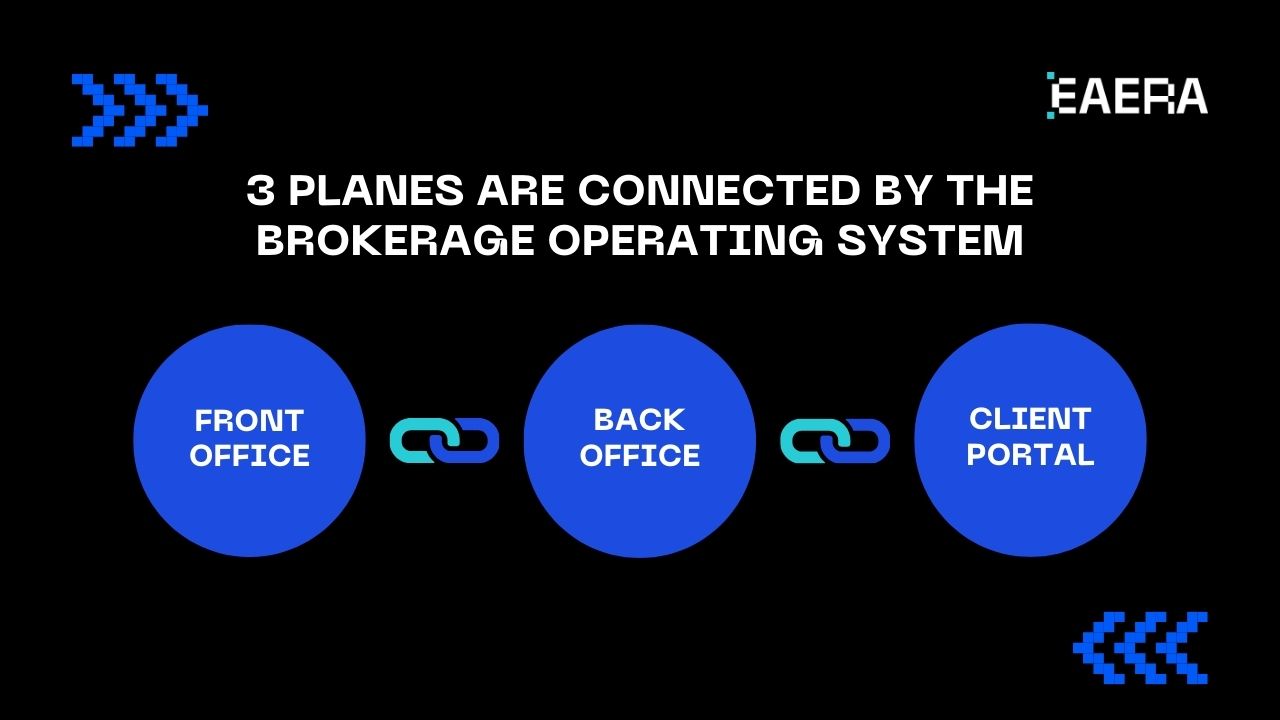
A contact database with a sales pipeline is not what a broker-grade forex CRM is. Three planes are connected by the brokerage operating system:
- Front office: workflows for lead capture, attribution, assignment, follow-up automation, and retention
- Back office: trading account lifecycle, wallets and transaction workflows, IB structures, permissions and approvals, and KYC decisioning
- Client portal (Trader’s Room): client self-service for onboarding, funds, account management, and support touchpoints
In practice, a forex CRM becomes the “single source of truth” for the objects that decide your revenue and risk:
- Lead → Client profile → KYC status + documents
- Wallet(s) + ledger events → deposits/withdrawals/refunds
- Trading accounts → platform mapping, leverage/groups, status changes
- IB tree → attribution rules, commission plans, settlements
- Case history → notes, tickets, audit logs, and evidence trails
For this reason, rather than marketing their products as a generic CRM add-on, vendors that target brokers market them as a unified CRM + back office + client portal stack.
2. Why Forex Brokers Need a Dedicated CRM
When expansion reveals operational flaws, brokers usually feel the need for a specialized forex CRM. The pain points are costly and reproducible:
- KYC backlog kills conversion: slow or inconsistent approvals delay first deposits and create a support queue that sales can’t “follow up” out of.
- Funds workflows fragment across tools: PSP dashboards + spreadsheets + emails = reconciliation gaps, delayed withdrawals, and higher dispute rates.
- IB disputes scale faster than acquisition: when attribution and commission logic are manual, partners churn or escalate—and your margin bleeds through “exceptions.”
- Trading account provisioning becomes a bottleneck: wrong group/leverage setup, slow account creation, or missing audit logs turns onboarding into a fire drill.
- Reporting becomes narrative instead of data: without unified events (lead → KYC → deposit → account → trading activity → withdrawals), leadership decisions become guesswork.
These are addressed by a purpose-built forex CRM that makes performance measurable throughout the funnel, standardizes workflows, and enforces governance (roles, approvals, and audit trails).
3. Core Features of a Modern Forex CRM
In 2026, operational control and workflow depth—rather than UI glitz—will be used to evaluate a modern forex CRM. Your broker-grade checklist should consist of the five modules listed below.
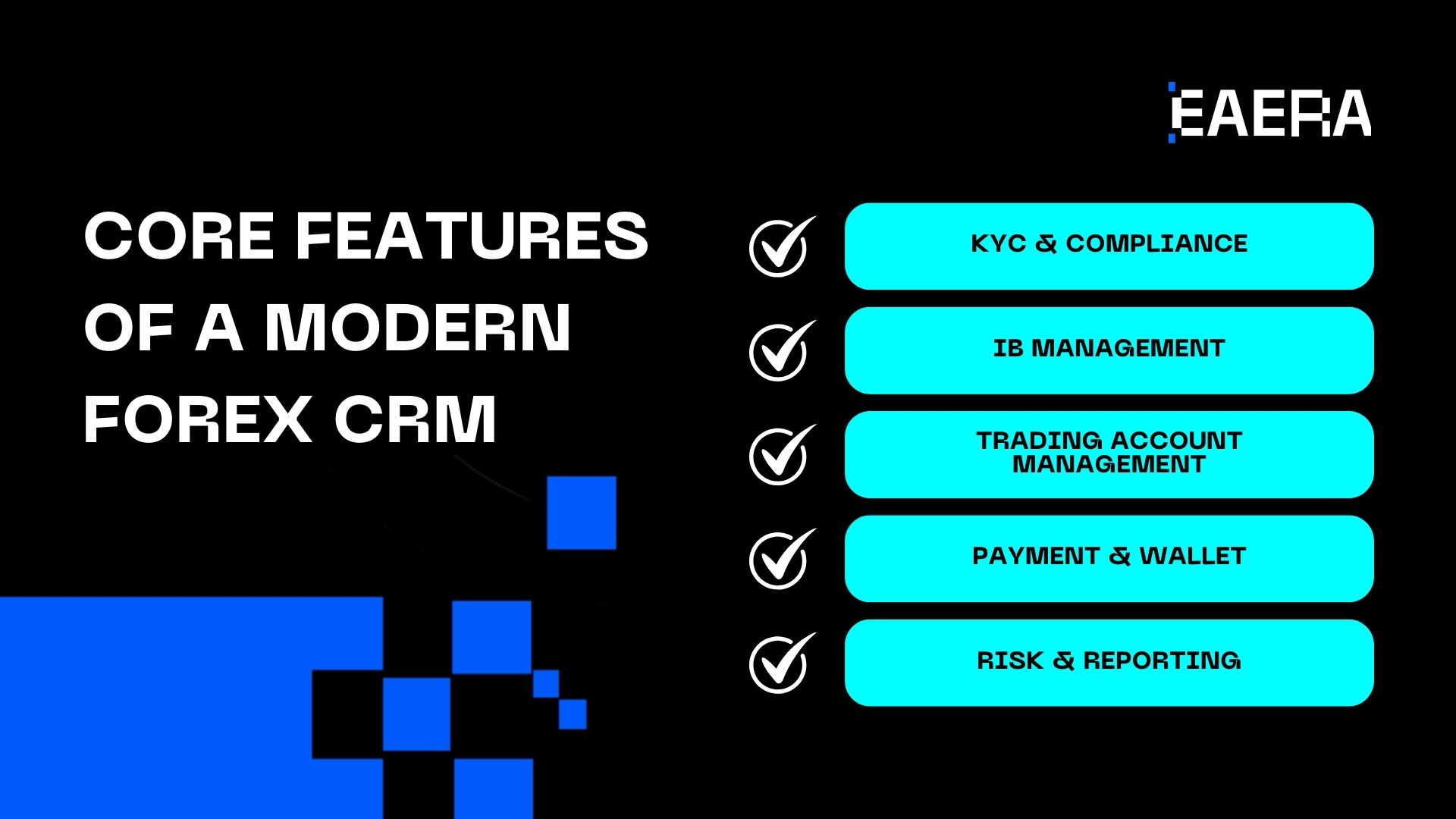
KYC & Compliance
Compliance should be handled by a forex CRM as a workflow engine rather than a document folder:
- State machine onboarding: Submitted → In Review → Approved/Rejected → Resubmission
- Document rules: required docs by region/client type, expiry tracking, version history
- Auditability: who approved what, when, and what changed (non-negotiable for disputes)
- Policy enforcement: configurable restrictions until KYC is complete (based on your policy)
- Queue management: SLA views, aging, reviewer throughput, escalation routing
Syntellicore, for example, explicitly positions automated KYC/AML capabilities as part of a broker back-office stack, including structured checks and rapid verification of workflows.
IB Management
IB growth is a control problem. A broker-grade forex CRM should include:
- Multi-tier hierarchy: parent/sub-IB trees, tier rules, and transparency
- Attribution integrity: lock logic to prevent reassignment disputes
- Commission engine: rebates/CPA/hybrid, settlement cycles, adjustments/clawbacks
- Partner analytics: acquisition, commissions, transactions, and performance dashboards
- Partner portal tooling: referral links/assets and clear reporting
Trading Account Management
This is where a forex CRM becomes operational infrastructure:
- Provisioning automation: create accounts based on triggers (KYC approved, deposit received, manual approval)
- Lifecycle controls: active/suspended/closed states, bulk actions, change history
- Configuration governance: leverage/groups/permissions, maker-checker approvals (as needed)
- Platform mapping: reliable account-to-platform linkage and event traceability
- Support context: “what changed” timelines to resolve disputes fast
Platform connectivity and account operations are frequently positioned as essential requirements rather than optional integrations in broker back-office stacks.

Payment & Wallet
A modern forex CRM should provide a broker-grade funds layer:
- Multi-currency wallet + ledger: balances, holds, internal transfers, full history
- Deposit workflows: status tracking, failure reason codes, auto-posting rules, reconciliation outputs
- Withdrawal workflows: approvals, risk checks, execution tracking, reconciliation exports
- Refund/chargeback handling: traceability, evidence capture, and policy routing
- Controls: permissions, limits, and audit logs for every fund action
Use FX Back Office (FXBO), which promotes deep integration coverage and places an emphasis on broker-grade CRM/back-office functionality related to client management and operational scale, as a standard for defining “wallet + payments” maturity.
Risk & Reporting
A forex CRM should make risk measurable and reporting operational:
- Unified event model: onboarding + wallet + account + IB events tied to one client identity
- Risk flags + review queues: configurable triggers tied to funds movement and behavior
- Broker KPIs: time-to-first-deposit, KYC SLA, payment success rates, withdrawal cycle time, IB ROI
- Audit-ready exports: evidence logs for internal reviews and external requirements
Broker CRM platforms are increasingly framed in industry coverage as “CRM + back-office operations,” reiterating that workflows and reporting are integrated into the core product rather than being optional.
4. Forex CRM vs Generic CRM
You can manage contacts and sales activities with the aid of a generic CRM. With permissions and audit trails, a broker forex CRM manages partner economics, trading account operations, funds workflows, and regulated onboarding.
| Capability | Generic CRM | Broker forex CRM |
| KYC workflow + secure docs | External/Manual | Built-in states, doc rules, audit trails |
| Wallet/ledger + PSP reconciliation | Not native | Deposits/withdrawals, internal transfers, reconciliation |
| Trading account provisioning | Not supported | Account lifecycle + platform mapping |
| IB hierarchy + commissions | DIY | Multi-tier tree + commission logic + partner analytics |
| Approvals & segregation of duties | Limited | Role-based controls + evidence logs |
| Broker reporting | Basic | Funnel + finance + partner + compliance reporting |
It is a sales tool with additional fields, not a forex CRM, if it is unable to handle KYC + funds + accounts as governed workflows.
5. How to Choose the Best Forex CRM for Your Brokerage
Choosing the best forex CRM is a governance decision, not a UI preference. Use a structured selection motion.
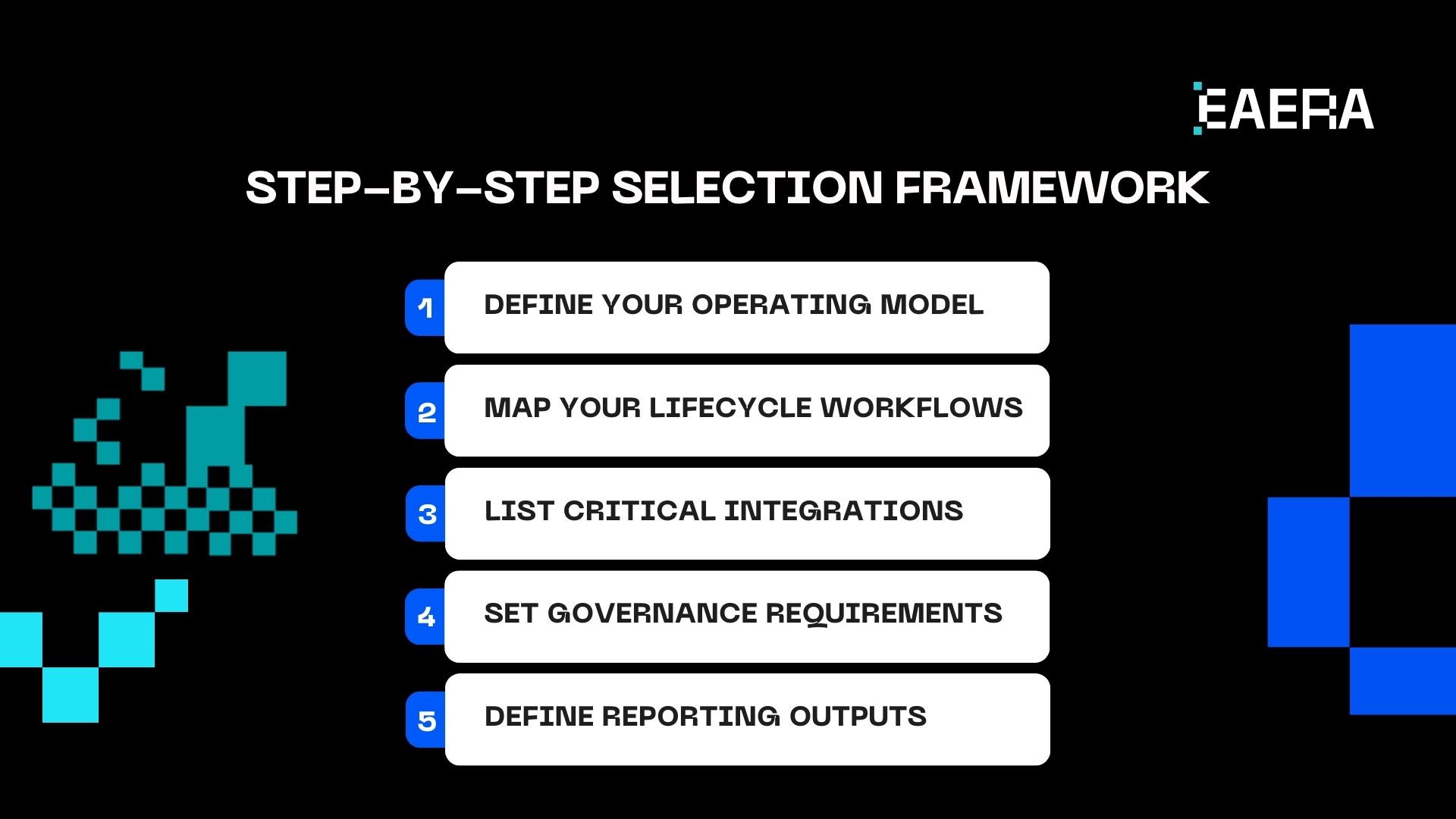
Step-by-step selection framework
- Define your operating model: brands/entities, regions, products, target segments
- Map your lifecycle workflows: lead → KYC → deposit → account → retention → withdrawal
- List critical integrations: trading platform(s), PSPs, messaging (email/SMS), analytics/warehouse
- Set governance requirements: roles, approvals, audit trails, access reviews
- Define reporting outputs: leadership KPIs + operational dashboards + compliance exports
Vendor demo script (non-negotiable)
Have every vendor demonstrate these flows live inside their forex CRM:
- Create lead → convert to client → submit KYC → approve/reject with reasons
- Deposit → wallet update → trading account creation → group/leverage set
- Create IB → link client → generate commission → show settlement history
- Withdrawal request → approval workflow → execution status → reconciliation output
- Pull the audit log for each step above
If a vendor can’t show an end-to-end evidence trail, you’re buying future disputes.
6. Best Forex CRM Software in 2026
Broker size, integration requirements, and governance maturity all influence “best.” These are noteworthy broker-focused forex CRM stacks for 2026; shortlist them based on the results of your demo after starting with EAERA.
- EAERA — positions itself as a cloud-based forex CRM solution for brokerages, spanning CRM, back office, client portal, and analytics/automation.
- B2CORE (B2BROKER) — emphasizes a Traders Room + broker operations stack, including IB program tooling and partner analytics.
- Syntellicore — positions FX back-office capabilities with automated KYC/AML and broker onboarding controls.
- FX Back Office (FXBO) — markets an “ultimate Forex CRM” and highlights extensive integrations footprint (useful for PSP-heavy setups).
- UpTrader Back Office — positions a back office for managing clients, partners, deposits/withdrawals, and trading conditions.
How to shortlist fast:
- Startup broker: prioritize time-to-launch, onboarding automation, clean wallet workflows
- Scaling broker: prioritize IB controls, approvals, auditability, reporting spine
- Multi-entity broker: prioritize multi-brand governance, data model maturity, integration SLAs
7. Pricing Models & ROI
Pricing for a forex CRM usually blends platform fees + implementation + integrations. Common models:
- Subscription (SaaS): monthly/annual, modular by feature set
- Seat-based: by admin users or departments (sales/compliance/finance)
- Volume-based: active clients, transactions, wallets, or number of trading accounts
- Enterprise license: plus maintenance/support tiers
- One-time services: implementation, migration, custom integrations, premium SLA
ROI levers (broker operator view)
A broker-grade forex CRM pays back through three channels:
- Cost-out: fewer manual KYC hours, fewer reconciliation hours, fewer support tickets
- Revenue uplift: faster onboarding → higher first-deposit conversion; stronger IB tooling → higher partner output
- Risk reduction: fewer chargebacks/refunds and faster dispute closure via evidence logs
A brokerage infrastructure is a forex CRM. Brokers who standardize KYC, wallets, IB economics, and account provisioning as regulated processes with quantifiable KPIs and defendable audit trails – rather than as disparate tools and traditional knowledge—will emerge victorious in 2026.