





“Precision” is not a latency headline in 2026. It occurs when systems partially fail, markets surge, and liquidity decreases. A contemporary FX trading platform needs to act consistently and provide evidence for its actions. The framework that follows focuses on what operators can verify in proof-of-concepts, demos, and actual production settings.
Related articles:
- Risk Management in Trading: How Brokers & Prop Firms Control Risk at Scale?
- Trading Competition Platform: Run Profitable Trading Contests for Brokers & Prop Firms
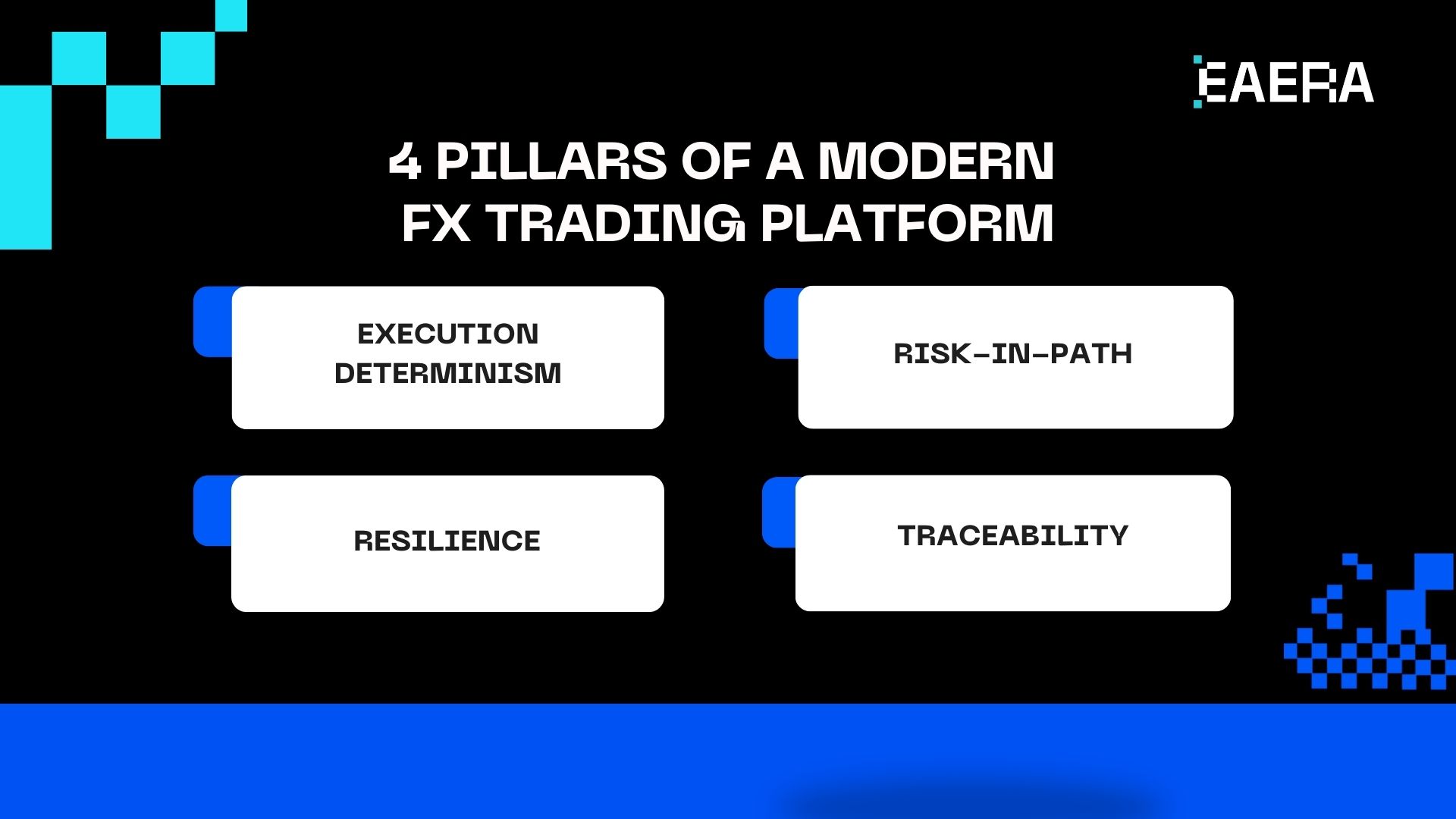
Precision Blueprint: The 4 Pillars of a Modern FX Trading Platform
Precision is a result rather than a characteristic. Even in chaotic situations, a precision FX trading platform consistently produces results in terms of execution, risk, and reporting. Dividing precision into four pillars is the most straightforward method of designing and assessing it.
1) Execution determinism
Predictable order outcomes are the first step towards precision. Fills, rejections, and slippage distributions should show consistent patterns rather than erratic fluctuations caused by load or edge cases.
2) Risk-in-path
Risk controls should not be an afterthought but rather an integral part of the execution workflow. Execution becomes unpredictable and challenging to defend if the system checks limits inconsistently or too late.
3) Resilience
Systems break down. For the platform to continue functioning without corrupting state or duplicating orders, precision necessitates safe recovery and graceful degradation.
4) Traceability
The platform must create an evidence trail, including inputs, rules applied, timestamps, and subsequent actions, when a trader challenges an outcome or compliance investigates an incident.
Precision outcomes you should be able to guarantee in an FX trading platform:
- Order lifecycle integrity from submit to confirmation
- Consistent application of validation and risk rules
- Stable performance under load, with clear back-pressure behavior
- Audit-ready event timelines for execution and risk decisions
- Predictable recovery that preserves order integrity
When the inputs are identical, a precision FX trading platform behaves in the same way twice; when the inputs are different, it explains itself.
Execution Under Volatility: How to Evaluate a Precision FX Trading Platform?
Precision becomes quantifiable when it comes to execution quality. When markets are calm, many platforms appear fine, but when they are volatile, they quietly fail. In 2026, stress-first benchmarks rather than average-case demos should be used to assess a precision FX trading platform.
Start by redefining “fast.” It is possible for a platform to be accurate and fast at the same time. Consistency—stable for reject reasons, consistent routing behavior, and predictable slippage ranges under the same market conditions—is given priority in precision execution.
The order lifecycle from start to finish is what matters most. Submit, validate, route, fill or reject, confirm, and update exposure should all be part of a single, cohesive pipeline. Traders will perceive any stage that lags or behaves differently under load as a confusing state or hidden loss.
Execution tests to run on an FX trading platform (keep these simple, but non-negotiable):
- Volatility spike simulation with liquidity thinning
- Burst orders (sustained load), measured with latency percentiles
- Rejection behavior under margin and permission edge cases
- Partial outage simulation (one dependency slows down)
- Retry and idempotency validation (no duplicated orders)
When you evaluate any FX trading platform, ask for volatility evidence, not marketing. Precision is the stability of distributions over time, not one perfect demo run.
Risk and Controls: Precision Means No Surprises
Risk is frequently described as slowing down execution. By preventing invalid orders and lowering post-trade corrections, embedded risk controls in a precision FX trading platform improve execution quality. The fundamental principle is straightforward: latency and inconsistency are introduced if risk checks take place outside of the execution path.
A precision risk layer should do three things reliably:
- Validate orders before they hit the market
- Enforce exposure and limit rules consistently
- Produce an evidence trail of decisions, not just outcomes
This implies that you should use versioned and deterministic risk logic. The platform should be able to determine which version of the rules were in effect at any given time. If not, the same trading behavior may yield different outcomes on different days, making it difficult for your team to defend their choices.

Controls that protect precision in day-to-day operations:
- Role-based access for sensitive actions and configuration changes
- Maker-checker approval for overrides and emergency adjustments
- Audit logs for every override, including reason and timestamp
- Clear escalation paths and incident handling procedures
- A controlled “exception queue” rather than ad-hoc manual fixes
One illustration of a governance-first strategy in financial systems is EAERA, which views workflows, permissions, and auditability as essential components rather than optional extras. That mindset matters when you’re trying to keep a precision platform consistent at a scale.
Architecture and Reliability: Designing for Failure, Not Perfection
When architecture is brittle, precision is brittle. A precision FX trading platform needs to be built with shock absorption, failure isolation, and safe recovery in mind. Because it enables the system to respond instantly to order and market events without depending on batch updates that cause lag, event-driven processing is a popular foundation for this in 2026.
Predictable performance under load and predictable behavior under partial failure are two operational benefits of good architecture. The second, which is frequently disregarded, is where “precision” endures in actual situations.
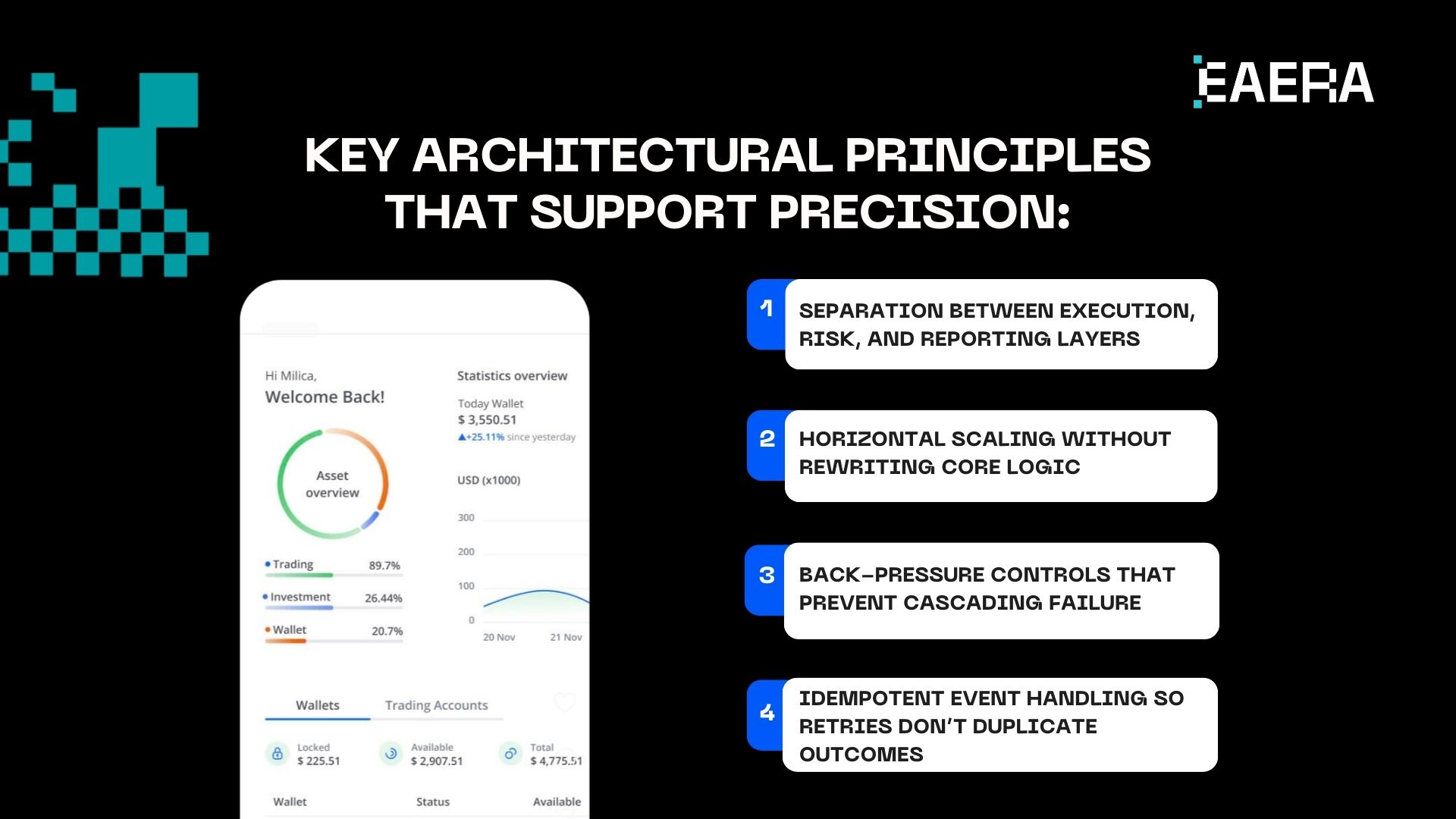
Key architectural principles that support precision:
- Separation between execution, risk, and reporting layers
- Horizontal scaling without rewriting core logic
- Back-pressure controls that prevent cascading failure
- Idempotent event handling so retries don’t duplicate outcomes
Architecture signals to demand in demos:
- Proof of graceful degradation under dependency slowdown
- Clear retry strategy with idempotency guarantees
- Recovery approach that preserves order integrity
- Monitoring and alerting built into the core system
- Evidence of stress testing beyond “happy path” conditions
- Clear operational runbooks for incident response
Precision isn’t real if a vendor can’t explain how they avoid duplicates during retries or recover state following a crash. Reliability is a component of the product in 2026.
Data Transparency: From Real-Time Visibility to Decision Lineage
Transparency is not what charts are. Evidence is necessary for precision. In addition to offering real-time visibility into orders, positions, balances, and exposure, a precision FX trading platform should offer decision lineage that clarifies what transpired and why.
Being visible encourages traders to take action. Operators can protect and enhance the system with the aid of lineage.
Real-time transparency should include:
- Order status and lifecycle events
- Position and exposure updates with clear timestamps
- Rejection reasons that are specific and consistent
- Execution metrics like latency percentiles and slippage bands
A structured record that connects results to inputs and rules is necessary for decision lineage. This includes which market data snapshot was used at the time, which exposure limit was triggered, and which validation rule prevented an order. Post-event analysis becomes speculative in the absence of lineage.
Must-have logs and tables to support precision:
- Order event log (submit, validate, route, fill, reject, confirm)
- Risk decision log (rule evaluated, threshold, result, timestamp)
- Account state timeline (balance, equity, margin changes over time)
- Execution metrics store (slippage, latency, rejection distribution)
- Incident timeline (alerts, impacted components, remediation actions)
Because it substitutes evidence for opinion, a robust FX trading platform lowers disputes and speeds up improvement.
Implementation Playbook: Proving Precision in Production
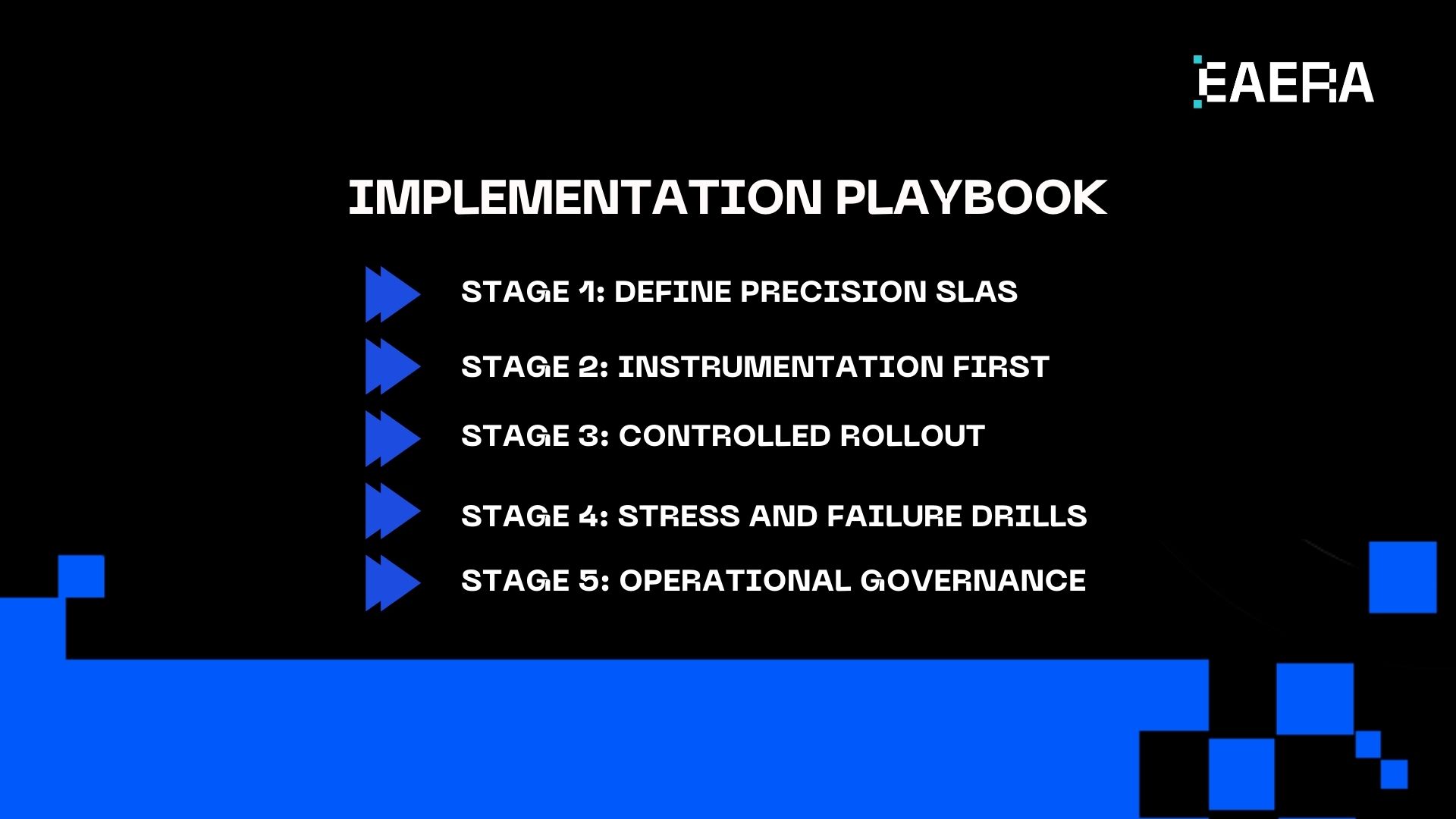
Until precision is able to withstand actual production use, it is not complete. The task at hand is to demonstrate that your operations team can safely monitor, intervene, and explain results while your FX trading platform maintains its deterministic nature under pressure.
Stage 1: Define precision SLAs
Prior to shipping, establish quantifiable bands such as latency percentiles, acceptable slippage ranges by instrument type, reject-rate thresholds, data freshness targets, and incident response time goals.
Stage 2: Instrumentation first
Create baseline dashboards, tracing, and event logging before increasing volume. Without observability, precision is a blind system that will quietly fail.
Stage 3: Controlled rollout
Make use of feature flags, traffic shaping, canary releases, and quick rollbacks. When change is managed, precision is easier to safeguard.
Stage 4: Stress and failure drills
Utilize production-like infrastructure for retry/idempotency validation, burst testing, partial outage drills, and volatility simulations. Ensuring safe degradation and recovery is the aim.
Stage 5: Operational governance
Maintain auditable change logs, limit sensitive actions by role, and use maker-checker for overrides. Precision is an operational discipline as well as a technical one.
Go-live readiness checklist for an FX trading platform:
- Precision SLAs defined and monitored
- Event logs and traces validated end to end
- Recovery drills completed without duplicated orders
- Override controls and audit logs enforced
- Incident playbooks tested and owned
- Clear post-incident review process for continuous improvement
When you want to expedite governance and operational control around execution workflows, EAERA can be considered a platform option, particularly if your bottleneck is repeatable for operations rather than code.
In 2026, precision will consist of traceable decisions and deterministic behavior under pressure. A true precision system integrates decision lineage, fault-tolerant architecture, embedded risk controls, and execution quality. Use this rollout playbook and blueprint to demonstrate that your platform is accurate in the one area that really counts: production.