




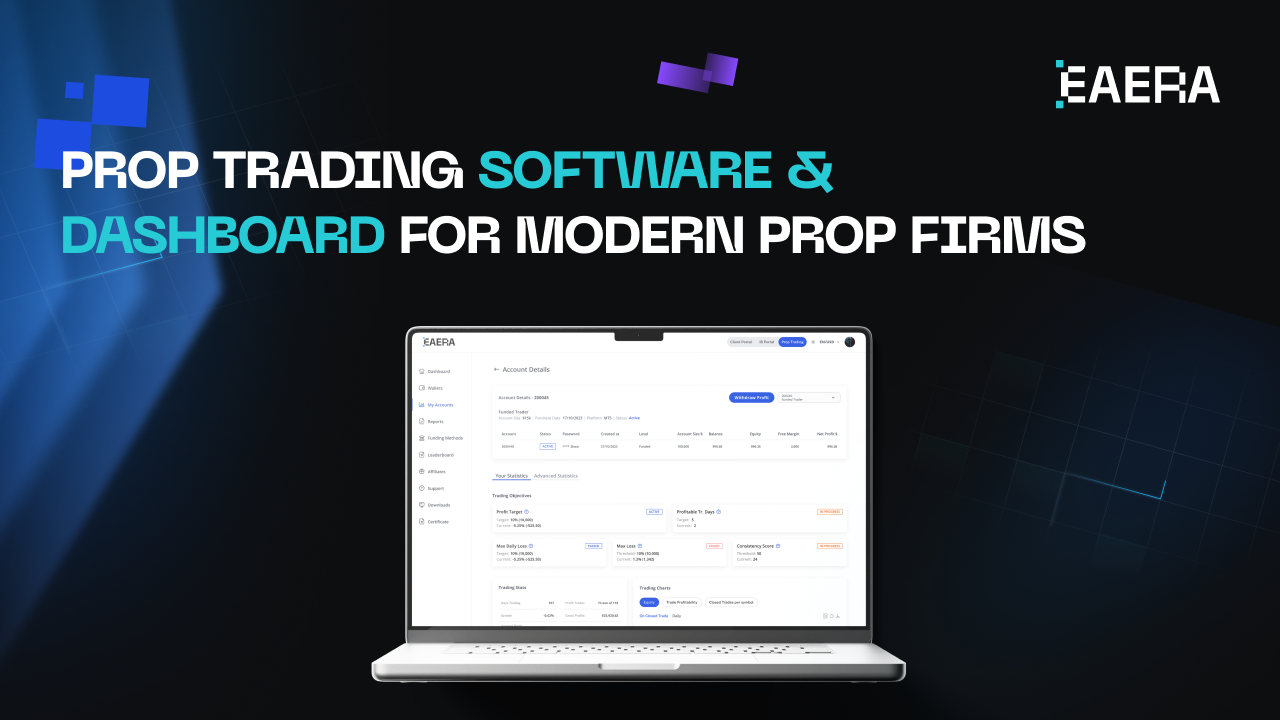
Prop firms are private trading companies that give traders capital (or capital-like purchasing power) with predetermined risk thresholds and profit-sharing agreements. Simply put, the company supports a trader’s execution with its own balance sheet and then distributes profits when performance is met within the guidelines.
The business is operationally demanding in the current retail-facing prop ecosystem: you’re not merely “running a trading program,” but rather a rules-driven production line that includes funded lifecycle, payouts, disputes, pass/fail, provisioning, monitoring, and purchase at scale.
Related articles:
- How to Choose the Right Smart Prop Firm in 2026?
- Prop Trading Solutions: Key Features and Top Provider
Prop firm software is important because it transforms a manual, delicate process into a regulated system that offers traceability, automation, and a trader experience that is trustworthy.
What Is a Prop Firm?
A broker and a prop firm, which stands for proprietary trading firm, are structurally distinct. The main services a broker offers to their clients are market access and execution. The main goal of a prop firm is to control downside risk by using traders and strategies to deploy capital (or simulated capital with stringent loss limits).
This is frequently operationalized by contemporary trader-funding companies through evaluation or “challenge” programs, in which traders pay to take part, perform under predetermined guidelines, and, if successful, are eligible to share profits. Challenge fees and associated add-ons/resets are cited by numerous industry explainers as key sources of income in this model.
Prop firm software ceases to be a “nice to have” at this point. Refunds, support costs, and reputational harm will result from inconsistent and unclear enforcement of your rules.
How Prop Trading Business Works?
Three stakeholder groups – traders, operations/risk, and finance – make up a prop trading firm, which is basically a lifecycle machine. This is how the high-level flow appears:
- Acquire traders → sell programs
- Provision accounts → monitor trading activity → enforce rules
- Graduate traders to funded stages → calculate splits → execute payouts
- Handle exceptions
In many contemporary models, payouts are regulated by rule design and risk limits, while program fees (challenge/evaluation) serve as the economic foundation.
The harsh reality brought about by this operating model is that scaling trader volume without scaling governance results in chaos rather than “growth.” The mechanism that maintains the machine’s determinism is prop firm software:
- deterministic enforcement (same inputs → same decisions),
- consistent communications (no surprise fails),
- and a defensible audit trail (for disputes and internal controls).
Businesses that treat operations like products—with clear guidelines, quick provisioning, steady payouts, and clear proof when something goes wrong—are the ones that survive.

Core Software Stack for Prop Firms
Instead of using just one tool, a modern prop company uses a stack. Prop firm software’s task is to bring that stack together so that your information, choices, and actions don’t disperse among disparate systems.
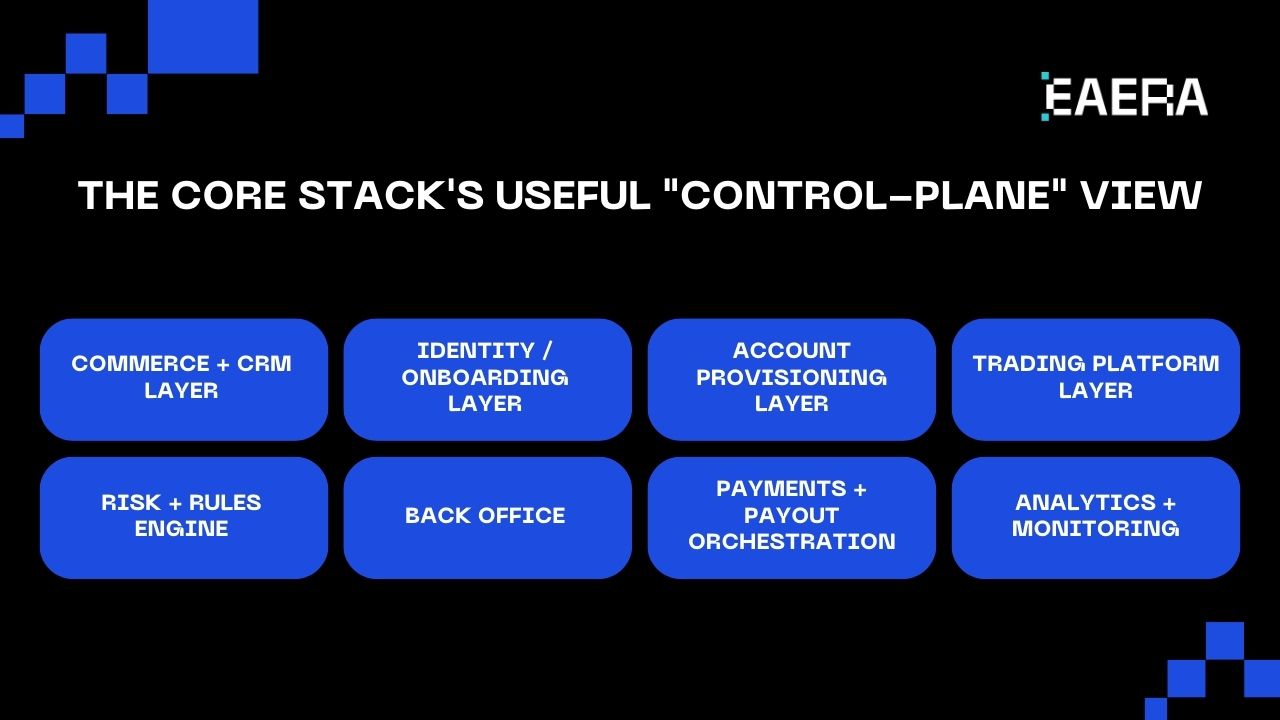
This is the core stack’s useful “control-plane” view:
-
Commerce + CRM layer
Program catalog, pricing, coupons, affiliate attribution, customer records, and lifecycle messaging are all handled from acquisition to purchase. Inconsistent customer context, refund friction, and attribution disputes are examples of leakage that occurs when this layer is weak.
-
Identity / onboarding layer (optional, but increasingly important)
You might require KYC checks or at the very least identity/fraud controls, depending on your model and jurisdiction. The need for a policy-based workflow as opposed to sporadic manual checks increases with scale.
-
Account provisioning layer
The first “moment of truth” is now. Without human involvement, the purchase should consistently result in a trading account with the appropriate ruleset, phase, leverage, and permissions. Provisioning latency is conversion friction in a high-volume operation.
-
Trading platform layer
Traders are executed here. Many businesses use pre-existing platforms and then add a prop layer. The event of integrity (accurate trade/equity data in almost real-time) is more important than the user interface.
-
Risk + rules engine
Rule evaluation, breach of detection, automated actions, warnings, and evidence logs are the areas where prop firm software proves its worth. Business policy is being enforced as a code.
-
Back office
Program configuration, account state management, approvals, case handling, and reporting are all done from this operational cockpit. Conceptually, the back office/admin panel functions as a “control tower” where risk monitoring, finance reconciliation, and compliance approvals are carried out.
-
Payments + payout orchestration
Two different muscles:
- incoming payments (purchase, refunds, chargebacks),
- outgoing payouts (eligibility, approvals, execution, reconciliation).
-
Analytics + monitoring
Without a coherent event model (purchase → provision → trade events → risk decisions → payouts), your “metrics” become opinions. Strong prop firm software enables operator-grade KPIs: purchase-to-first-trade time, breach reason distribution, dispute rate, payout cycle time, and refund/chargeback rate.
You can tell right away if your stack is fragmented by the inconsistent pass/fail decisions, manual payout spreadsheets, and support tickets that ask fundamental questions that your dashboard ought to be able to answer.
Prop Trading Dashboard Explained
A prop trading dashboard is more than just a trader’s “nice UI.” It is a layer of trust that encourages better trading practices while lowering disputes and support expenses.
A modern dashboard inside prop firm software should do four jobs:
- Make rules legible in real time
Always visible are the remaining daily loss, drawdown buffer, profit target progress, minimum days, and current phase status.
- Provide predictive guidance (not just outcomes)
Disputation tickets and “surprise fail” frustration are decreased by warnings such as “approaching daily loss limit.”
- Show an event timeline that can settle arguments
The dashboard ought to display the precise metric that was violated, along with the time and rule version. When the trader asserts, “I was up and still failed.”
- Build self-serve operations
Clear next steps to minimize operational touchpoints, funding updates, payout history, and document submission (if applicable).
In summary, prop firm software safeguards your brand through the dashboard. Not only does a transparent dashboard enhance user experience, but it also lessens the workload associated with chargebacks, refunds, and escalation.
Risk Rules, Challenges & Automation
Risk guidelines are not a footnote; they are your product. The safeguards that make the economics feasible and the payouts controllable include profit targets, drawdown limits, daily loss caps, minimum days, news trading regulations, and lot limits.
Manual enforcement breaks at scale, which is the operational issue. Any human-in-the-loop decision-making becomes erratic and only justifiable with a sufficient number of traders.
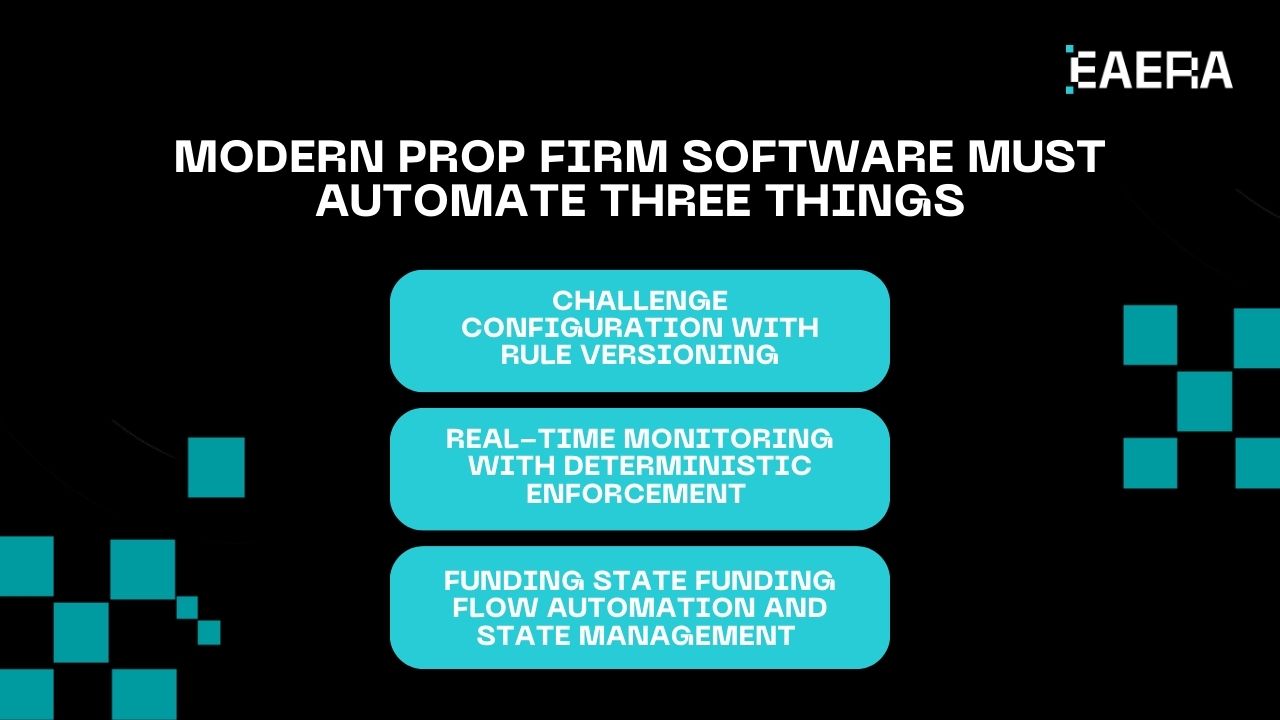
That’s why modern prop firm software must automate three things:
- Challenge configuration with rule versioning
Programs evolve. You need rule sets that can be updated without rewriting your entire system, while still preserving historic accuracy.
- Real-time monitoring with deterministic enforcement
EAERA’s prop firm positioning explicitly mentions implementing trader risk rules with real-time alerts and automatic closures, alongside broader risk monitoring. Whether you choose closures, restrictions, or fail states, the key is deterministic behavior.
- Funding flow automation and state management
As programs become multi-phase, funding logic gets complex (phase-specific rules, scaling, payout eligibility). EAERA highlights why manual processes become a scaling of liability and emphasize automation, state transitions, and immutable logs as core controls.
Best Prop firm software Solutions
“Best” depends on your operating model (build vs buy vs hybrid), your needed time-to-market, and your appetite for integration ownership. The fastest way to choose is to evaluate solutions by control coverage:
- Do they cover the full loop?
- Do they produce defensible evidence?
- Do they reduce manual ops?
- Do they integrate cleanly with your trading platform and payment rails?
Below are common solution directions, with real providers as reference points.
– End-to-end prop firm software platforms (fast time-to-value)
These are designed to centralize CRM/back office, rules, dashboards, and payout workflows—ideal if you want one operating system rather than stitching tools.
This route is typically the best fit when your priority is launching speed and operational standardization.
– Trading platform-first stacks (when execution UX is the priority)
If your differentiation hinges on trading UX, charting, or platform ecosystem, you may start with a trading platform and add the prop layer around it.
This direction can work well, but only if your prop firm software layer still delivers deterministic rule enforcement, evidence logs, and payout governance (otherwise you’re just renting a front-end).
– Hybrid approach (buy the core, build the differentiators)
Common in mature teams: buy a stable prop firm software core (rules, back office, payout workflows), then build your differentiators (custom trader experience, segmentation, gamified engagement, partner portals, analytics).
Why EAERA for Prop Firms?
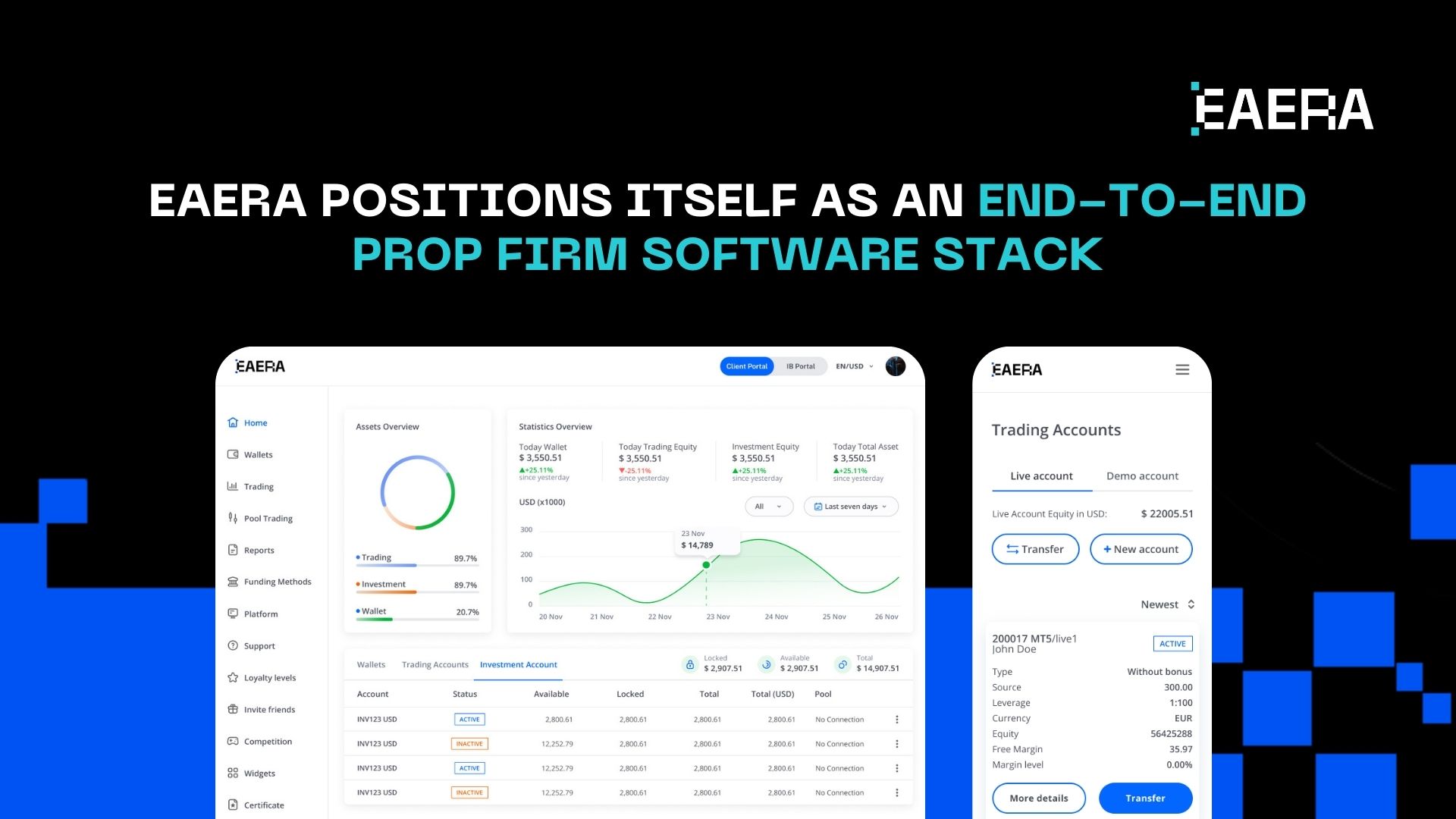
EAERA positions itself as an end-to-end prop firm software stack: combining CRM functions, risk control modules, real-time prop dashboards, and payout automation on a unified platform. From EAERA’s own product pages, the emphasis is on:
- automated evaluations and flexible profit-sharing management
- real-time trader dashboards with performance and rule compliance visibility
- risk rules with real-time alerts and automated actions (including automatic closures)
- and governance-first funding/payout workflow design with audit readiness as a scaling requirement.
If your priority is to reduce manual operations while keeping risk and payouts defensible, EAERA is positioned in the “control-plane + dashboard + automation” lane – exactly where modern prop firm software needs to be scaled without breaking trust.