




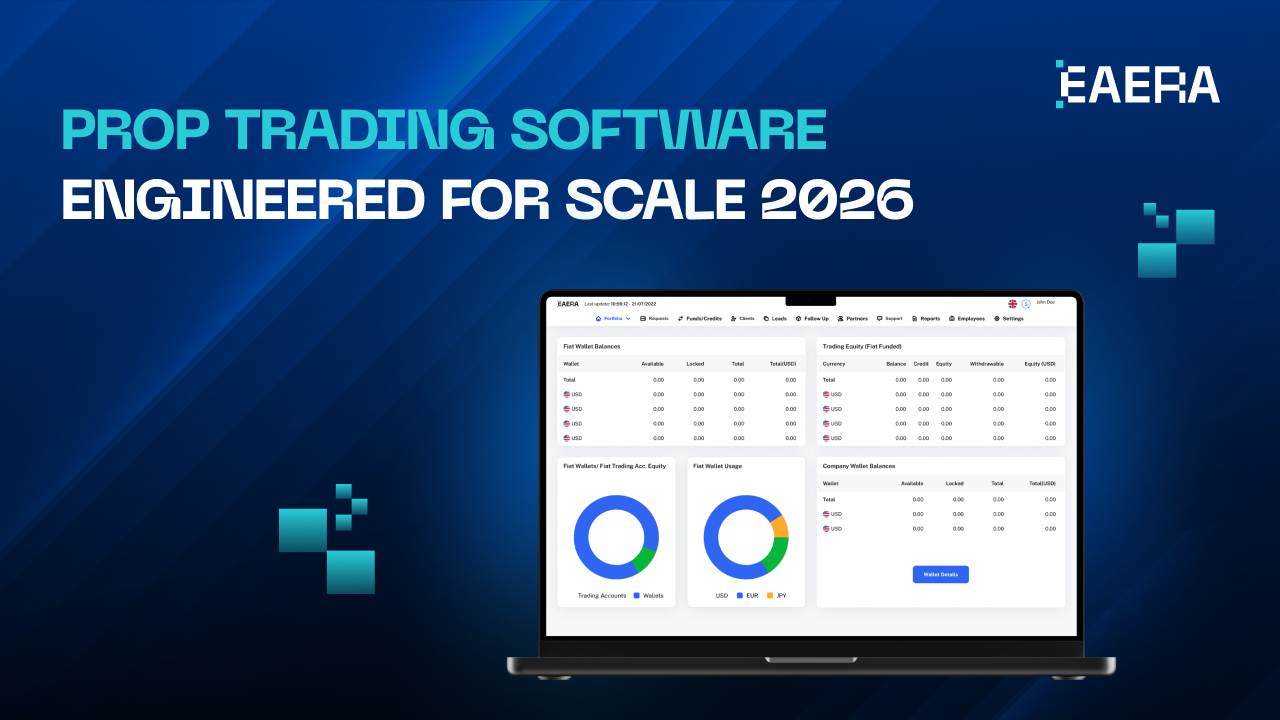
Lack of demand is not the reason why many prop firms fail. They fail because expansion reveals gaps in operations and trust, including payout backlogs, inconsistent rule enforcement, delayed provisioning, dispute spikes, and fraud pressure. Scale does not equate to “more volume.” Under volume, the scale remains constant. Instead of requiring manual heroics, the proper prop trading software transforms growth into repeatable results with controlled workflows and convincing evidence.
Related articles:
The Scale Model: What Breaks First When Prop Firms Grow
Prop growth typically appears healthy until it becomes unhealthy. The first cracks show up in areas like operations queues and trust signals that aren’t visible on marketing dashboards. The friction does not double as the volume does. It makes compounds.
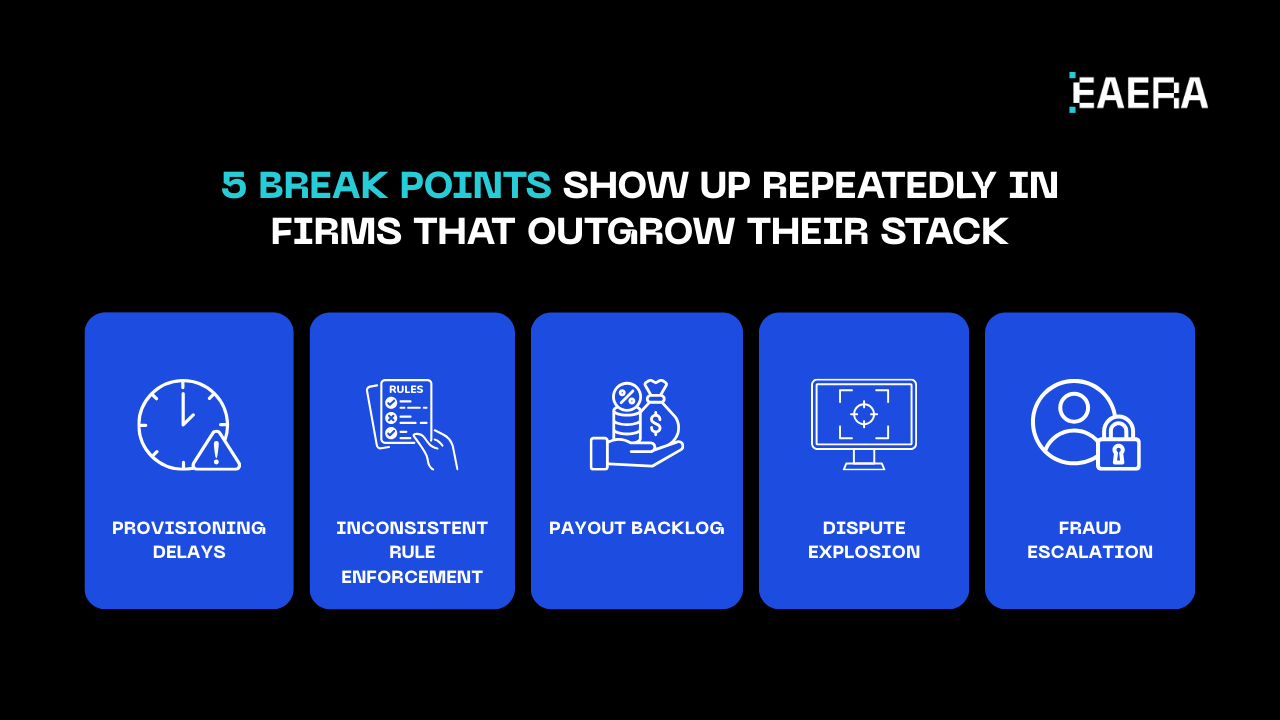
Five break points show up repeatedly in firms that outgrow their stack:
- Provisioning delays: Purchase spikes create account creation backlogs. Traders wait, churn, and open tickets.
- Inconsistent rule enforcement: Two similar cases receive different outcomes. Disputes rise because “fairness perception” collapses.
- Payout backlog: Payouts become manual. SLAs slip. Public sentiment turns quickly.
- Dispute explosion: Support becomes the operating system. Screenshots replace evidence logs.
- Fraud escalation: Multi-accounting and abuse scale faster than human review capacity.
When volume rises, these signals flatten in a scalable business. That only occurs when the process is held together by the system rather than by individuals.
The Operating System Approach to Prop Trading Software
A small program can be executed by a feature-based toolset. It is unable to operate a large-scale prop business. Whether your prop trading software acts like an operating system or like a set of tools makes a difference.
By using an operating system approach, you standardize the lifecycle and assign consistency to the system. Decisions are still made by humans, but they are made in controlled, evidence-based workflows.
A true OS-style prop trading Software has three structural properties:
1) A unified state model
Every account lives in a clear state: evaluation, funded, paused, failed, payout eligible, under review. State transitions are consistent and logged.
2) A shared data spine
Limits, equity calculations, breach of events, and payout eligibility all pull from the same source of truth. No “spreadsheet truth.”
3) Governed workflows
Sensitive actions (overrides, payout approvals, eligibility exceptions) have roles, approvals, and audit trails.
Prop trading software designed for scale prioritizes structure because of this. UI is important, but its trustworthiness depends on its structure.

Risk Control Layer: Rules, Monitoring, and Explainable Outcomes
Risk management is not a policy of support. It’s a product. Your company’s growth budget will be spent on disputes if risk logic is ambiguous, inconsistent, or delayed.
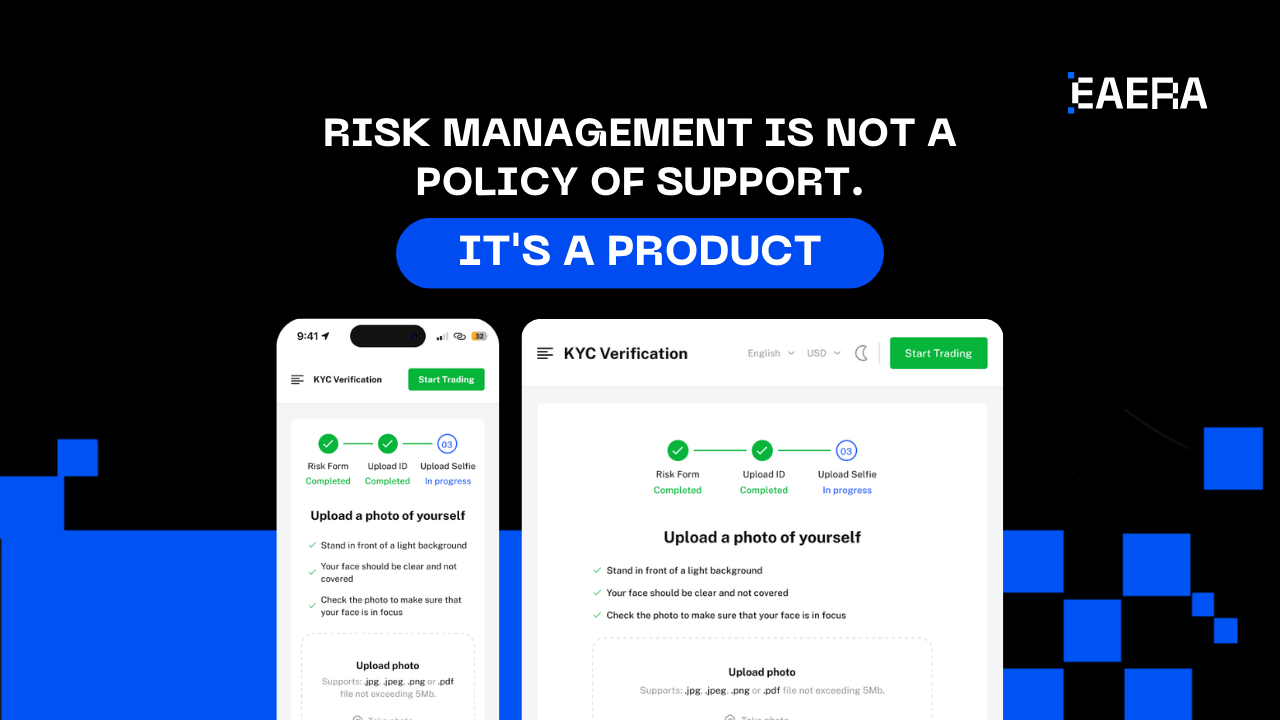
Scale-ready prop trading software requires three layers of risk control working together:
Rule governance (versioned and reproducible)
Rules need to be updated with dates of implementation. History cannot be altered when a rule is changed. The system must be able to demonstrate which set of rules was in effect for a particular account at a given moment.
Real-time monitoring with warnings
Risk is not a final assessment. A contemporary prop trading program constantly assesses limits and issues near-breach alerts. Warning bands lessen “accidental fails,” which lowers refunds and disputes.
Explainable outcomes with evidence timelines
A record of the rule name, threshold, measured value, and timestamp should be kept for each breach. Every decision to pass or fail should be repeatable.
Traceability and workflow control are viewed as fundamental design constraints in fintech systems, and EAERA reflects this governance-first operations mindset. That kind of thinking is in line with what large-scale risk-controlled prop trading software needs to provide.
Payout Operations at Scale: Eligibility, Approvals, Reconciliation
The engine of trust is payouts. Even with a robust marketing funnel, growth becomes brittle if payouts are sluggish, irregular, or difficult to explain. Payouts are handled as a controlled workflow rather than a manual exception by the top prop trading software.
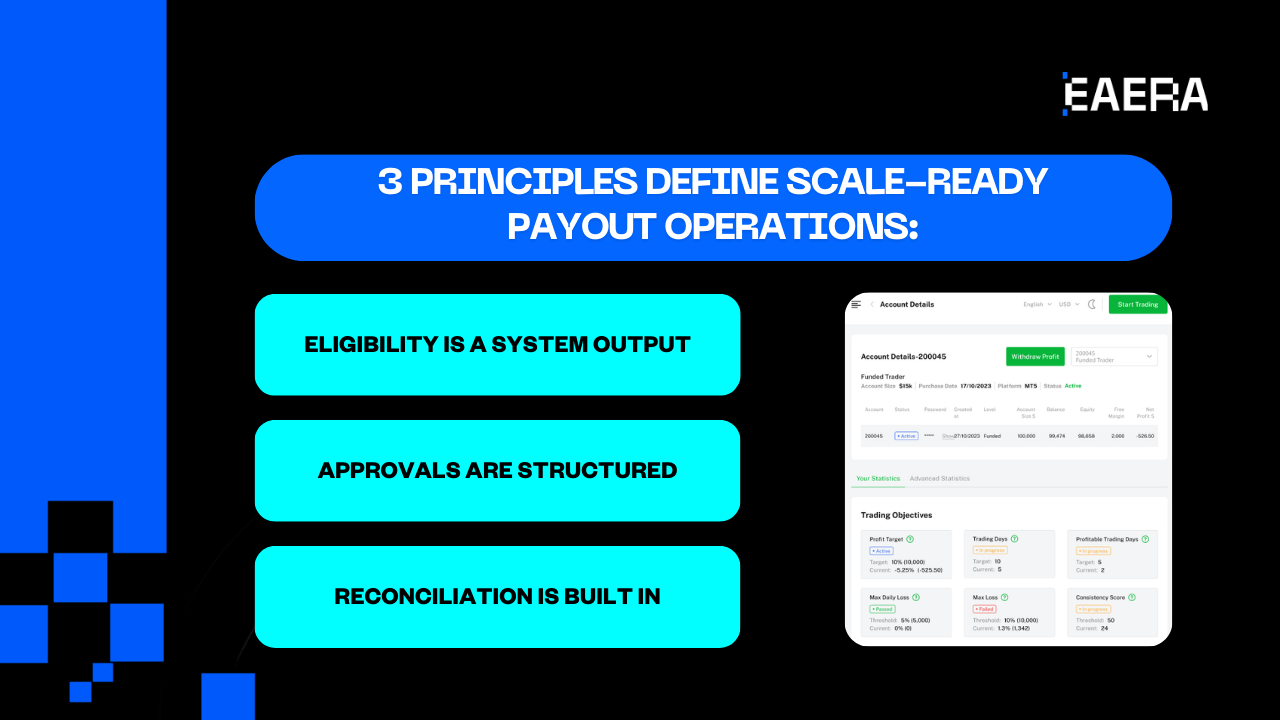
Three principles define scale-ready payout operations:
1) Eligibility is a system output
The rule state and account history should be used to automatically determine eligibility. Scalability is hampered by manual “eligibility checks.”
2) Approvals are structured
Role controls and maker-checker logic are necessary for sensitive actions. You want defensibility, but you also want speed.
3) Reconciliation is built in
Reconstructing payout history from chat logs shouldn’t be necessary for finance. The system’s event trail should be used to generate reconciliation outputs.
Payout controls that prevent chaos:
- Eligibility calculation record attached to every payout request
- SLA targets for each payout stage (submitted, reviewed, approved, executed)
- Maker-checker approval for high-risk payouts or exceptions
- Status tracking visible to operators (and ideally traders)
- Clear exception routing (hold, request info, investigate, reject with evidence)
- Audit log export for payout decisions and overrides
Consistency is a crucial test: can two similar payout requests result in two similar processing outcomes independent of the staff member working that shift? If not, the stack is not engineered for scale.
Data and Analytics: Cohorts, Profitability, and Intervention Signals
Measurable levers are necessary for scale. You cannot distinguish between “revenue volume” and “profitable growth” without cohort analytics. It is impossible to stop trust breakdowns before they become public without intervention signals.
Your prop trading software should support two levels of analytics:
Cohort economics (profitability and payout ratio bands)
You must view profitability by trader segment, acquisition channel, and program type. A company may appear profitable overall, but some cohorts may not be profitable because of high payout ratios, high refunds, or high dispute costs.
Operational signals (what to fix this week)
You want early indicators, such as dispute themes, payout backlog by reason, near-breach frequency, and top breach reasons. You can avoid escalations in this way.
Dashboards leadership should review weekly:
- Purchase-to-account time and time-to-first-trade
- Pass rate and breach reason distribution by cohort
- Disputes per 1,000 traders and refunds per cohort
- Payout cycle time and payout exception rate
- Manual review rate and tickets per 1,000 traders
The system becomes more than just an admin panel thanks to these metrics. Additionally, they show whether your prop trading software is just recording friction or actually reducing it.
In 2026, scale is more than just more traders; it’s consistency under volume. Whether your prop trading software can enforce rules deterministically, run payouts predictably, settle disputes with evidence, and function dependably under load is what separates growth from collapse.