



Risk does not rise linearly as trading operations expand; rather, it compounds. Exposure across capital, systems, and behavior is increased with higher volumes, more participants, and quicker execution. The operating system now decides whether a business can scale sustainably, and risk management is no longer a supporting function for brokers or prop firms.
Related articles:
- How to Choose the Right Smart Prop Firm in 2026?
- What Modern Software for Brokers Should Offer in 2026?
This article describes how contemporary brokers and prop firms create and implement risk management at scale, moving away from manual supervision and toward system-led governance that puts an emphasis on long-term resilience, control, and consistency.
Why Risk Management Is the Core Constraint in Trading at Scale?
Profitability is frequently used to gauge trading success, but risk management is what defines trading survival. Manual checks and individual judgment might be adequate on a small scale. They’re not on scale.
Several structural realities make risk management the core constraint:
- Capital exposure grows faster than human oversight
- Market volatility affects many accounts simultaneously
- Inconsistent rule enforcement creates tail risk
- Human decision-making becomes a bottleneck
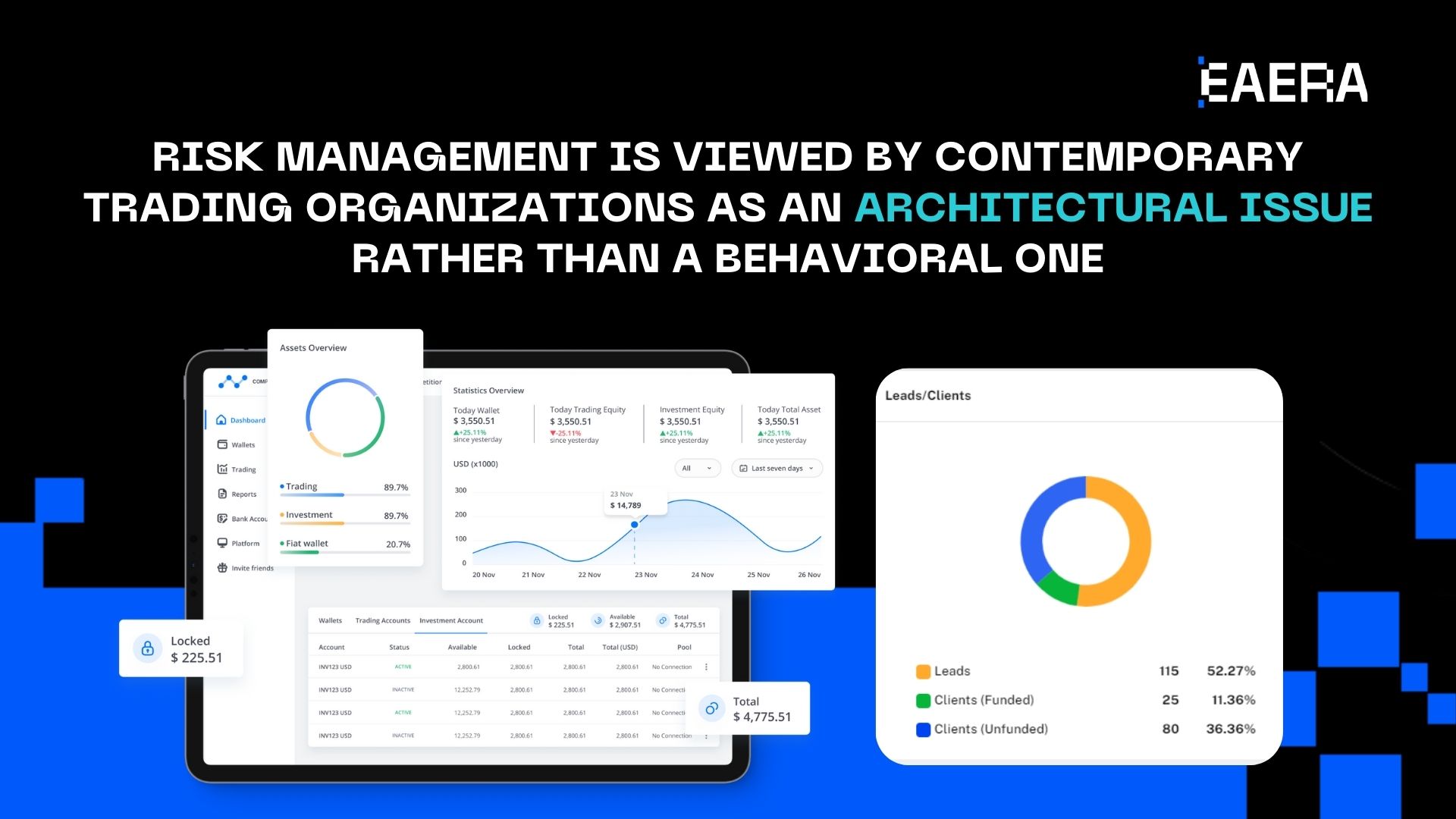
The cost of a single failure rises sharply as operations scale. Systemic losses may result from a missed risk limit, a postponed intervention, or an uneven application of the rules. For this reason, risk management is viewed by contemporary trading organizations as an architectural issue rather than a behavioral one.
How Brokers and Prop Firms Differ in Risk Control Design?
Brokers and prop firms both work in trading environments, but they have very different exposure profiles. Rather than using a standard method, effective control systems take into account these variations.
Brokers: Client-Driven Exposure
Brokers primarily manage client-originated exposure, including:
- Client trading behavior
- Liquidity and counterparty risk
- Regulatory capital requirements
- Operational and settlement exposure
Here, exposure limits, margin logic, and ongoing oversight of thousands of client accounts are the main focuses of risk management.
Prop Firms: Behavior-Driven Exposure
Prop firms trade firm capital, making trader behavior the dominant risk variable. Common exposure sources include:
- Emotional trading decisions
- Accumulating drawdowns
- Correlated strategies across accounts
- Payout sustainability
Controlling behavior at scale is just as crucial for prop firms as controlling market exposure. Systems must stop individuals from endangering company assets.
Notwithstanding these variations, the two models agree on one essential tenet: system-led scalable control is required.
Core Layers of Risk Control Used at Scale
There is no rule that applies to effective risk management. It is a tiered framework intended to lessen the likelihood and consequences of failure.
Key layers include:
- Pre-trade constraints: Limits on position size, leverage, and instrument access before execution.
- Real-time exposure tracking: Continuous monitoring of equity, margin usage, and portfolio concentration.
- Drawdown containment: Daily and maximum loss thresholds that automatically restrict activity.
- Post-trade feedback loops: Performance analysis used to refine limits and detect emerging patterns.
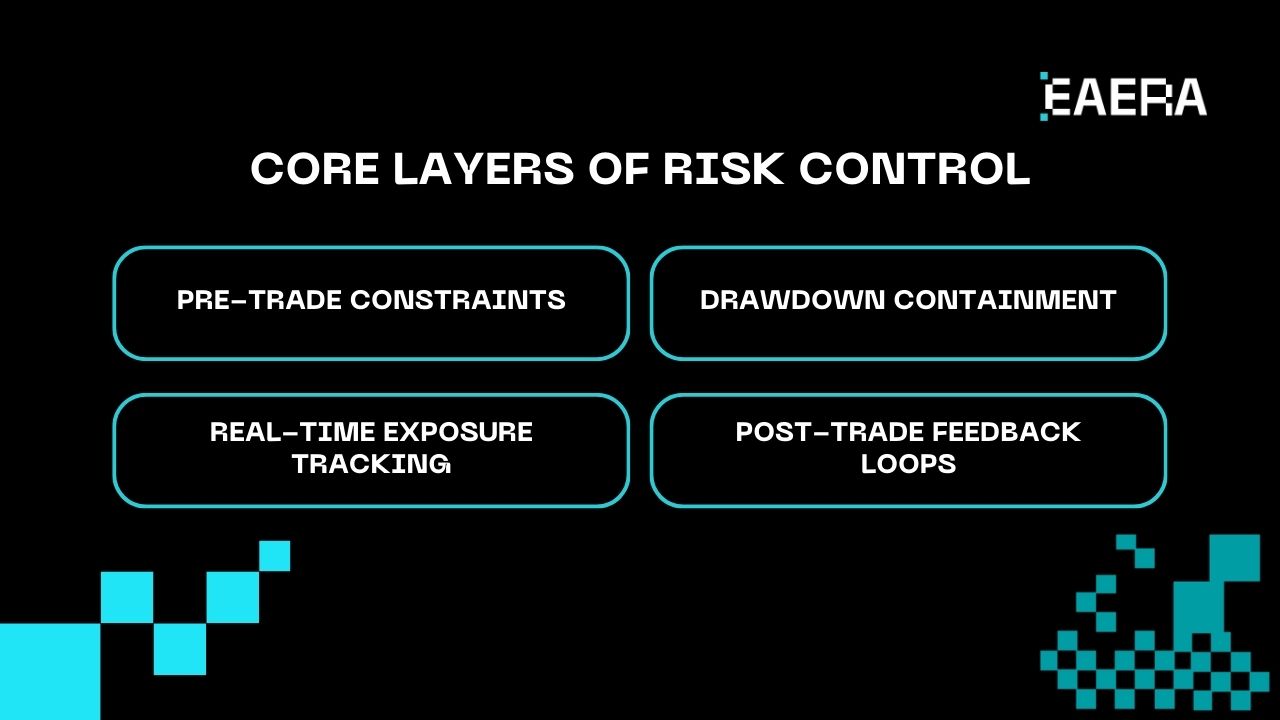
Layered control makes sure that no single breach causes irreparable harm. Another layer steps in if the first one fails.
Automation as the Backbone of Scalable Control
Manual supervision is not scalable. Automation is a structural necessity rather than an effective upgrade.
Automated control systems enable:
- Rule-based enforcement without human bias
- Instant account state changes when limits are breached
- Uniform application of rules across all users
- Continuous monitoring instead of periodic checks
Additionally, automation eliminates uncertainty. Results become consistent, auditable, and predictable. For extensive trading operations, this predictability is crucial.
EAERA and other enterprise-grade platforms show how automated governance can be integrated into trading infrastructure to guarantee that discipline is enforced by design rather than by accident.
Behavioral Risk as a Structural Problem
One source of exposure is market volatility. Behavioral instability is frequently less predictable and more dangerous.
Common behavioral risks include:
- Overtrading during winning streaks
- Escalating exposure after losses
- Revenge trading following drawdowns
- Decision fatigue over long sessions
Modern control systems address these risks structurally rather than emotionally.
Common mechanisms include:
- Trade frequency limits
- Mandatory cooldown periods
- Progressive capital allocation based on consistency
- Temporary trading locks after repeated violations
Firms lessen their reliance on traders’ self-discipline by integrating these mechanisms. The system, not the person, gains control.
Controlling Exposure Across Entities and Regions
Organizations become more complex as they grow. Global prop firms and multi-entity brokers are required to maintain centralized oversight while enforcing distinct regulations in various jurisdictions.
Key challenges include:
- Entity-specific regulatory obligations
- Regional liquidity and volatility differences
- Consolidated exposure visibility
- Capital segregation requirements
Scalable systems address this through:
- Entity-aware rule configuration
- License-specific thresholds
- Group-level dashboards with drill-down capability
Platforms like EAERA support this orchestration by enabling centralized governance without compromising local compliance requirements.
Measuring the Effectiveness of Risk Controls
Only when risk management yields quantifiable results can it be considered effective. Instead of depending solely on anecdotal judgment, firms must regularly monitor governance metrics.
Key indicators include:
- Average drawdown depth and recovery time
- Frequency and clustering of rule breaches
- Capital utilization efficiency
- Stability of payout cycles over time
These indicators show whether exposure is being controlled proactively or only in response to losses.
System-Led Control vs Discretion at Scale
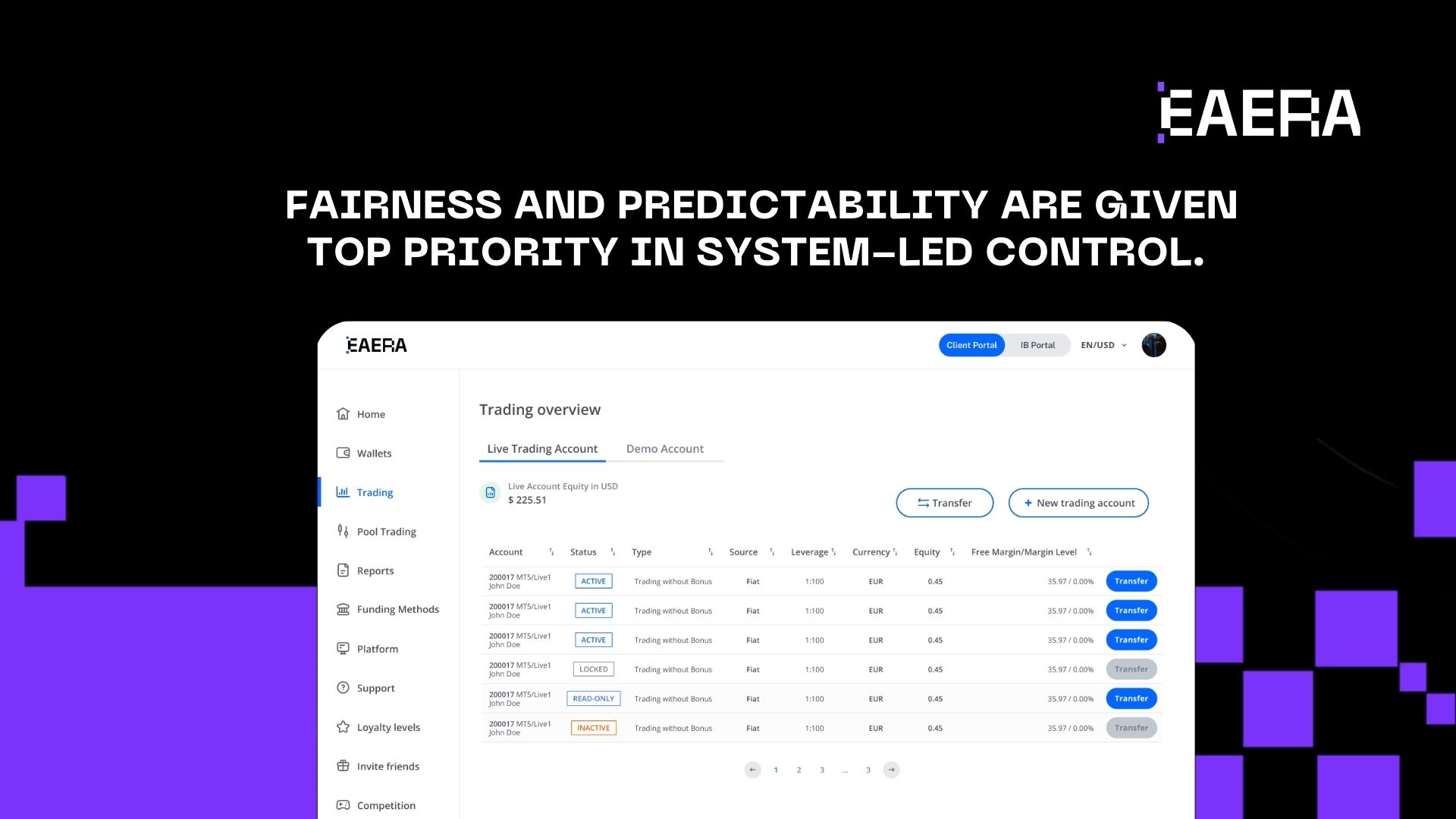
Human judgment is the foundation of discretion-based control. Although adaptable, it is inconsistent and challenging to audit. Fairness and predictability are given top priority in system-led control.
Discretion-led approach
- Flexible but inconsistent
- Dependent on individual experience
- Difficult to scale and review
System-led approach
- Predictable and enforceable
- Scales with volume and complexity
- Transparent and auditable
System-led governance continuously performs better at scale in terms of resilience and stability than discretionary models.
Control as a Strategic Advantage
Well-designed control frameworks do more than prevent losses. They enable:
- Stable capital planning
- Predictable payouts
- Lower operational stress
- Stronger trust with traders, clients, and regulators
Businesses are better positioned to grow sustainably when they view risk management as a strategic capability rather than a constraint. By creating systems that incorporate governance into each operational layer, infrastructure providers like EAERA demonstrate this change.
For an organization or an industry, successfully trading at scale is less about the degree of risk taken and more about the degree of risk managed over time. For brokers and prop firms looking to establish the correct governance model as the basis of stability, it’s about implementing discipline within the entire system rather than the entire policy structure.