



In 2026, smart prop trading firms compete on speed, trust, and operational consistency. If your operation relies on spreadsheets, ad-hoc approvals, and “human memory,” you will hit a ceiling fast. Automation is not about doing the same work faster – it’s about making the business defensible and scalable. In practice, automation is the scalability layer for smart prop trading under volatility, fraud pressure, and reputational risk.
Related articles:
- Forex CRM Explained: What It Is and How It Benefits Your Brokerage
- Forex CRM Software for Brokers: Complete Guide, Features & Best Solutions 2026
What “Smart Prop Trading” Means in 2026?
In smart prop trading, rules are the product and process is the moat. The company wins in smart prop trading by making programs that are easy to understand, hard to take advantage of, and easy to enforce on a large scale.
In practice, a smart prop trading model typically includes:
- A rule engine that can configure and version evaluation criteria (drawdown, daily loss, profit targets, time constraints, minimum days, etc.).
- Real-time risk monitoring that evaluates breaches continuously, not “after the fact.”
- A transparent dashboard that makes it obvious where a trader stands (remaining drawdown, target progress, warning thresholds).
- A payout workflow that is predictable, auditable, and resistant to disputes.
The key difference versus “classic prop” is this: smart operations are built to survive volume. That requires deterministic behavior. When rules are enforced differently by different reviewers or time periods, perceived fairness collapses—and perceived fairness is directly tied to refunds, public sentiment, and long-term conversion.
Why Manual Operations Fail Prop Firms?
A small smart prop trading program can be operated manually. They are unable to operate a prop company.
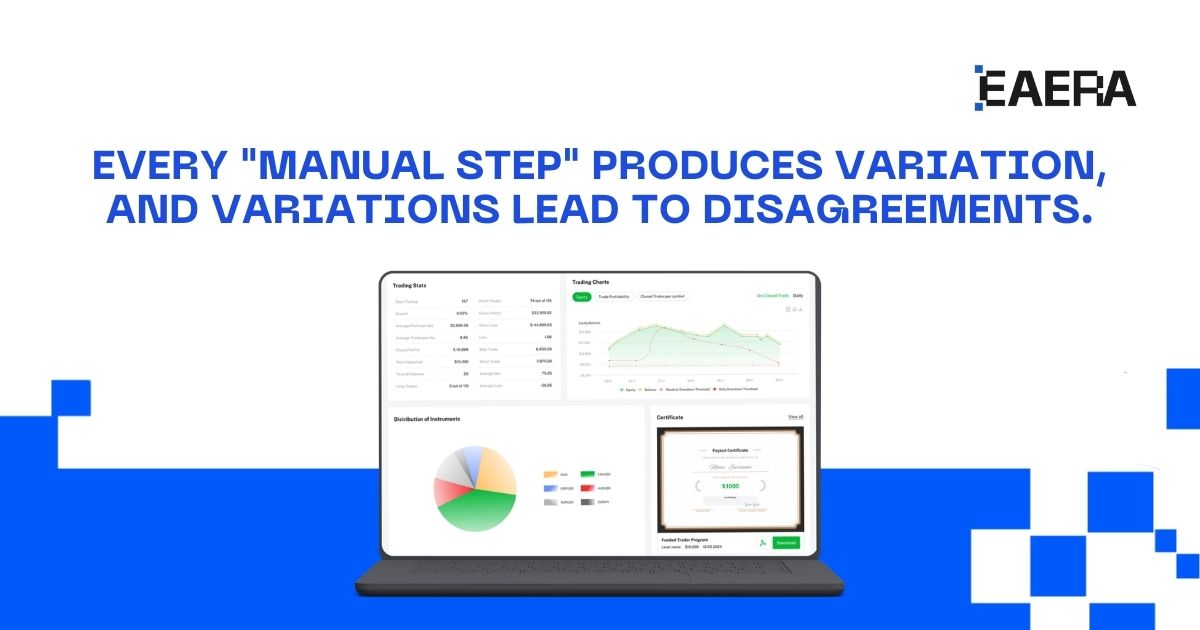
Account provisioning, breach review, rule exceptions, payout eligibility checks, fraud triage, and support escalations are the areas where manual handling usually crept in. Every “manual step” produces variation, and variations lead to disagreements.
Common failure modes (and their real cost):
- Inconsistent pass/fail outcomes → traders escalate, request refunds, and post negative reviews.
- Slow provisioning (purchase → account delivery) → conversion drops and support load rises.
- Delayed payouts → reputational damage that’s hard to reverse, even if the root cause was operational.
- Spreadsheet-led adjustments (resets, add-ons, special cases) → data drift and accounting errors.
- Late fraud detection → losses and payout abuse, plus higher false positives when you react too aggressively.
- Support overload during volatility → teams spend time explaining, not improving the system.
Simple diagnostic signals you’re hitting the ceiling:
- A high % of accounts require “manual review” to decide pass/fail.
- Payout cycle time varies widely (same case type, different outcome).
- The same dispute reason appears repeatedly (rule clarity + evidence gaps).
- Ops headcount scales linearly with trader volume.
What to Automate First in Smart Prop Trading?
Automation in smart prop trading is most effective when it eliminates bottlenecks throughout the lifecycle without making your company a mystery. Automating the flow rather than random features yields the highest return on investment.
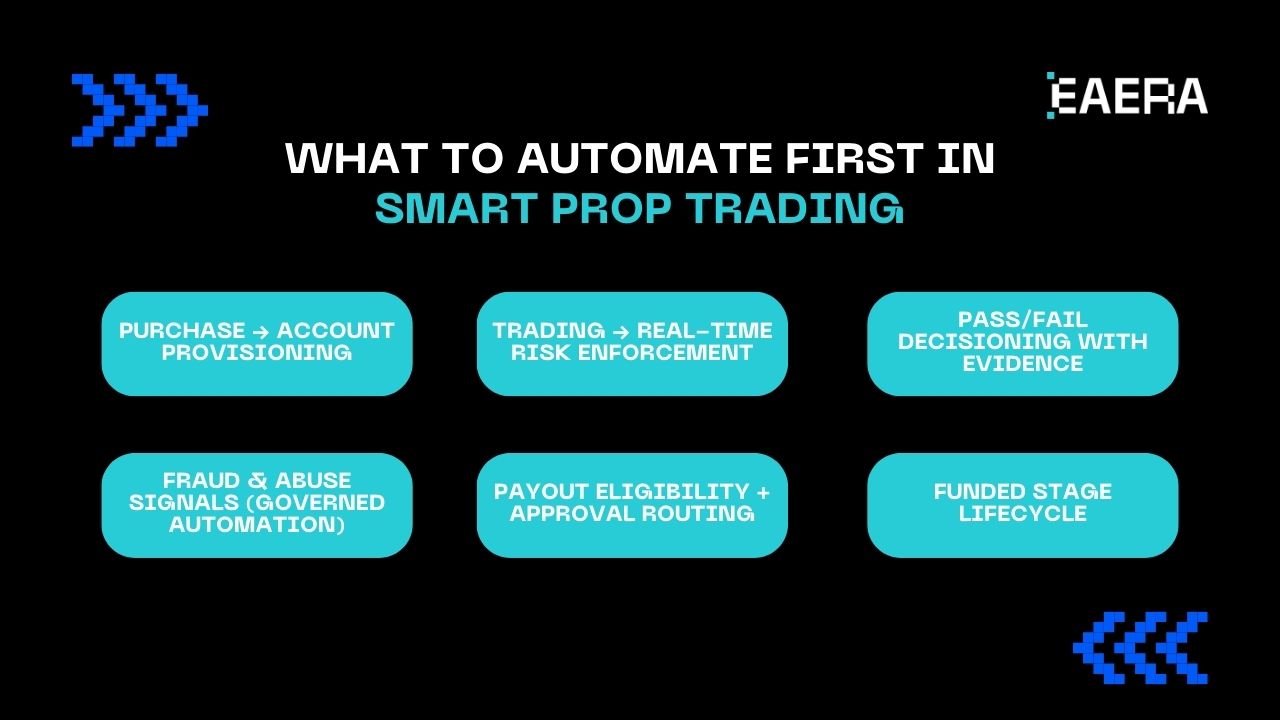
1) Purchase → Account Provisioning
Automate credential delivery, ruleset assignment, and account creation to make time-to-first-trade predictable.
The reason it matters is that each hour of delay results in more tickets and fewer activations.
2) Trading → Real-Time Risk Enforcement
Using deterministic actions (warn, restrict, fail) based on explicit policy, automate breach detection, and warning thresholds.
Why it matters: When a trader encounters “surprise failure,” the majority of disputes arise.
3) Pass/Fail Decisioning with Evidence
Evaluate rules automatically and keep track of the evidence, including the rule that was triggered, the value that was violated, the timestamp, and the rule version.
Why it matters: Reputational damage and refunds are decreased by making consistent decisions.
4) Funded Stage Lifecycle
Automate scaling plan updates, limit adjustments, and state transitions (funded, paused, and restricted).
Why it matters: Financial risk arises from manual errors in funded operations.
5) Payout Eligibility + Approval Routing
Automate payout scheduling, eligibility computation, approval procedures, and reconciliation results.
Why it matters: The foundation of the company’s trust is its consistent payouts.
6) Fraud & Abuse Signals (Governed Automation)
Automate queuing and flagging instead of punishing people right away.
Why it matters: you prevent unfair false positives while safeguarding economics.
A practical mapping from automation area to business KPIs:
| Automation area | KPI(s) it improves | Typical business impact |
| Provisioning | Purchase → account time, activation rate | Higher conversion, fewer tickets |
| Risk enforcement | Dispute rate, refund rate | Better trust + lower support load |
| Evidence logs | Dispute resolution time | Faster resolution, fewer escalations |
| Payout workflows | Payout cycle time, payout failure rate | Reputation lift, retention lift |
| Fraud signals | Loss events, false-positive rate | Protect margin without backlash |
Automation Without Governance Is a Risk
Automation can scale your advantages—or scale your mistakes.
The rule of thumb: automate process, not judgment. A well-governed system has clear ownership, permission boundaries, and audit trails.
What not to fully automate:
- Irreversible punishments (hard bans, permanent disqualifications) without a review path.
- Payout denials without explainable evidence tied to rules and timestamps.
- Rule changes without versioning, effective dates, and impact visibility.
Governed automation is the trust engine of smart prop trading, and it requires:
- Role-based access to sensitive actions (rule edits, payout approvals, overrides) are controlled.
- Maker-checker approvals for high-risk actions (payout execution, commission adjustments, exception handling).
- Immutable logs: “who did what, when, why.”
- Rule versioning: the platform must show which rule set applied to each evaluation period.
- Exception queues with SLAs: exceptions are normal; unmanaged exceptions are chaos.
Automation becomes an enhancer of trust when governance is designed. Automation turns into a reputational risk when governance is absent.
Metrics That Prove Smart Prop Trading Automation Works
Measurable results should be used to support automation. Track deltas after establishing baselines.
High-signal KPI groups:
Conversion & speed
- Purchase → account creation time
- Time-to-first-trade
- Drop-off rate during onboarding
Fairness & trust
- Dispute rate per 1,000 traders
- Refund/chargeback rate
- Breach reason distribution (is one rule causing most blowups?)
Operations efficiency
- Manual review rate (what % still needs humans?)
- Tickets per 1,000 traders
- Median time to resolve a dispute
Payout performance
- Payout cycle time (request → executed)
- Payout failure rate
- % payouts requiring “special handling”
Risk outcomes
- Fraud flag hit-rate and false-positive rate
- Loss events linked to policy gaps
- Repeat abuse patterns (same behavior, different accounts)
You can’t improve these if you can’t measure them, so incorporate measurement into the operating model as soon as possible.
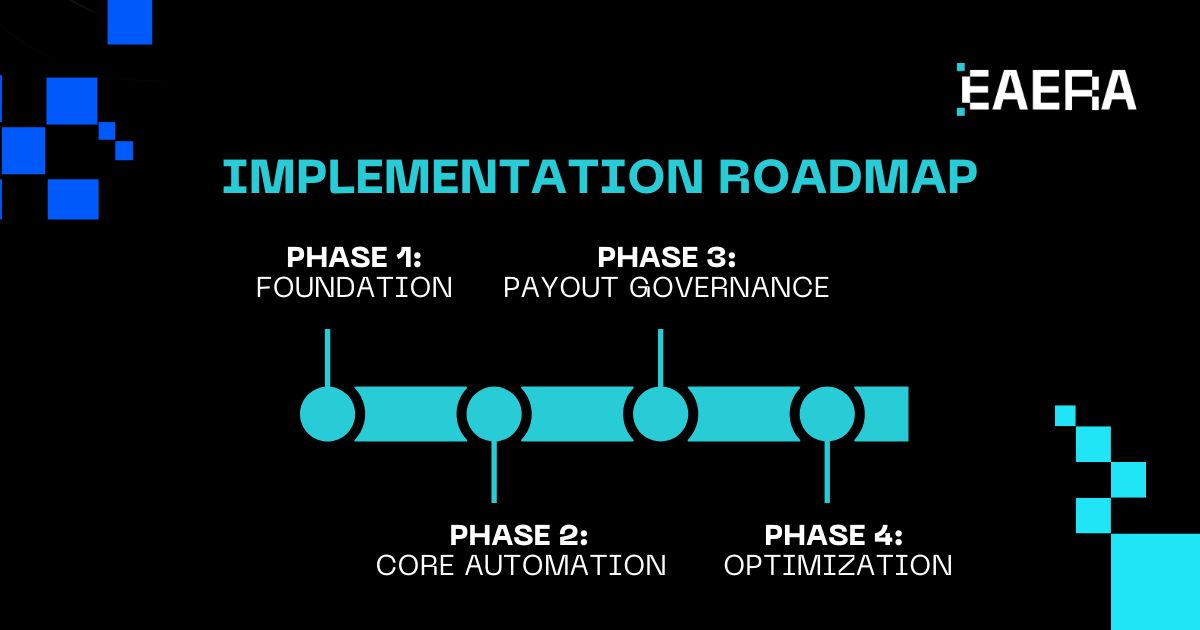
Implementation Roadmap: 30–90 Days to Automated Operations
Smart prop trading is stabilized through a phased rollout. Automating the lifecycle without causing production instability is the aim.
Phase 1: Foundation
- Define rule catalog + edge cases
- Standardize event model (trade events, breaches, state changes, payouts)
- Implement audit logging baseline
- Ship a minimal dashboard that reflects rule status clearly
Phase 2: Core automation
- Provisioning automation (purchase → account)
- Real-time breach detection + warnings
- Deterministic pass/fail decisioning with evidence logs
Phase 3: Payout governance
- Eligibility logic + approval routing
- Payout scheduling + reconciliation outputs
- Exception queue + SLA definitions
Phase 4: Optimization
- Fraud signals + review workflows
- Segmentation and experiments (program variations with rule versioning)
- Operational analytics refinement
If your goal is to scale rapidly with governed workflows, EAERA‘s integrated stack for prop operations (rules, dashboards, and workflow automation) can hasten standardization.