



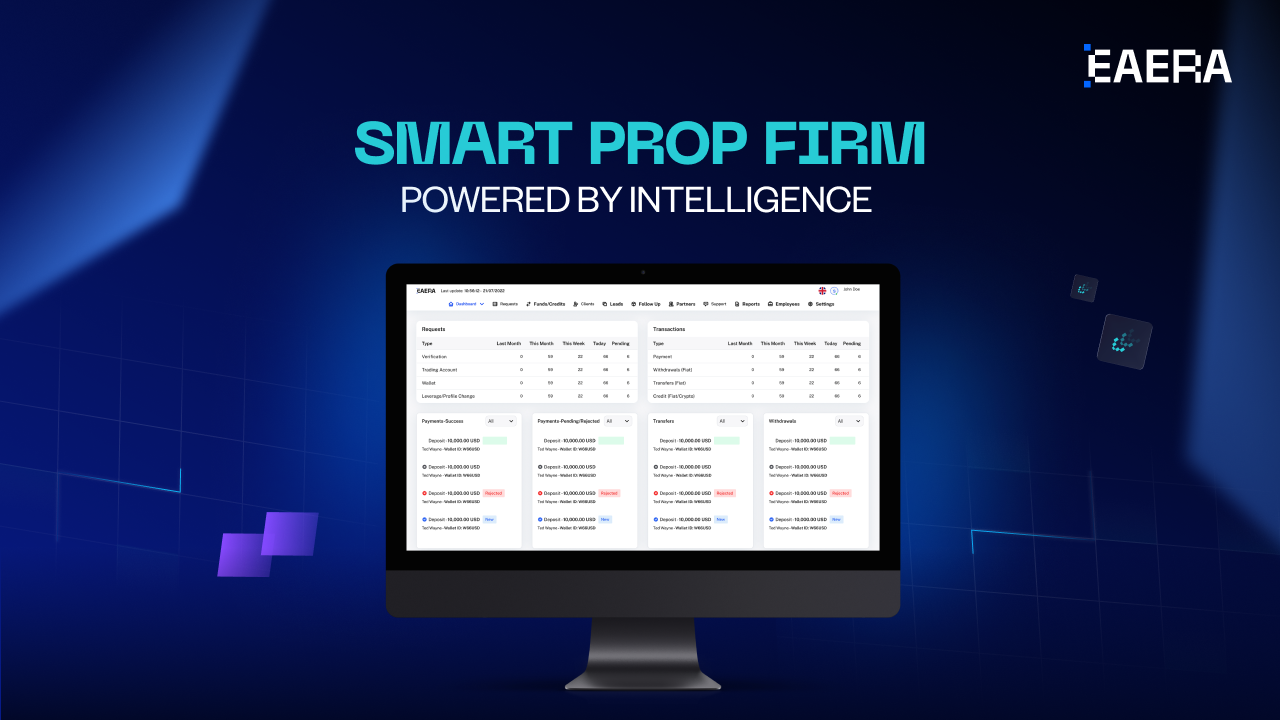
Prop firms seldom fail due to a lack of demand. Inconsistent rule enforcement, payout friction, dispute spikes, and fraud pressure are examples of how they break when volume increases and trust doesn’t scale. Instead of viewing intelligence as a marketing tool, a smart prop firm views it as a control layer for results. The objective is straightforward: predictable choices, comprehensible outcomes, and scalable processes that safeguard unit economics and reputation.
Related articles:
- Smart Prop Trader Journey Explained
- Smart Prop Trader: How To Choose a Prop Firm That Fits Your Lifestyle and Goals
The Smart Prop Firm Operating Model
The three guiding concepts of a smart prop firm are data-as-control, governance-as-system, and rules-as-product. That’s the difference between a fast operator and a modern operator.
Rules-as-product refers to a program that is intended to be easily understood and consistently enforced. Sensitive actions are managed by audit trails, permissions, and approvals under governance-as-system. Data-as-control means the firm sees risk and operational bottlenecks early, then intervenes before they turn into disputes or payout chaos.
“Manual operations + support glue” is not the same as a smart prop firm. Spreadsheets, ad hoc approvals, and case-by-case decisions are examples of manual operations where humans keep the system together. It functions on a small scale before collapsing at large volumes. A smart prop firm, on the other hand, is built so that people are supported by the system rather than the other way around.
Five traits that separate a smart prop firm from a fast operator:
- Program rules are versioned and reproducible, not rewritten silently
- Risk is monitored in real time with near-breach warnings
- Every outcome can be explained with evidence, not opinions
- Payouts run as governed workflows with SLAs
- Profitability is managed by cohort, not by monthly revenue totals
Intelligence is useful because of this operating model. “Intelligence” turns into noise in the absence of structure.
Intelligence That Matters: Signals, Decisions, and Guardrails
Intelligence is not a chatbot in prop. The capacity to identify operational problems and risks early on and take consistent action is intelligence. Three elements are essential to a smart prop firm: signals, decisions, and guardrails.
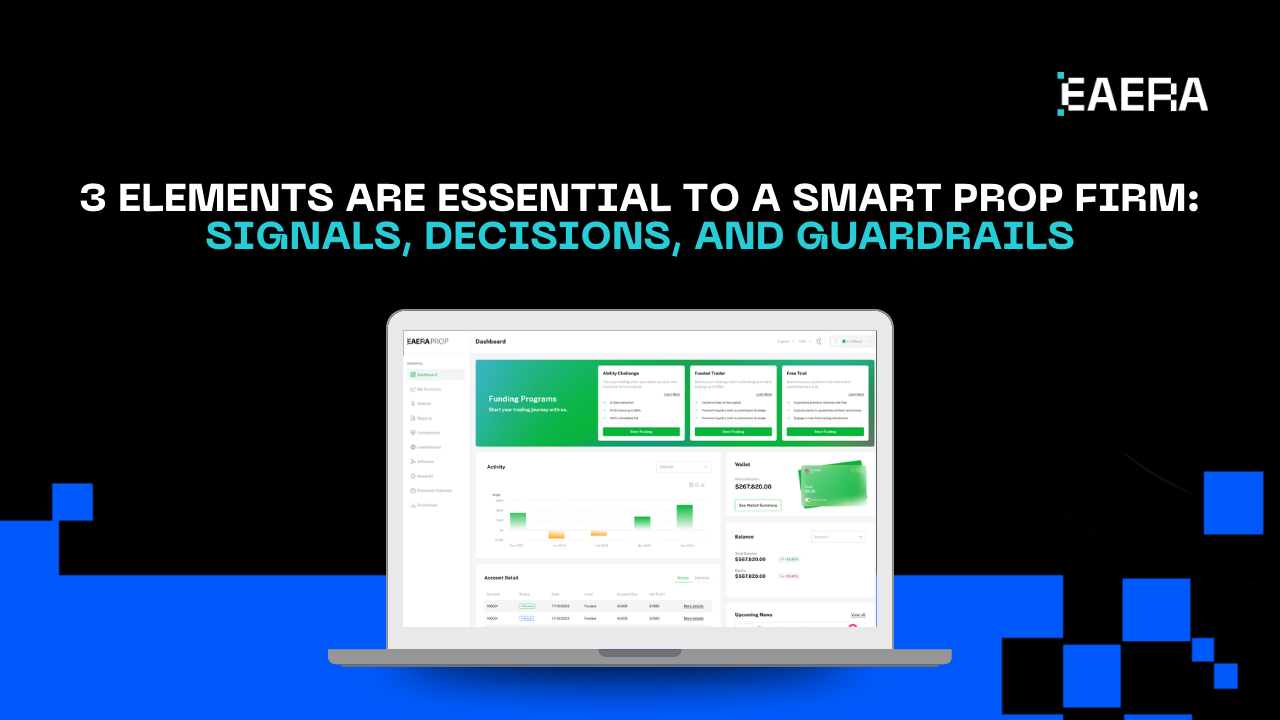
The observable inputs are called signals. The system uses those inputs to make decisions. Guardrails guarantee that decisions are safe, auditable, and consistent.
A smart prop firm monitors signals that are directly related to unit economics, risk, and trust. Keeping track of everything is not the goal. The goal is to monitor what predicts abuse, payout friction, disputes, and breaches.
High-signal indicators a smart prop firm should track:
- Remaining drawdown buffers and near-breach frequency
- Breach reason distribution by program and cohort
- Payout eligibility states and payout backlog risk
- Refund and chargeback signals by channel and cohort
- Multi-account or collusion indicators (behavior + identity patterns)
- Support ticket themes tied to specific rule confusion
Only when those signals result in deterministic decisions do they add value. “If these inputs happen, the system will do this, every time” is what a smart prop firm should be able to say.
Intelligence is prevented from becoming a black box by guardrails. This includes audit logs for overrides, rule versioning with effective dates, maker-checker approvals for sensitive operations, and SLA-managed exception queues. This is how a smart prop firm maintains speed without going careless.

Trader Intelligence Layer: Reduce Breaches, Increase Trust
The experience of a trader is what creates or destroys trust. The majority of disputes originate from a trader’s belief that they are safe and the system’s disagreement. By making risk visible and results understandable, a smart prop firm closes that gap.
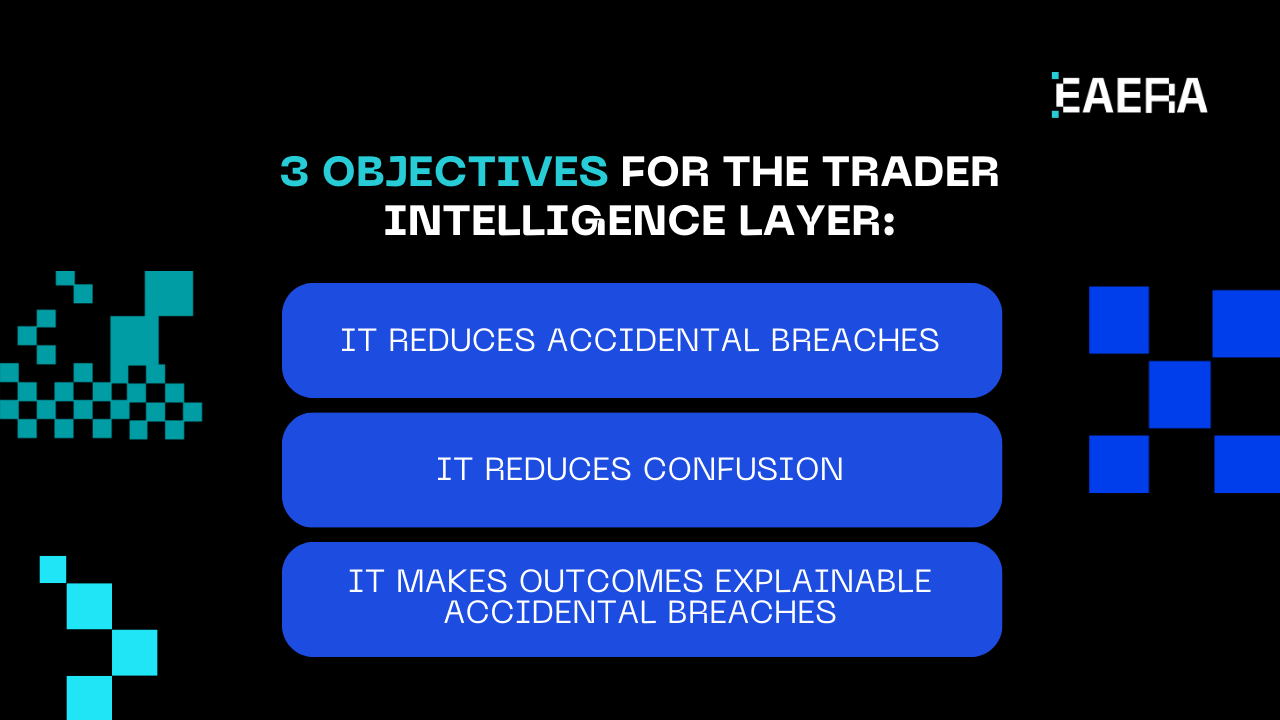
There are three objectives for the trader intelligence layer.
First, it reduces accidental breaches. This necessitates real-time risk transparency, including warning bands that indicate “approaching limit” rather than waiting until “failed,” as well as remaining buffers for daily loss, maximum loss, and any trailing logic.
Second, it reduces confusion. Rule definitions are not concealed in documents by a smart prop firm. Definitions are presented in context, with examples and unambiguous timestamps, where the trader needs them.
Third, it makes outcomes explainable. The system should display the evidence of timeline—rule triggered, threshold, measured value, and timestamp—when an account passes or fails. This makes disagreements quickly resolved.
A smart prop firm gains credibility by eliminating surprises. Because of this trust, there are fewer refunds and a lighter support load, both of which increase profitability.
Operations Intelligence Layer: Payouts, Support, and Audit Readiness
A smart prop firm cannot scale if payouts and disputes remain manual. Operations intelligence turns the back office into a controlled system rather than a reactive queue.
The area with the most leverage is payout governance. Instead of being determined by hand, eligibility should be calculated as a system output. Role-based and uniform approval routing is required. Instead of being negotiated in chat, exceptions should be traceable.
For the same reason, support intelligence is important. Screenshots shouldn’t be used for support. A smart prop firm automatically connects tickets to evidence logs so that disagreements can be settled by viewing the event timeline rather than arguing over what transpired.
All of this is connected by audit readiness. Being audit-ready does not equate to being slow. Defensible is what it means. To manage investigations, partner scrutiny, and payment-provider inquiries, a smart prop firm requires rule versioning, immutable logs, decision lineage, and exportable timelines.
One example of an ecosystem-first, governance-forward strategy is EAERA, which treats workflows, permissions, and auditability as essential infrastructure. That way of thinking is consistent with what a smart prop firm’s operations intelligence should look like.
Profitability Intelligence: Cohorts, Payout Ratios, and Early Intervention
Revenue volume is managed by many prop operators. Cohort profitability is how a smart prop firm operates. This change is significant because volume can conceal issues such as high refund cohorts, unprofitable channels, or payout ratio spikes that wipe out margin.
Early problem detection and safe intervention are key components of profitability intelligence. A smart prop firm tracks payout ratio bands by program and channel, pass rates by cohort, dispute rates by cohort, and the cost-to-serve (tickets and manual reviews) rather than waiting for monthly results. You can modify program packaging, education, warnings, or payout workflow to stabilize a segment that drifts.
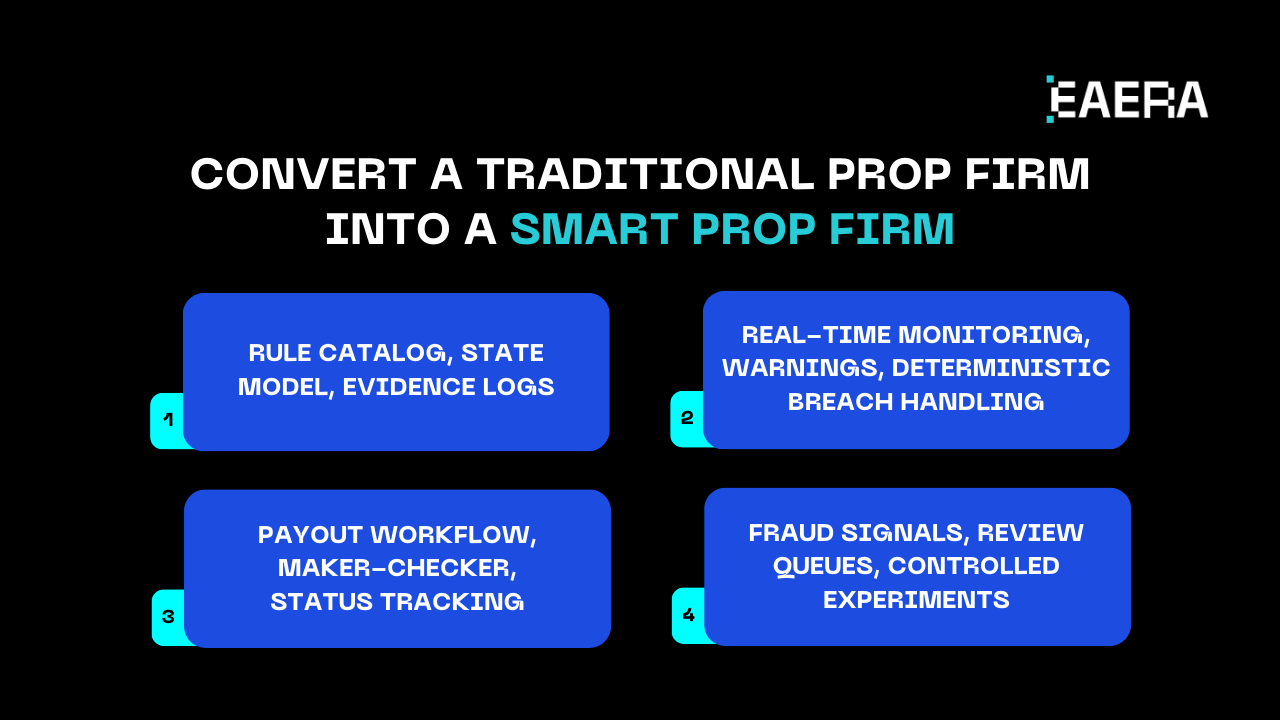
Implementation: Convert a Traditional Prop Firm into a Smart Prop Firm
It is a change, not a feature release, to become a smart prop firm. Phased approaches that incorporate governance from the start are the safest.
Step 1: Rule catalog, state model, evidence logs
Make the business replicable first. Clearly define the rules, create a lifecycle state model, and make sure that each significant event results in an evidence record. “Intelligence” becomes erratic in the absence of this basis.
Step 2: Real-time monitoring, warnings, deterministic breach handling
Include real-time buffers and near-breach alerts. Make sure rule versions and timestamps are linked to deterministic breaches and pass/fail outcomes.
Step 3: Payout workflow, maker-checker, status tracking
Transform payouts into a controlled process with visible status, eligibility calculation, and approval routing. This is the point at which trust is gained or lost.
Step 4: Fraud signals, review queues, controlled experiments
Incorporate fraud detection that queues and flags instead of punishing right away. Next, conduct cohort-specific controlled experiments to increase conversion and retention without creating conflicts.
EAERA can be used as a benchmark for developing an audit-ready operating model more quickly if you wish to expedite governance and workflow standardization through a platform approach.
Hype and “AI features” do not define a smart prop firm. It is characterized by intelligence that produces scalable, consistent, and explicable results.