



A modern forex CRM provider today is not simply a software vendor providing lead management tools. By 2026, brokers will need to have the infrastructure in place to operate in areas like onboarding, compliance, retention, analytics, and long-term scalability.
The forex industry has become much more competitive in the last few years. Increasing acquisition costs, growing client expectations, and increasing operational complexity across global markets. This means brokers require CRM systems that are integrated into operational ecosystems, not isolated sales platforms.
Related articles:
- Forex CRM: How to Choose the Best Provider for Your Brokerage
- Forex CRM Software for UK Brokers: 6 Must-Have Features in 2026
The right forex CRM provider can impact your conversion speed, operational efficiency, compliance readiness, and client retention. In this article, we look at the four non-negotiable features brokers must look for when evaluating CRM providers in 2026.
Why Choosing the Right Forex CRM Provider Matters More in 2026?
Brokerage operations have undergone significant changes in the role of CRM systems. Many companies used to view CRM platforms as sales tools, for lead management and communication.
Today the CRM infrastructure is at the heart of brokerage operations. Combining onboarding, client management, compliance, payments, support and analytics under one operational roof.
Several market factors are driving this shift:
- Rising client acquisition costs
- Greater regulatory pressure
- Increasing operational complexity
- Higher trader expectations for digital experiences
- More competitive global brokerage markets
Today’s traders want onboarding and communication experiences on par with fintech and digital banking platforms – including real-time updates, fast verification and personalized engagement.
Brokers are meanwhile seeing their client numbers rise, but they still need to be operationally efficient and compliance-ready.
Weak CRM infrastructure leads to delays, fragmented workflows, and inefficiencies that directly impact the bottom line. A strong forex CRM helps brokers decrease friction and support scalable growth.
Feature 1: Automation Across the Entire Client Lifecycle
Automation is becoming the foundation of efficient brokerage operations.
The best forex CRM provider solutions automate processes across the entire client lifecycle, including:
- Lead capture
- Lead routing
- Onboarding workflows
- KYC verification
- Follow-up communication
- Retention campaigns
- Reporting workflows
Without automation, brokers rely heavily on manual operations that slow down onboarding and create inconsistencies across teams.
Automated Onboarding
The faster you can onboard, the higher your conversion rate will be. CRM automation simplifies registration, documentation collection, account verification and account activation.
This removes onboarding friction and gets traders active faster.
Trigger-Based Communication
CRM automation also improves communication consistency. Instead of relying entirely on manual outreach, brokers can automate:
- Email sequences
- SMS notifications
- Reactivation campaigns
- Deposit reminders
- Support updates
More sophisticated automation workflows enable timing and messaging of communications to be customized according to trader behavior, level of engagement or account activity.
This reduces the operational load and leads to a more responsive client experience.
Ultimately, automation enables brokers to increase efficiency, eliminate lag time, and increase client retention simultaneously.

Feature 2: Real-Time Operational Visibility and Analytics
Data visibility is one of the biggest competitive advantages for brokers in 2026.
However, a strong forex CRM provider should be able to provide operational insight in real-time, allowing firms to keep track of performance rather than waiting reports to arrive.
Key analytics capabilities include:
- Conversion tracking
- Funnel performance monitoring
- Client activity analysis
- Retention metrics
- Team productivity tracking
- Operational bottleneck detection
Real-Time Dashboards
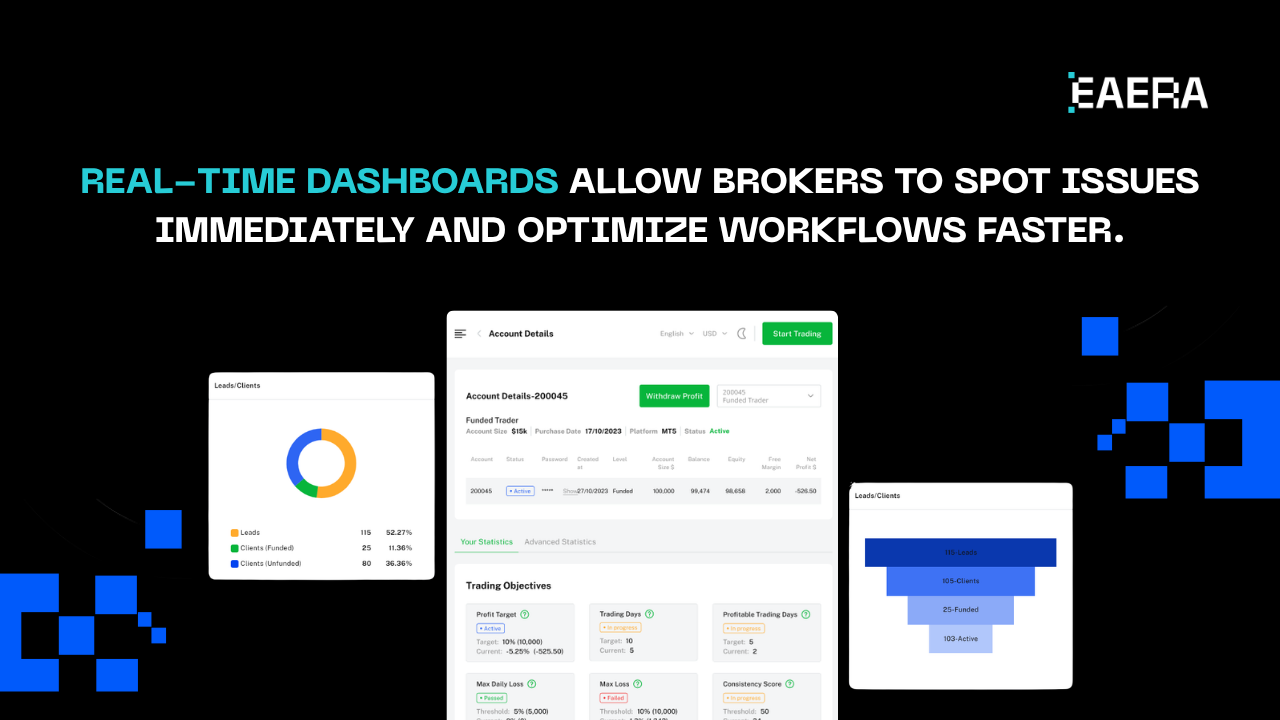
Real-time dashboards allow brokers to spot issues immediately and optimize workflows faster.
For example, firms can quickly detect:
- Slow onboarding stages
- Underperforming acquisition channels
- High drop-off points
- Inactive client segments
This visibility enables management to make faster operational decisions and more efficiently allocate resources across acquisition, support and retention teams.
Retention Analytics
Retention has become a bigger deal with the rising acquisition costs. CRM analytics allow brokers to identify churn risks early and proactively engage with traders before they go inactive.
The ability to combine operational data with behavioral insight provides brokers a significant competitive advantage.
Feature 3: Deep Integration with Trading and Back-Office Systems
Operational inefficiencies and inconsistent client experiences are caused by disconnected systems.
Thus, deep system integration is now a mandatory feature in the selection of a forex CRM provider.
Modern CRM platforms should integrate directly with:
- MT4 and MT5 platforms
- Wallet and payment systems
- KYC and compliance tools
- Support and ticketing systems
- Marketing and communication platforms
Why Integration Matters?
Without integration, brokers often face:
- Duplicate data entry
- Delayed updates
- Fragmented workflows
- Operational inconsistencies
- Increased compliance risks
Integrated systems ensure onboarding, trading activity, payments and support interactions are aligned across departments in real time.
This enhances operational efficiency and client experience.
Unified Operational Ecosystem
Best forex CRM provider platforms build a single operational ecosystem where all departments work in the same layer of the infrastructure.
This minimizes manual coordination between teams and enhances overall workflow efficiency.
Feature 4: Scalability and Multi-Region Support
Scalability is no longer optional for growing brokerage firms.
A CRM system that works for a small operation may not work as the volume of clients, the complexity of operations and the expansion into regions grows.
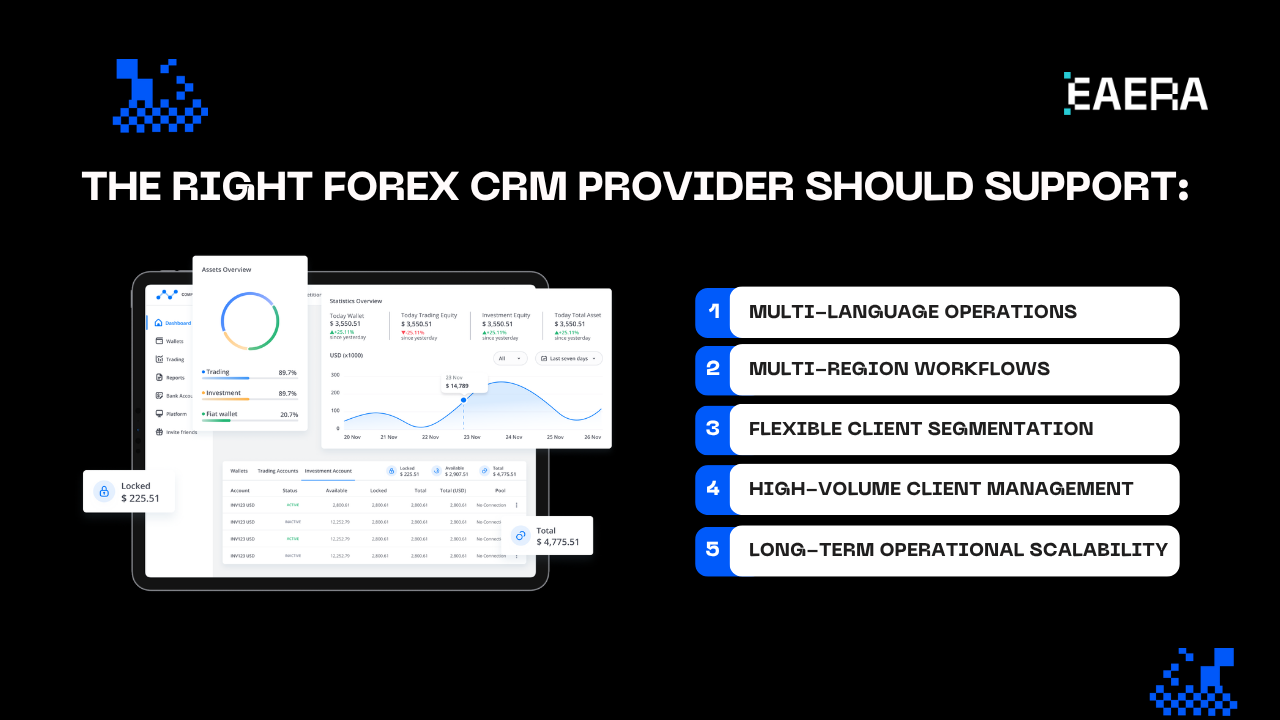
The right forex CRM provider should support:
- Multi-language operations
- Multi-region workflows
- Flexible client segmentation
- High-volume client management
- Long-term operational scalability
Multi-Region Operations
Global brokers often work in different regulatory environments, languages, and client behaviors. CRM systems must be able to manage this complexity without creating a fragmented operational experience.
Flexible workflow configuration is especially important for brokers operating in multiple regions with different onboarding and compliance requirements.
Long-Term Growth Support
Scalable CRM systems enable brokers to grow without a corresponding growth in operational expenses or internal complexity.
Scalable infrastructure solutions such as EAERA are showing how to enable multi-region brokerage operations while still being operationally efficient.
Forex CRM Provider Comparison: What Brokers Should Evaluate
Not all CRM vendors have the same operational capabilities. Most platforms provide simple lead management but don’t have the infrastructure to power modern brokerage operations.
| Area | Basic CRM Vendor | Advanced Forex CRM Provider |
| Automation | Partial workflows | End-to-end automation |
| Reporting | Manual or delayed | Real-time analytics |
| Integration | Limited connectivity | Full ecosystem integration |
| Scalability | Basic growth support | Multi-region infrastructure |
| Retention Tools | Generic campaigns | Behavior-driven automation |
| Compliance | Limited visibility | Audit-ready operational monitoring |
Operational support and flexibility in implementation should also be considered, especially for brokers who require custom workflows or regional variations, he said.
EAERA-type platforms offer scalable CRM ecosystems that combine operational automation, analytics and infrastructure for long-term broker growth.
By 2026, brokers will need more than a CRM tool in isolation. They need operational infrastructure that can support acquisition, onboarding, retention, compliance, and scalability simultaneously.