



Trading competition software enables brokers, prop firms and trading businesses to launch, manage and scale trading contests with less manual effort and more operational control. Trading competitions are not simple marketing campaigns anymore in 2026. They are engagement systems that help you with acquisition, activation, retention, trader development, and revenue growth.
Related articles:
- Trading Competition Software to Grow User Engagement
- Trading Contest Platform to Drive Revenue Growth in US
A good platform should automate registration of participants, contest rules, leaderboards, performance tracking, breach monitoring, prize calculation, and reporting. Without automation, competitions can very quickly become unmanageable, inconsistent, and hard to scale.
What Is Trading Competition Software?
Trading competition software is a platform for brokers; prop firms and fintech trading businesses can use to develop and run trading contests. These competitions can be based on profit percentage, trading volume, risk-adjusted performance, account growth, consistency, or challenge rules based on phases.
The software handles the operational logic behind the competition. The system automates the process from setup to reporting instead of manually checking.
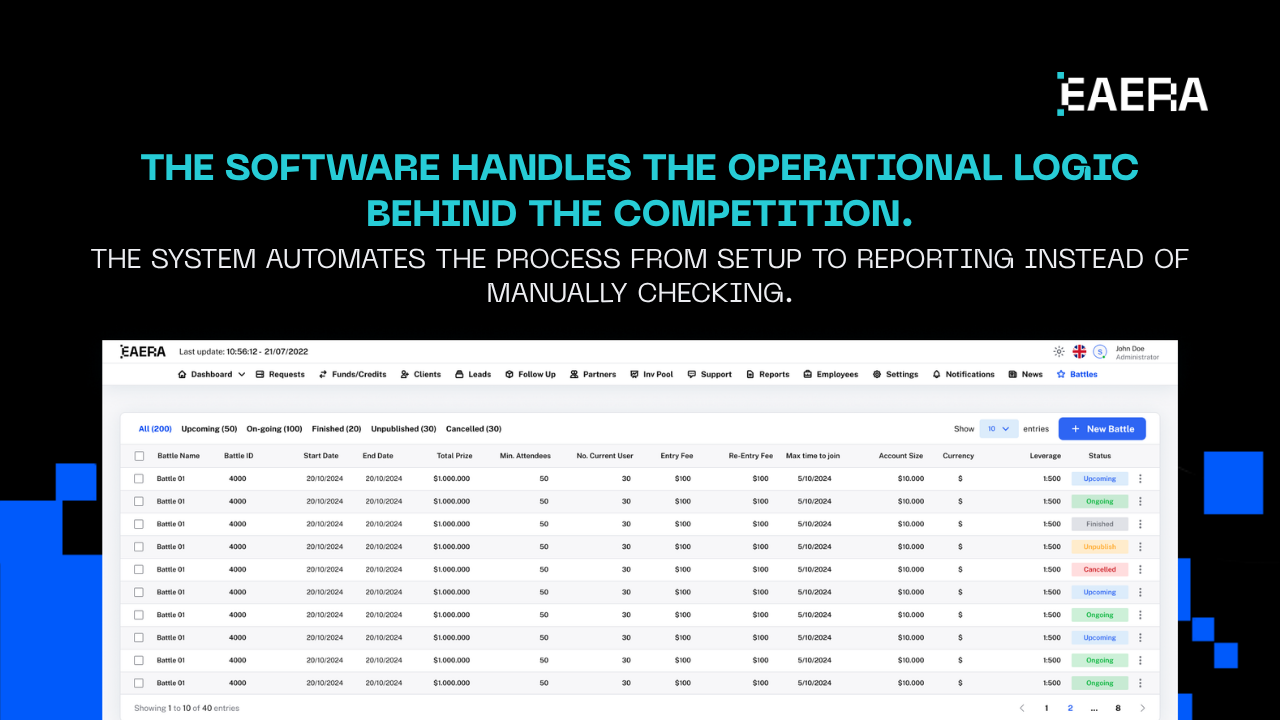
Core functions usually include:
- Contest setup and configuration
- Participant registration
- Real-time leaderboard
- Trading performance tracking
- Automated rule validation
- Account status monitoring
- Prize calculation
- Reporting and analytics
- CRM or client portal integration
Many business models can be based on trading competitions. Demo contests can be used by brokers to attract new users, live contests to generate trading activity, or referral-based contests to support partner growth. Prop firms can leverage competition mechanics to power challenge programs, trading rankings, or funded account paths.
Why Trading Competitions Matter More in 2026?
In 2026, trading platforms will compete on more than spreads, instruments, and account types. They compete on experience, engagement, and user loyalty.
Traders have many platform choices. Switching costs are low. If a platform doesn’t give users a clear reason to come back, activity drops off fast.
Trading competitions creates that reason.
They help businesses build urgency around:
- Registration
- First login
- First trade
- First deposit
- Demo account usage
- Live trading activity
- Referral participation
- Community engagement
Competitions create a performance loop, unlike static promotions. Traders enter, trade, check rankings, change strategy, and return to improve their position.
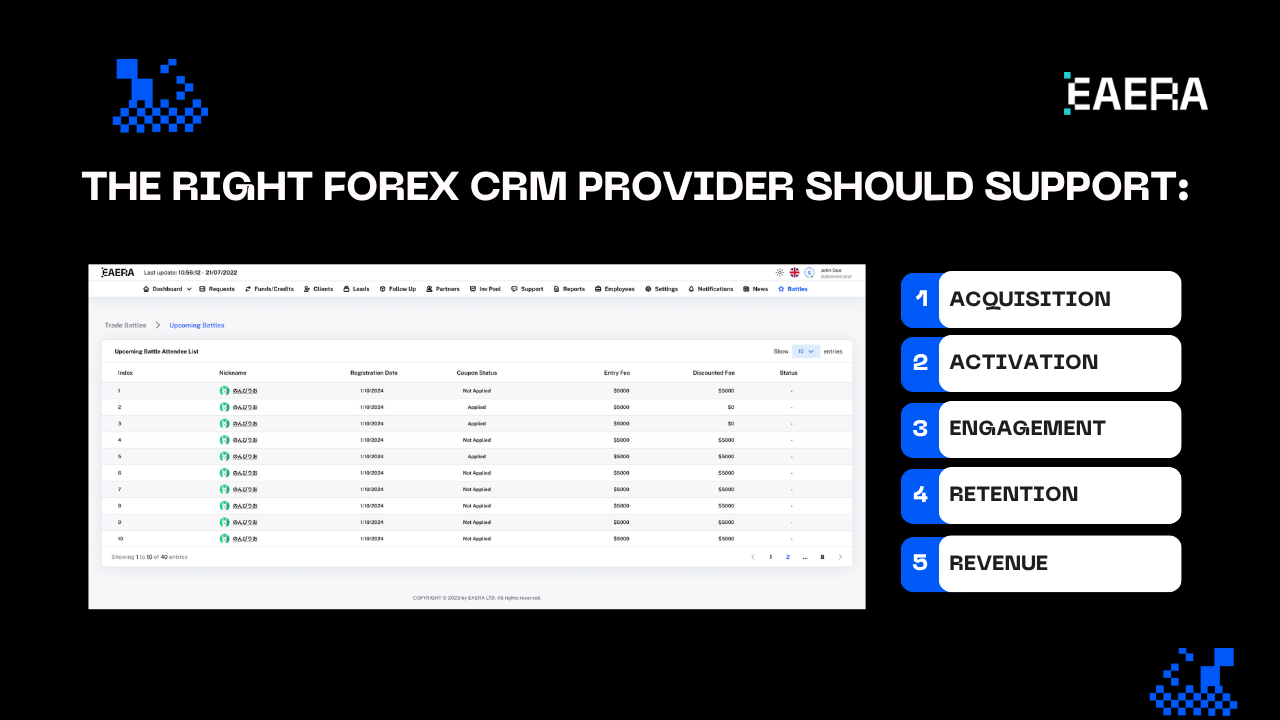
This creates value across the full lifecycle:
- Acquisition: contests give marketing teams a campaign hook
- Activation: users have a reason to start using the platform
- Engagement: leaderboards encourage repeat sessions
- Retention: recurring contests build platform habits
- Revenue: active traders can create stronger lifetime value
Automation Features Every Platform Should Include
A serious trading competition software platform must automate workflows that would otherwise slow down operations, create disputes, or limit scale.
-
Automated Contest Setup
Teams should be able to configure contest type, duration, eligible instruments, account types, rules of joining, ranking logic, prize tiers and disqualification conditions without heavy development work.
-
Automated Participant Eligibility
The system must check if a trader is eligible to join based on some business rules.
Without automated checks, teams could approve the wrong participants, create unfair competitive conditions, or increase compliance risk.
-
Real-Time Leaderboards
Leaderboards are the main engagement layer of a trading competition. Traders need to know where they stand, how their performance is changing, and what they need to work on.
A good leaderboard should update automatically from live or near-real-time trading data. Rank, score, profit %, trading volume, drawdown or custom contest metrics may be used.
-
Automated Rule Enforcement
Rules should not be subject to manual review. The system shall identify violations such as excessive drawdowns, prohibited instruments, duplicate accounts, abnormal trading behavior, or failure to meet minimum requirements.
This protects fairness. Every participant should be evaluated using the same logic.
-
Automated Prize Calculation
Manual prize calculation results in delays and disputes. The platform will automatically assign winners, prize categories, payout amounts, and reward status.
This also helps finance and operations teams reduce errors.
-
Automated Reporting
The best trading competition software will display business impact, not just contest activity.
Automation reduces manual work and improves fairness, transparency, and operational control.
How Trading Competition Software Helps Brokers Scale?
Manual contests can work for small campaigns. They don’t work when a broker must deal with thousands of participants, multiple account types, regional eligibility rules, and recurring contest calendars.
Trading competition software helps brokers scale by standardizing contest operations.
Key scalability benefits include:
- Faster campaign launches
- Reusable contest templates
- Consistent rule enforcement
- Real-time ranking updates
- Lower support workload
- Fewer manual payout errors
- Better partner campaign tracking
- Easier multi-region contest management
Scaling is not just about getting more users. It is about control as complexity increases.
EAERA provides brokers with trading competition technology that enables businesses to conduct customizable events, track performance, manage leaderboards, and support scalable trader engagement.
What to Look for Before Choosing a Platform?
When selecting trading competition software, the design of the leaderboards should not be a factor. The software must support marketing, operations, compliance, finance, support, and management reporting.
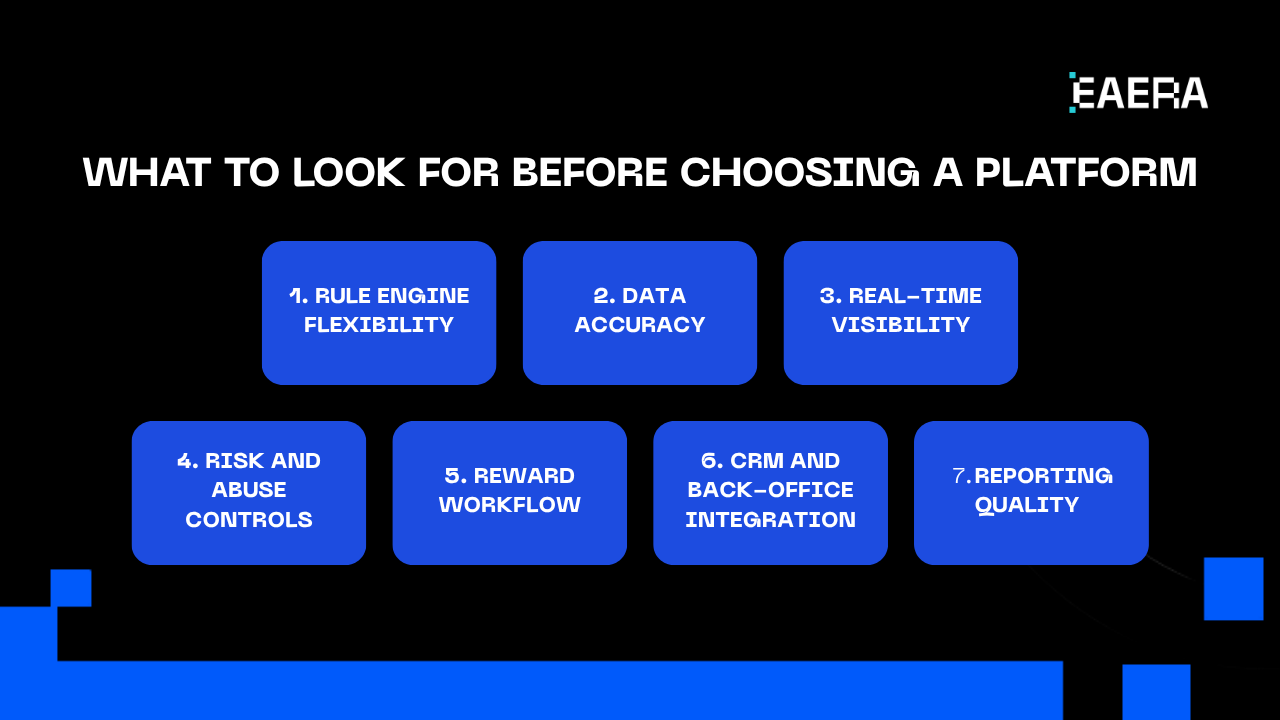
Before buying, brokers should evaluate the platform across seven areas.
-
Rule Engine Flexibility
Are there different contest models, ranking calculations, account types, risk limits, and eligibility criteria?
The business can create new formats without rebuilding the system with a flexible rule engine.
-
Data Accuracy
Is the system reliable in terms of syncing trading accounts, client records, deposit status, KYC status, and partner attribution?
If the data is wrong, the leaderboard is wrong. If the leaderboard is wrong, trust breaks.
-
Real-Time Visibility
Can traders and internal teams instantly see rankings, status changes, rule breaches and performance updates?
Real-time visibility keeps the competition engaging and reduces support questions.
-
Risk and Abuse Controls
The platform should detect duplicate accounts, unusual behavior, rule violations, and ineligible trading activities.
This is essential for protecting both the broker and honest participants.
-
Reward Workflow
Can the system automate the prize calculation, payout status, approval workflow and winner verification?
A clean reward workflow improves trust and reduces operational pressure.
-
CRM and Back-Office Integration
Contest data should be tied to client profiles, sales follow-up, retention campaigns, partner reports, and finance workflows.
That’s where the platform has a commercial benefit. The broker can use contest behavior to identify high value traders, reactivation opportunities, and partner driven growth.
-
Reporting Quality
The right trading competition software should help businesses answer not only “who won?” but also “did this contest drive acquisition, activation, retention, and revenue?”
How to Build a Winning Trading Competition Strategy in 2026?
The best results for a trading competition software platform are achieved when the contest has a clear business goal. Brokers should not start competitions just because they seem exciting. Each campaign should be centered on a measurable growth goal.
The benefit of demo-contests for acquisition is that they reduce the barrier to entry. Live contests mean better active client engagement. Volume contests drive trading activity; risk-adjusted contests result in more disciplined participation. Partner-led growth can be helped by referral contests.