



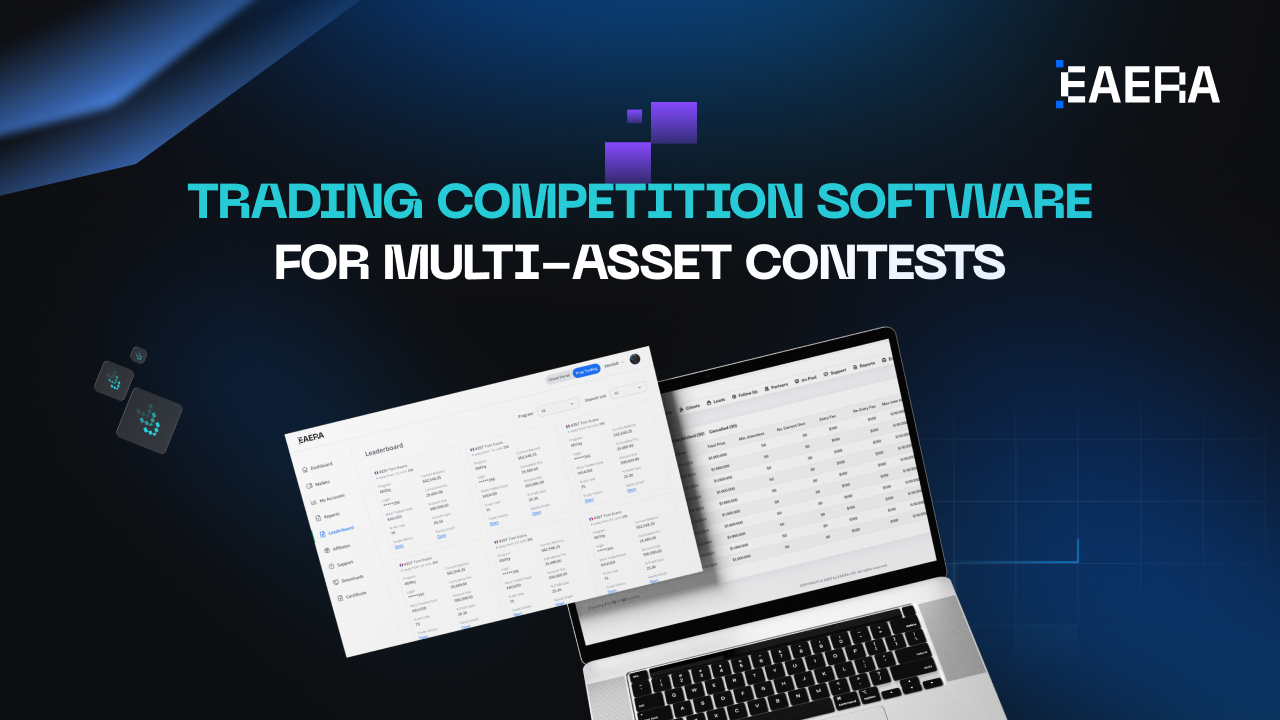
Multi-asset competitions can be run by brokers with the help of trading competition software that automates contest setup, eligible instruments, rules for participants, leaderboard ranking, risk controls, prize workflows and reporting performance. Contests can increase engagement for brokers offering forex, metals, indices, commodities, shares, or crypto CFDs only when rules are clear, and results are fair.
Related articles:
- Trading Contest Platform to Drive Revenue Growth in US
- Trading Contest Platform: 5 Must-Haves Before Going Live
Explore how multi-asset trading competitions function, the difficulties brokers encounter, and the software capabilities required to execute scalable contests.
Why Multi-Asset Contests Are Harder Than Single-Market Competitions
Single-market contests are easier to run as all traders trade under similar conditions. For instance, a forex-only competition will normally feature less variation in market hours, contract specifications, and asset behavior. Multi-asset contests are more sophisticated as traders can compete in forex, gold, oil, indices, shares and crypto CFDs all at once.
Different asset classes behave differently. Gold can be very volatile on macro news. Indices may be active during certain market sessions. Oil can be very sensitive to inventory data and geo-political events. Crypto CFDs might behave differently on weekends or overnight, depending on how the broker has set up their products. Shares can move after hours and corporate events.
Trading competition software should help the brokers to cope with these differences with clear configuration, fair rules, and automated calculations.
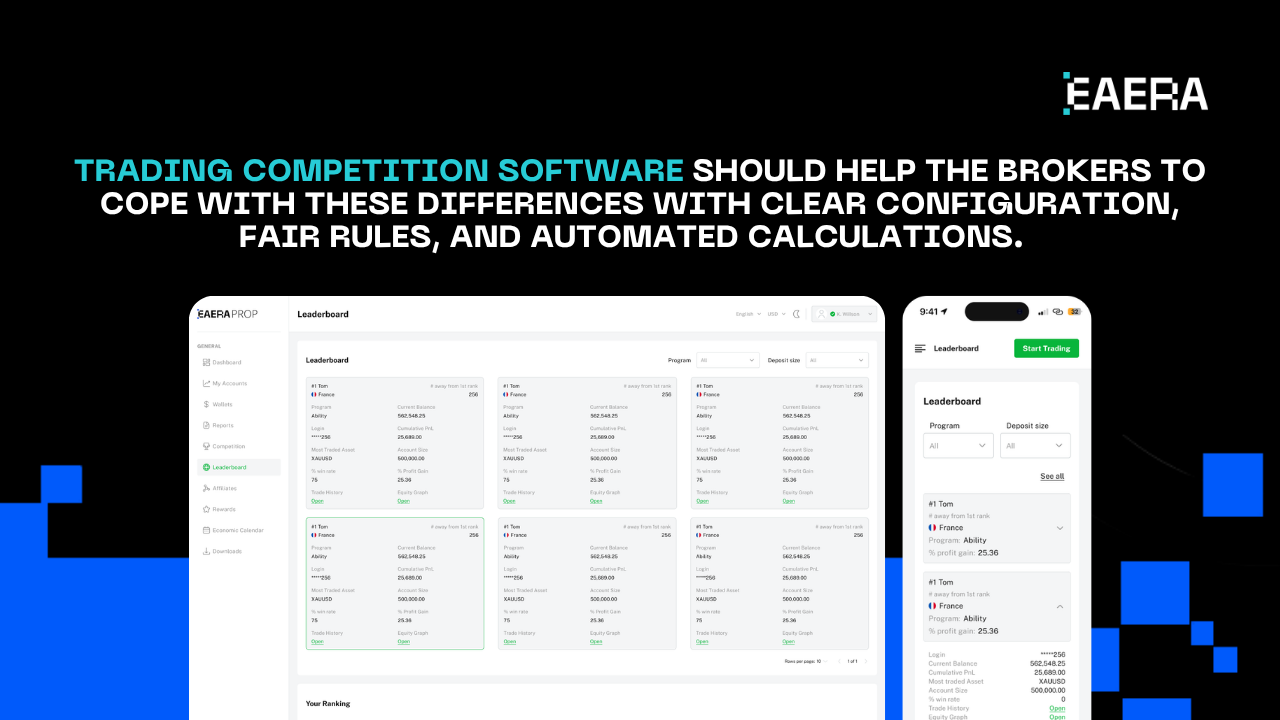
The aim is not just to add more instruments. The aim is to make competitive multi-asset trading fair, transparent, and controllable.
Contest Setup: Rules, Eligible Assets, and Participant Criteria
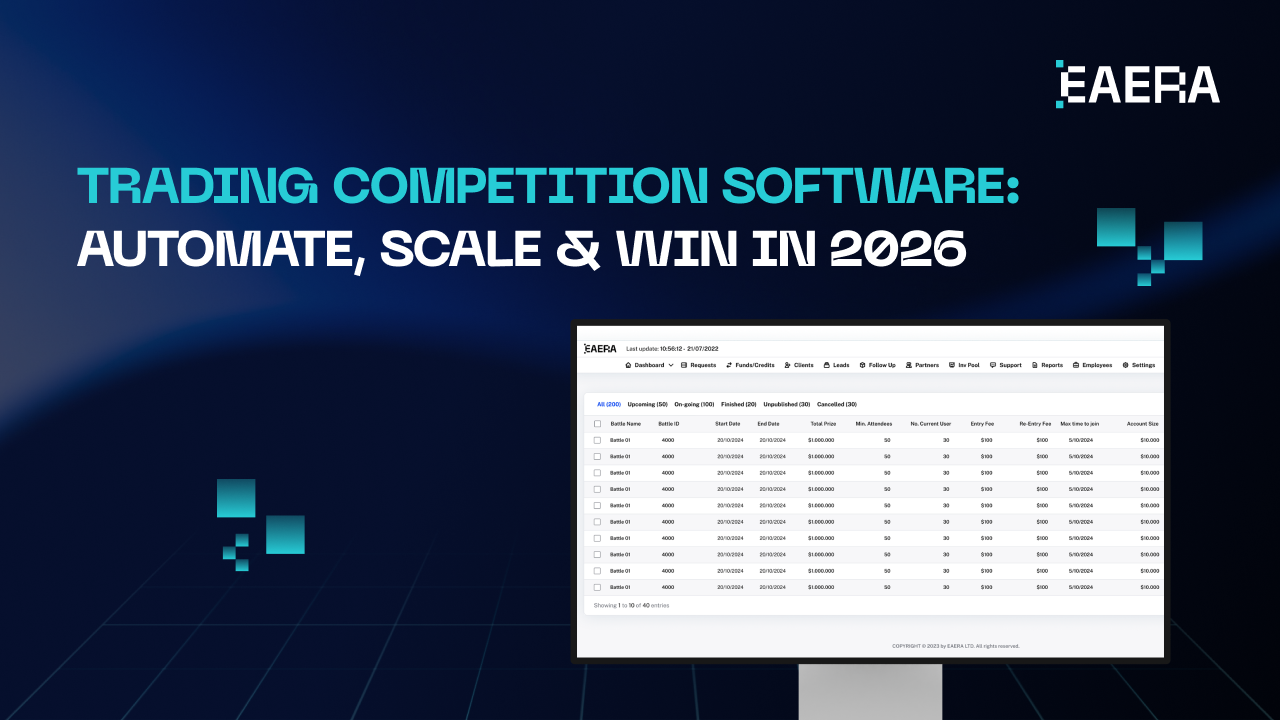
The setup is the spine of a multi-asset contest. Brokers must specify the eligibility criteria for participants, the types of accounts eligible to participate, the permissible trading instruments, and the contest’s start and end date.
A strong trading competition software should allow brokers to configure:
- Contest name and description
- Registration period
- Start date and end date
- Account type
- Initial balance or account size
- Eligible asset classes
- Minimum trade requirement
- Region or client group eligibility
- Demo or live account participation
This is important because multi-asset contests might be unfair if traders compete under different circumstances. If some traders are trading higher risk symbols and some are trading lower volatility instruments, the ranking may have nothing to do with skill or strategy.
Also important is eligibility. Brokers may want to run contests for new clients, active traders, certain regions, VIP clients, demo users, or live account holders. Clear eligibility rules mean fewer questions about support and fewer disputes.
The contest set up should also provide visibility for the participants. Prior to the start of the contest, traders should familiarize themselves with the allowed instruments, account conditions, ranking method, risk limits, prize structure, and disqualification rules.
A good setup means few operational questions before the contest begins, and no arguments after results are printed.

Fair Ranking Logic for Multi-Asset Performance
The most important thing in any trading contest is to have a fair ranking. In multi-asset contests, raw profit can be inadequate on its own, as different assets have different risk levels and trading behavior.
Trading competition software should support ranking methods such as:
- Profit gain
- Percentage return
- Equity growth
- Balance growth
- Risk-adjusted return
- Consistency score
- Drawdown-adjusted performance
- Minimum trade count
- Minimum trading days
- Rule-compliant performance
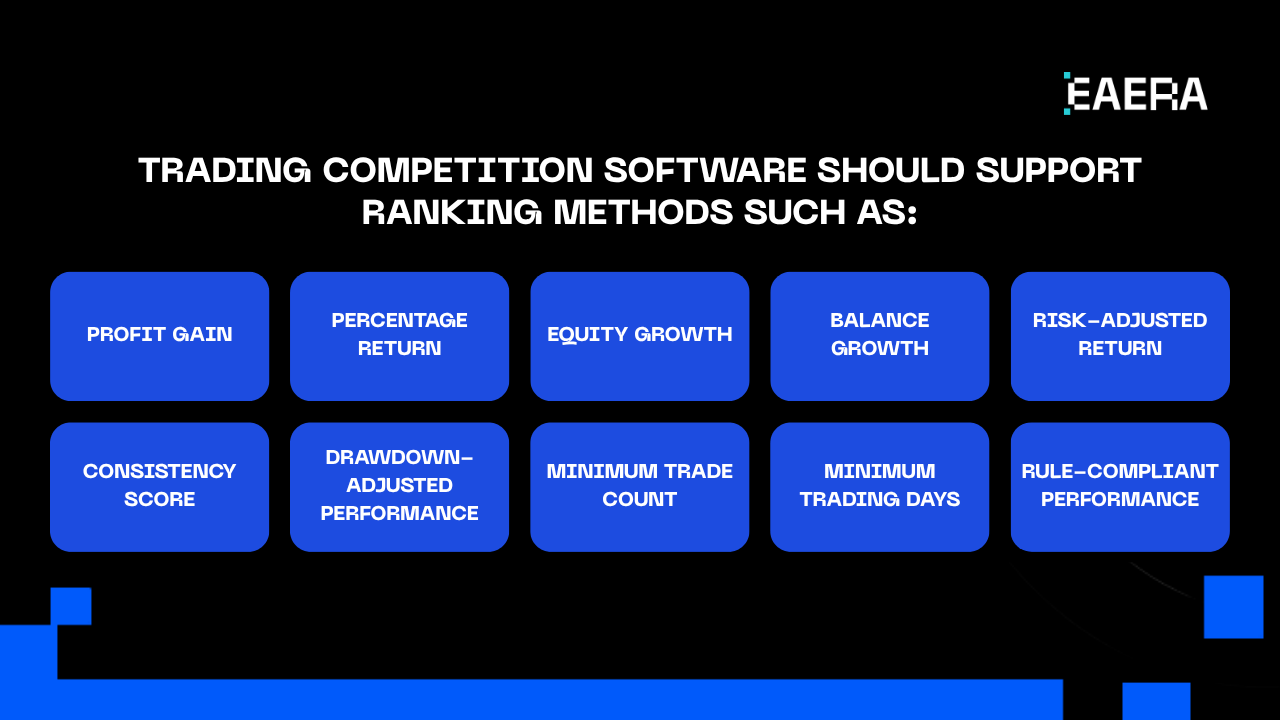
A trader who gets a great return from one high risk trade might not be the same quality as a trader who grows steadily over the contest period. Brokers may want to reward performance and consistency, not just absolute profit.
For example, a participant who trades one volatile asset and wins a large move may rank first by profit. But another participant may perform more consistently over several trading days with controlled drawdowns. If the contest is designed to reward disciplined trading, the software should support ranking logic that supports that goal.
The best trading competition software should be able to process results with clean data, apply rules automatically, and disregard invalid trades or disqualified accounts. The leaderboard should be sufficiently transparent so that participants understand how ranks are computed.
Fair ranking keeps the contest’s reputation intact and allows brokers to build trust among traders over the long term.
Risk Controls and Rule Enforcement During the Contest
Trading competition should promote engagement, not reckless behavior. Brokers require risk controls that preserve the structure of the contest and prevent rule abuse.
A strong system should support:
- Maximum drawdown
- Daily drawdown
- Minimum equity requirement
- Maximum open positions
- Minimum trading duration
- Prohibited trading styles, if applicable
- Symbol restrictions
- Breach detection
- Auto-disqualification
- Manual review status
Trading competition software should monitor rule breaches automatically instead of relying on manual checks after the contest ends.
This is especially the case in multi-asset contests, as risk can be dramatically different by symbol. “The participant trading in highly volatile instruments may be able to gain quickly but also exceed the drawdown limits. Another participant may use banned symbols or have open positions which are against contest rules. Without automated monitoring, admin teams may only discover issues after the leaderboard have already been viewed by participants.
Depending on the contest policy, the system should be able to flag the account, hide the participant from the leaderboard, mark the result for manual review, or disqualify the participant.
Automatic rule enforcement lessens admin workload and levels in the playing field for all participants. It also helps brokers to avoid disputes by showing why a participant was flagged or removed from ranking.
Real-Time Leaderboards, Participant Experience, and Engagement
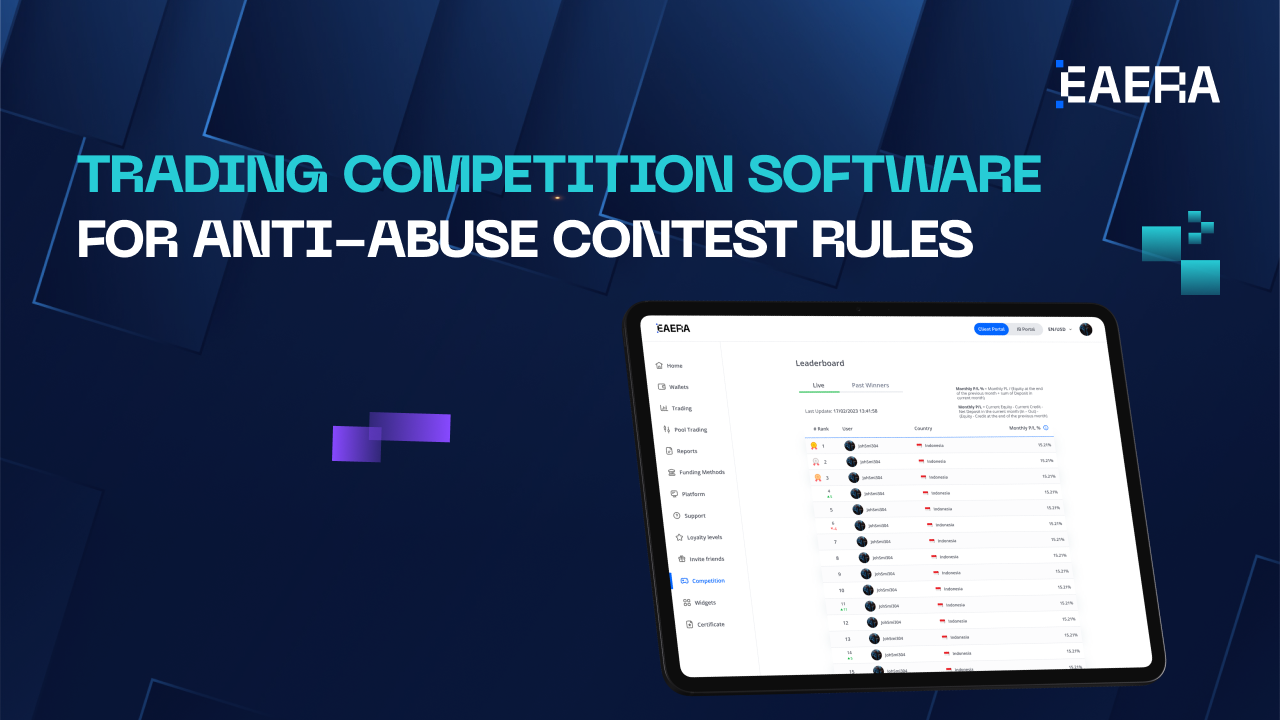
A contest only works if you can follow your progress. Visibility, motivation, and momentum can be generated by leaderboards in real time or near real time.
Leaderboards let participants see where they are and what they need to improve. They also help brokers produce marketing material during the contest, like weekly rankings, top performers, milestone updates, and campaign reminders.
Participant experiences need to be transparent and simple. Traders should not need contact support to understand their rank, performance, contest status, or eligibility. If the system shows rule breaches, it should show them in a way that reduces confusion.
However, leaderboard design needs to be done carefully. Brokers should not display confusing metrics, delayed calculations, or incomplete rankings leading to disputes. If rankings are based on return, consistency of score or drawdown-adjusted performance, the rationale should be visible to participants.
A great participant experience transforms a trading contest from a back-office campaign to an active engagement journey.

Automation, Reporting, and Broker Growth Value
The value of trading competition software is not only in conducting the contest. It lets brokers measure engagement, acquisition, activation, retention, and trading behavior.
The system should automate:
- Contest registration
- Account creation or account assignment
- Eligibility checks
- Leaderboard updates
- Rule breach alerts
- Participant notifications
- Prize approval
- Result export
Reporting should help brokers analyze:
- Active participants
- Trading volume
- Asset class usage
- Most traded symbols
- Deposit or funding behavior
- New client activation
- Demo-to-live conversion
- Retention after contest
- Campaign ROI
- Rule breach rate
These insights tell brokers if the contest is just creating short-term activity or real business value. For example, there could be many contest registrations, but little trading activity. Another battle might have fewer participants, but more activation and retention. Reporting allows brokers to benchmark their campaigns and to improve the design of future contests.
EAERA helps brokers grow with connected CRM, client portal, back office, trading competition tools, reporting, alerts and workflow automation.
The right trading competition software will help brokers turn contests into measurable growth campaigns, not one-off promotional events.