




The best forex CRM provides brokers with the ability to pinpoint and address trader drop-off points at any stage of the client lifecycle, from lead capture to registration, KYC, funding, first trade and retention. Many brokers lose traders not because demand is weak, but because the next step is not clear, not immediate or not connected to team action.
Related articles:
This article looks at five common drop-off points and how the best forex CRM can assist brokers in reducing friction, increasing visibility and getting more clients trading actively.
Why Trader Drop-Off Happens in Broker Operations?
Usually, a trader drop-off occurs when a client has shown an interest, but the broker does not take the appropriate next step. They often failures in the workflow. The client may be interested, but the broker internal process may not be connected enough to move the client forward.
A best forex CRM should give brokers a clear view of every step in the lifecycle:
- Lead captured
- Registered client
- KYC pending
- KYC approved
- Deposit attempted
- Deposit completed
- Trading account created
- First trade completed
- Active trader
- Dormant or retained client
The best forex CRM addresses trader drop-off by linking client lifecycle data with automated reminders, team tasks, payment signals, trading activity and retention workflows.
Before brokers can fix drop-off, they need to know exactly where traders leave the journey.
Drop-Off Point 1: Lead Captured but No Fast Follow-Up
The first drop-off point occurs when a lead shows interest but does not receive rapid, relevant follow-up. Leads can fill out a form, click on a campaign, request a demo, contact support, or start registration. If no sales owner follows up quickly, the lead could go cold.
For brokers spending money on paid campaigns, affiliates, content, events, or referral channels, this is a direct loss. The broker has created interest, but the lead is not progressing to the next stage.
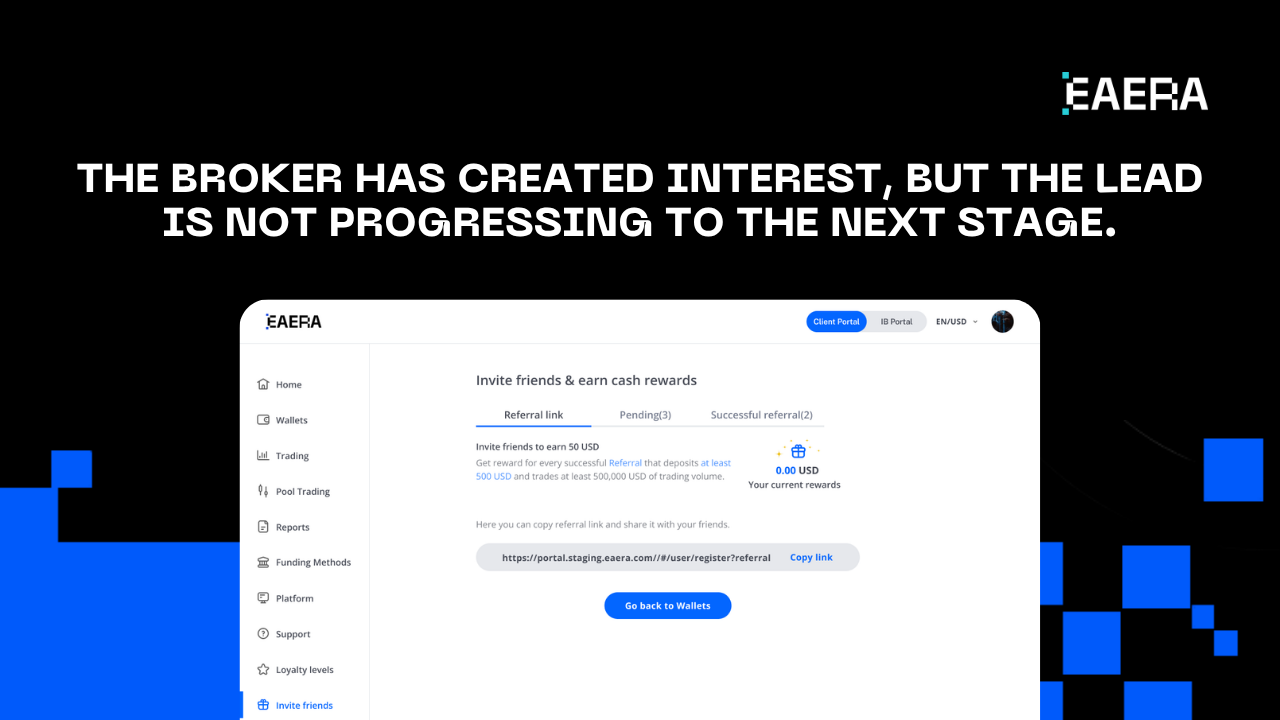
A best forex CRM should have lead source tracking, auto-assignment, sales owner visibility, follow-up reminders, overdue task alerts, communication history, lead status, and dashboards for managers.
Context drives conversion; speed matters. It’s important that you personalize your follow-up based on the lead’s background. A new signup or paid campaign lead is a new introduction to the platform, while a returning client needs a focused reactivation strategy. Similarly, an IB referral must be managed partner-specific so that relationships are maintained.
Smart automation drives the entire workflow. The CRM should instantly route high-intent campaign leads, flag overdue follow-ups directly to managers, and automatically progress a lead’s lifecycle stage the moment registration begins.
Drop-Off Point 2: Registration Started but KYC Not Completed
Many traders register but never complete KYC. This can happen because of unclear instructions, hard to upload documents, vague rejection reasons, or the client doesn’t know what to do next.
The traders already know what they want. They have now moved beyond awareness and are in the broker’s onboarding flow. If they leave without completing KYC, the broker loses a potential verified client even before funding can start.
Best forex CRM should support brokers with managing:
- Required profile fields
- Missing document reminders
- KYC provider results
- Review queues
- Approval or rejection reasons
- Manual review notes
- Client notification history
- Risk or verification status
The best forex CRM should be able to show the onboarding status to the sales, support, compliance, and back-office teams.
Efficiency requires absolute clarity all the way. The system must prompt the clients for missing files automatically, update the teams on active reviews, and provide support with a clear rejection reason to guide the user. If a manual check gets stuck, managers need the visibility to see the bottleneck immediately.
This visibility reduces repeated internal questions. The client is approved and sales does not have to ask Compliance. The agent doesn’t need to wait for confirmation from back-office to respond to the client. Managers can see how many clients are stuck in pending, rejected, or incomplete stages.
Reducing KYC drop-off means more registered clients moving through to approval and funding.

Drop-Off Point 3: KYC Approved but No Deposit
The broker still must lead the verified client to funding, since the client has passed one important stage. If the CRM does not trigger the next step, the client may be approved but inactive.
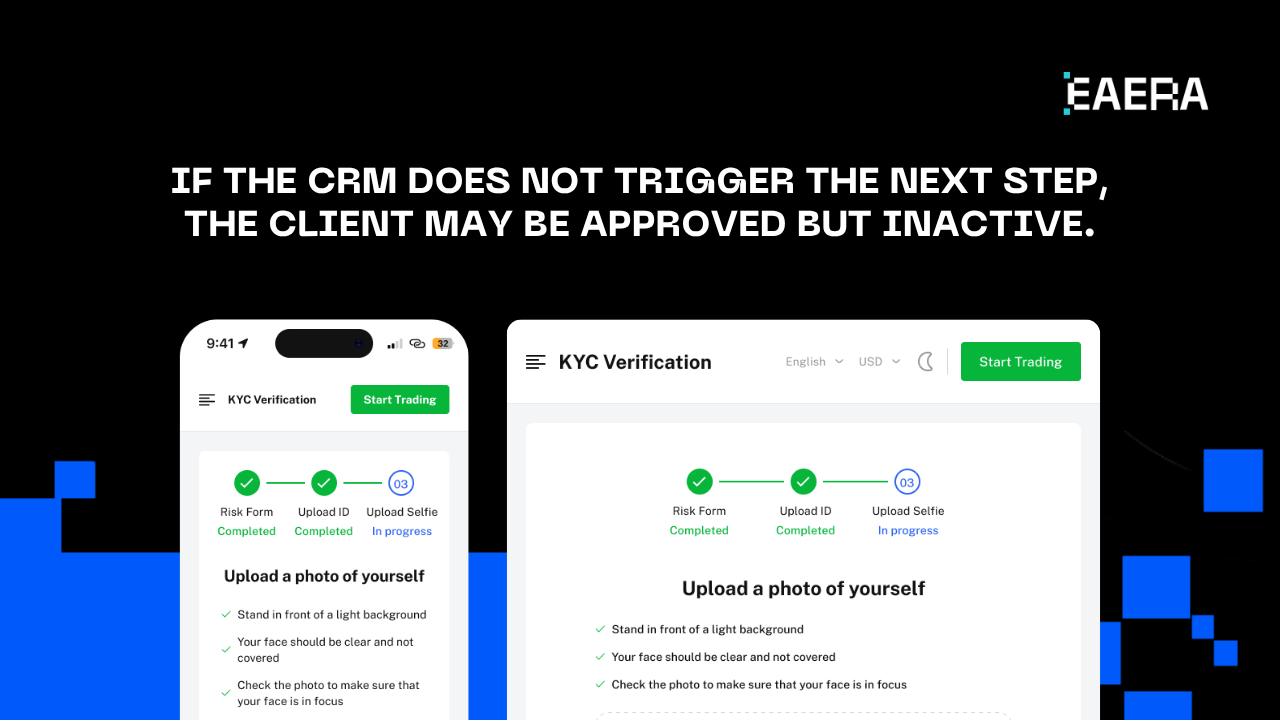
This is a normal clandestine drop point. The broker considers the client to have successfully completed the onboarding process. But from the client’s point of view, the next step may not be obvious. They might not know which payment method to choose, whether their wallet is ready, how to deposit the funds, or whether there are limits in place.
Best forex CRM needs to connect KYC approval to funding prompts, sales or support tasks, deposit method visibility, wallet access, regional payment rules, failed payment tracking, client communication history, and funding conversion reports.
A KYC-approved client may need different support depending on region, payment method, account type, or previous behavior. A generic message may not be enough. For example, a client using bank wire may need different guidance from a client using local payment methods or crypto funding.
Reducing deposit drop-off helps brokers turn verified clients into funded clients.
Related articles: 5 Best Forex CRM Features for High-Volume Broker Teams
Drop-Off Point 4: Funded Account but No First Trade
A KYC-approved client might need different support depending on the region, payment method, type of account, or previous behavior. A generic message may not suffice. For example, a client using bank wire will require different instructions than a client using local payment methods or crypto funding.
Funded clients have high intent but are not active traders yet. Many brokers lose momentum between the deposit and the first trade, because wallets, trading accounts, and activation workflows are decoupled.
But the client may have deposited funds and not traded. The money can stay in the wallet and not be moved over to the trading account. Failed to create a trading account. The account is locked or restricted. The client may need a bit of guidance before making the first trade.
Connected CRM gives brokers the ability to see activation gaps before the client loses interest.
This stage is critical because each action shows a different level of intent:
- Registration shows interest.
- KYC approval shows readiness.
- The deposit shows financial intent.
- First trade shows real platform activation.
Drop-Off Point 5: Active Trader Becomes Dormant
The last drop-off point is after the client has already traded. This is where a lot of brokers over-rely on generic reactivation campaigns, instead of behavior-based retention strategies.
Traders stopped trading for a reason. Lack of activity may be due to declining volume, failed deposits, stuck withdrawals, an expiring document, or an unresolved restriction. If data is siloed, your retention team will know that a trader stopped, but not why, and so they won’t be able to fix it.
Retention must be contextualized as an account manager might need to follow up with a high-value trader whose volume is declining. A customer with multiple failed deposits may require payment assistance. A trader should not receive a generic promotion before the issue is resolved if there is an open support ticket.
EAERA can help brokers reduce trader drop off by providing visibility across the lifecycle of a trader from onboarding, KYC, deposits, trading activation, support and retention.
The best forex CRM helps brokers detect where traders leave the journey and trigger the right action at the right time.