




Revenue teams in brokerage businesses require more than sales notes and lead lists. They need a connected operating system to help them manage acquisition, follow-up, onboarding, KYC, funding, trading activation, retention, and reporting. Forex CRM software allows revenue teams to work from a single source of client data, prioritize high-intent opportunities, close conversion gaps, and measure performance across the entire client lifecycle.
Related articles:
- Forex CRM Software: 7 Key Characteristics That Deliver Results
- Forex CRM Software for Regulated Brokers
Define Revenue Ownership Across the Client Lifecycle
Revenue teams frequently overlook opportunities when ownership changes between marketing, sales, onboarding, funding, and retention. Marketing gets lead, sales contacts it, KYC holds it, deposit holds it and then it is ignored after first trade.
A professional revenue model should define ownership across every stage of the client lifecycle:
- Lead capture
- Lead qualification
- Sales follow-up
- Registration
- KYC completion
- Deposit conversion
- Trading account funding
- First trade
- Repeat activity
- Retention and reactivation
The forex CRM software should allow brokers to assign ownership at each stage and make the next action visible to the responsible team. This is important because revenue growth is not created by one department alone. Marketing may generate demand, sales may convert interest, onboarding may complete verification, finance may support funding, and retention may protect long-term value.
When ownership is unclear, prospects slow down between stages. A verified client may not receive deposit guidance. A funded client may not receive activation support. An inactive trader may not be assigned to a retention workflow.
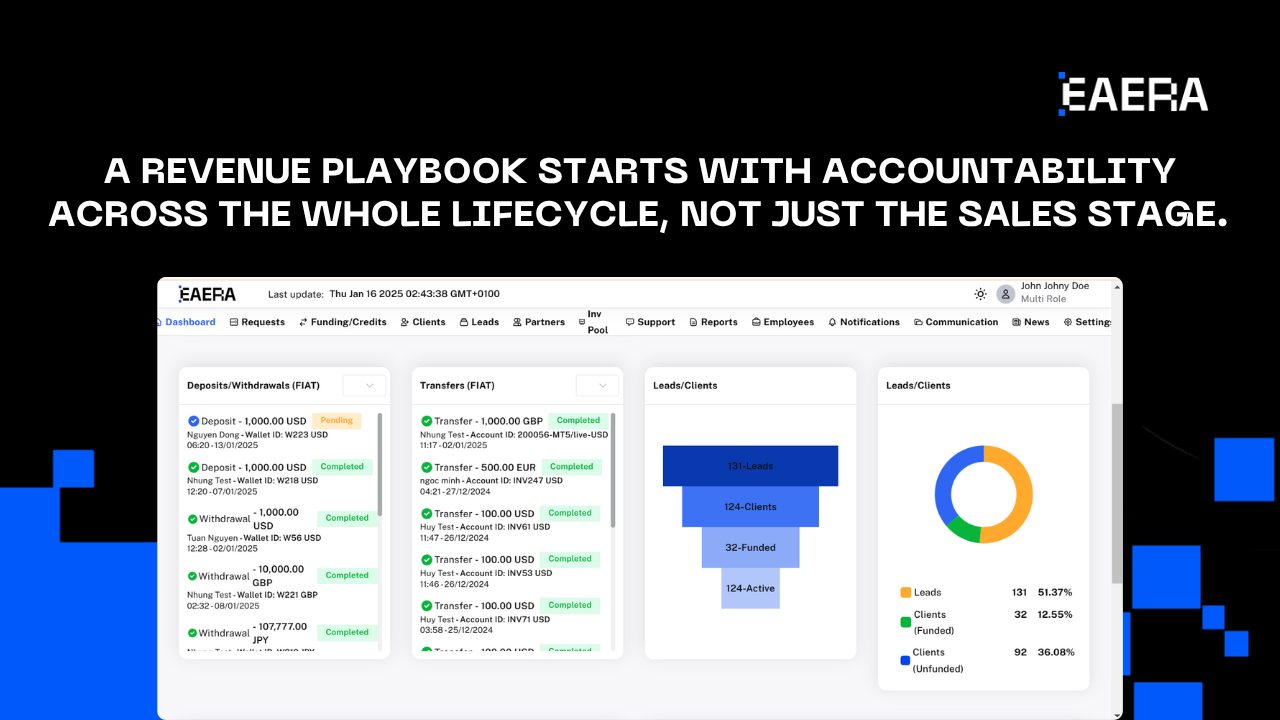
A revenue playbook starts with accountability across the whole lifecycle, not just the sales stage.
Prioritize Leads by Quality, Source, and Intent
Lead volume alone doesn’t drive revenue growth. A campaign may generate many contacts, but few proven clients. Another source may produce fewer leads, but better deposit and trading activation rates. It’s not just about the number of leads generated for broker revenue teams. The more important thing is which leads are most likely to make it all the way through the journey.
Forex CRM software should allow revenue teams to evaluate leads by source, campaign, landing page, IB or referral attribution, region, language, demo request status, registration activity, communication response, KYC progress, deposit intent, and past source quality.
Lead scoring should be based on business progression, not just interest. A lead that registers with us or fills in profile details or starts KYC has a stronger intent than a lead who just fills in a form. A lead that lands on the deposit page or asks about payment options may require a faster follow-up than a general inquiry.
This helps revenue teams spend their time and budget more smartly. Sales managers can focus on high-intent leads. Marketing teams can measure channels by verified, funded, and active clients instead of raw lead volume. Broker owners can identify sources of long-term value.
Prioritizing leads helps teams spend their time on areas with the most potential for conversion.

Turn Sales Follow-Up into a Structured Workflow
Sales performance becomes more difficult to manage when follow-up is based on individual habits. Revenue teams need structured workflows that show response time, communication history, and next actions.
The forex CRM software should provide automatic lead assignment, track first response, create follow-up tasks, alert overdue tasks, provide communication history, notes of calls and messages, track sales stage, provide lead re-assignment rules, provide manager visibility and provide conversion reporting by owner.
A structured workflow helps teams avoid duplicate outreach, missed callbacks and inconsistent sales handling. It also allows managers to see sales discipline and bottlenecks more clearly. In case a lead is assigned but not contacted, the system should show the delay. Managers should be able to see the load if a salesperson has too many overdue tasks. If one source has strong registration but weak KYC completion, sales and onboarding teams should investigate together.
A high-intent demo request should trigger a faster response than a low-intent newsletter lead. If the assigned salesperson does not follow up within the expected window, the system should flag the delay before the prospect goes cold.
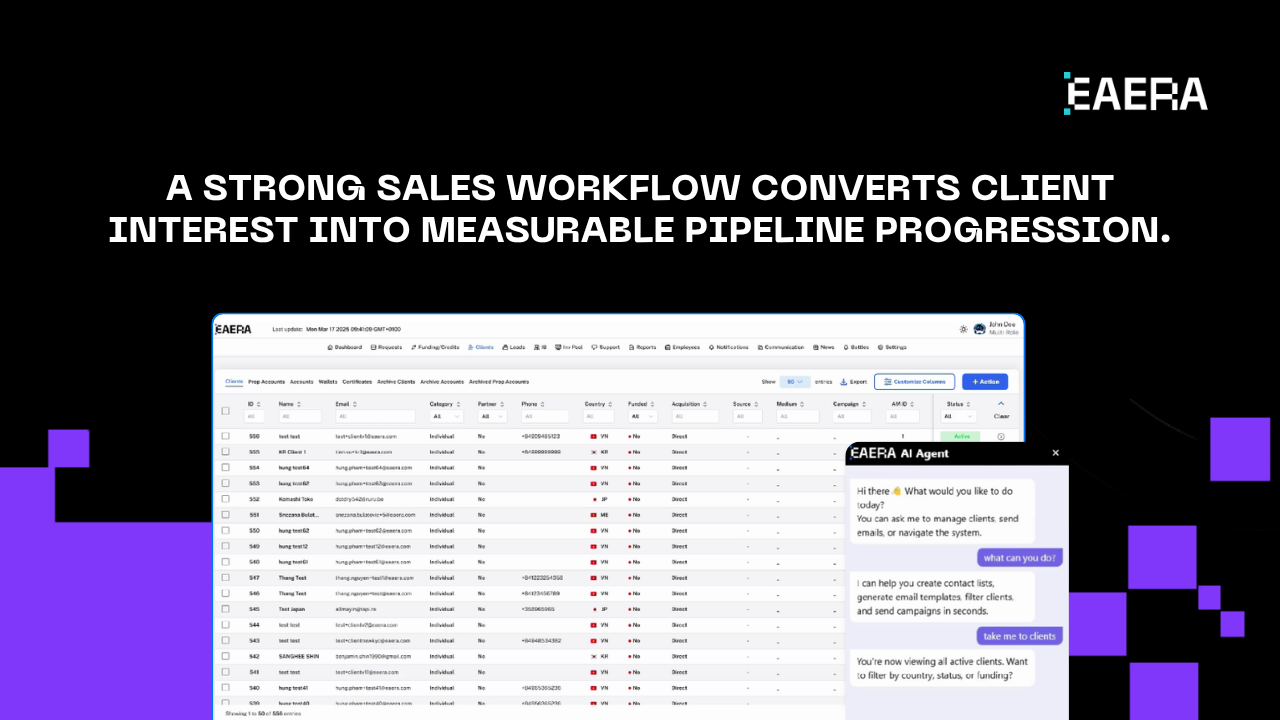
A strong sales workflow converts client interest into measurable pipeline progression.
Build Retention and Reactivation into the Revenue Playbook
Revenue continues after first deposit or first trade. Brokers must keep active traders trading; spot falling engagement and revive dormant clients before they become worthless. So, the revenue playbook has to cover not only acquisition and sales conversion, but also post-activation workflows.
Forex CRM software should assist teams in monitoring retention indicators such as first trade date, last trade date, active trading days, trading frequency, volume trend, deposit and withdrawal behavior, support issues, campaign response, dormant status, reactivation result.
These signals help teams act with more timing and relevance. Activation guidance may be needed for a depositor who never trades. A trader that trades once they stop, might need education or account manager for follow up. A previously active trader with declining volume may need to retention attention. A client with an unresolved support issue should not receive generic promotional messages before the problem is handled.
Retention workflows should be based on behavior and client context, not broad campaigns alone. Revenue teams that understand client behavior can prioritize the right users, personalize follow-up, and protect long-term value.
The strongest revenue teams manage the full relationship, not only the first conversion.
Forex CRM Software Checklist for Revenue Teams
Revenue teams should evaluate forex CRM software by how well it supports full-funnel visibility, team ownership, conversion tracking, automation, and reporting.
Key capabilities to assess include:
- Unified lead and client profile
- Lead source tracking
- Campaign and IB attribution
- Automatic assignment rules
- Sales follow-up tasks
- Communication history
- Lifecycle status tracking
- KYC status visibility
- Deposit attempt tracking
- Failed payment alerts
- Wallet and trading account visibility
- First-trade tracking
- Retention and dormancy alerts
- Revenue dashboards
- Team performance reporting
- Role-based permissions
- Audit trails
- Workflow automation
EAERA supports broker operations through connected CRM, client portal, back office, funding, trading account workflows, affiliate management, reporting, alerts, and automation.

For broker revenue teams, EAERA can support a connected environment across lead management, sales ownership, onboarding, KYC, funding, trading activation, retention, and performance reporting.
| Revenue Stage | CRM Capability Needed |
| Lead generation | Source tracking and attribution |
| Qualification | Intent signals and prioritization |
| Sales follow-up | Tasks, ownership, and communication history |
| KYC | Status visibility and review outcomes |
| Funding | Deposit tracking and failed payment alerts |
| Activation | Trading account readiness and first-trade tracking |
| Retention | Activity signals and dormant trader workflows |
| Management | Revenue dashboards and team performance reporting |
The right forex CRM software helps revenue teams manage growth as a connected lifecycle, not a disconnected set of sales activities.