



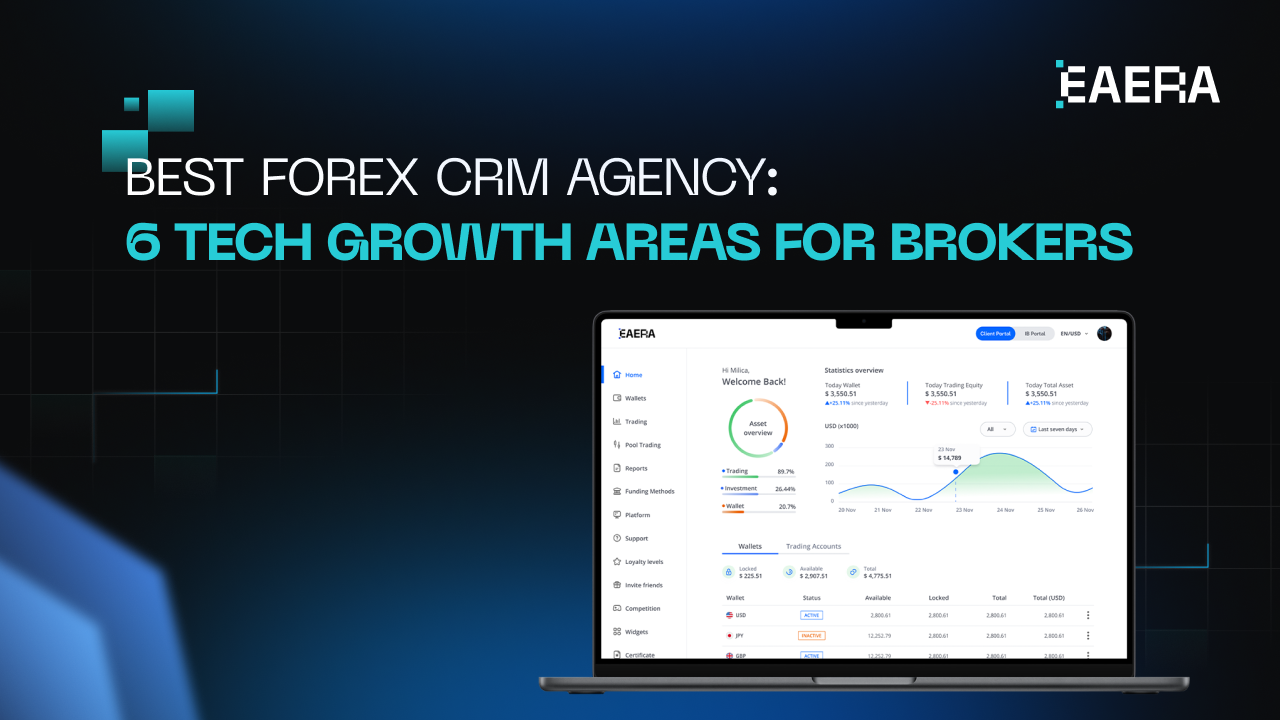
The best forex CRM agency assists brokers in expanding by enhancing more than simply client data handling. It underpins the technology areas that influence broker performance including sales workflows, onboarding, KYC, payments, trading account operations, IB management, reporting, and automation.
A basic CRM can hold leads, notes, and sales activity. That’s not enough for brokers with trading platforms, payment workflows, wallets, partner networks, and retention journeys.
Related articles:
Brokers should choose a CRM agency that can support growth throughout the entire brokerage lifecycle, not just its ability to set up fields or dashboards.
Growth Area 1: Sales Workflow and Lead Conversion
The first area of growth is sales workflow. Brokers need a faster way to route leads, better follow-up and clearer lead ownership. A CRM shouldn’t just hold on to leads once they’re in the system. It should give sales teams a sense of where each lead came from, who owns the next action, and which prospects are most likely to move forward.
A best forex CRM agency should help brokers build sales workflows around real client intent, not just static lead lists.
Key capabilities include:
- Lead source tracking
- Auto-assignment by region, language, source, or workload
- Sales pipeline stages
- Follow-up reminders
- Overdue task alerts
- Duplicate control
- Demo-to-live conversion tracking
- Manager visibility into response time and conversion
Lead conversion is often a matter of timing. A prospect that just registered, opened a demo account or asked for platform information should not wait for manual assignment. The longer you wait, the bigger the risk of losing leadership to other brokers.
A good CRM agency should also help brokers to clearly define the sales stages. For example, a lead can move from new inquiry to contacted, qualified, registered, verified, funded, and active. This gives sales managers better visibility in where prospects drop off.
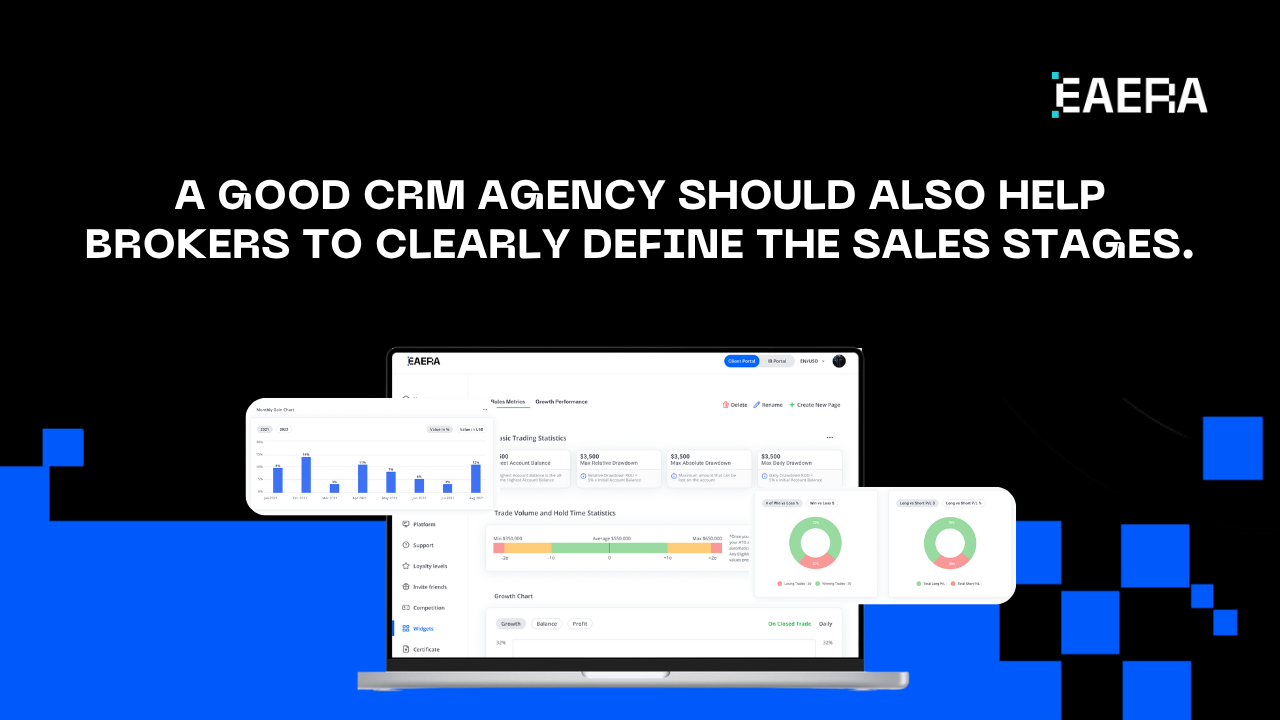
The right time, with the right context, is better for sales growth when the CRM enables teams to act.
Growth Area 2: Onboarding, KYC, and Compliance Workflows
The second growth area is onboarding. Brokers lose clients through slow or unclear registration, verification, and account approval. A client can start with all the right intentions and then lose interest if the next step isn’t clear, or the review of documents takes too long.
The best forex CRM agency should help brokers connect:
- Registration status
- Client profile completion
- Required fields
- KYC document submission
- Verification status
- Review queue
- Approval or rejection reason
- Client notification history
- Account opening eligibility
Onboarding is both a conversion and control workflow. Clients will drop off if the process is too slow. If it’s too loose, the broker increases operational and compliance risk.
A good CRM agency will assist brokers with setting up clear workflows for various client statuses.
This space is also valuable for internal teams. Compliance, sales, and support must not operate from different records. Everyone must see the same client status, document stage, and communication history.
A best forex CRM agency should help brokers reduce onboarding friction while keeping verification steps visible, structured, and auditable.

Growth Area 3: Payments, Wallets, and Funding Visibility
The third growth area is payments. Funding is one of the strongest signals of client intent, but many brokers continue to treat payment data as a finance only record. And this creates a serious gap between client interest and team activity.
The best forex CRM agency should help brokers connect CRM with:
- Deposit requests
- Failed transactions
- Pending bank wires
- Payment method performance
- Wallet balance
- Trading account funding
- Withdrawal status
- Finance approval workflow
- Client transaction timeline
Without tying payment data to CRM, sales teams may not know that a verified client tried to make a deposit. Support teams might need to ask finance for updates about transactions. Managers may not be able to identify the most unsuccessful payment methods.
The best forex CRM agency should help brokers turn payment data into sales, support, and retention action.
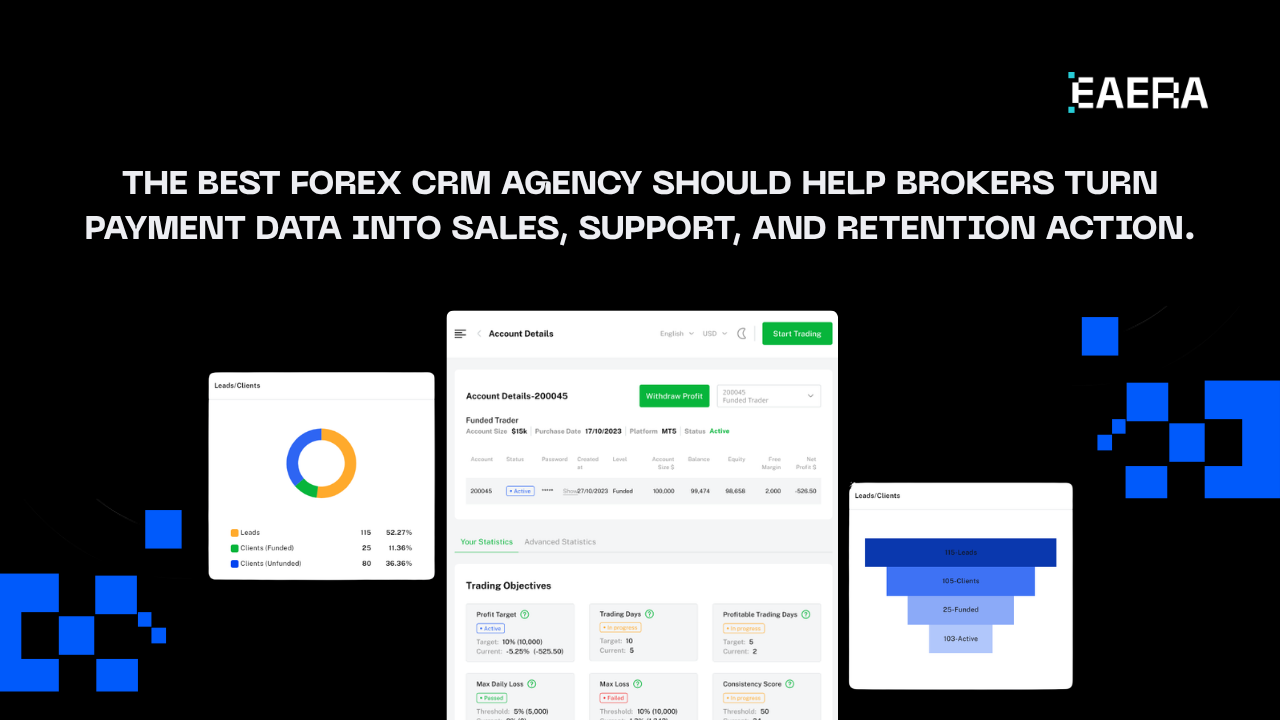
It takes more than a simple payment integration. The CRM should show payment status in the client’s profile and link funding events to tasks, so teams can understand where conversion is happening.
When payments, wallets, and CRM are unified, brokers can recover failed deposits faster, reduce support tickets, and measure where funding conversion breaks.
Growth Area 4: Trading Account Operations and Real-Time Trader Insights
The fourth growth area is trading account operations. A broker’s CRM should not end with registration or deposit. It should connect to trading account status and trader activity.
A strong CRM agency should help brokers build visibility into:
- Trading account creation
- Account type
- Account status
- Balance and equity
- First trade status
- Last trade date
- Trading volume
- Active and inactive clients
- Platform connection
- Account transfer history
This is important because a funded client is not necessarily a trader. The client could deposit but never open a trading account. Another client might open an account but never make a first trade. A high-value client may cut back on activity without the retention team knowing.
The best forex CRM agency should be able to help brokers convert trading activity into operational insight; not leave it stranded in the trading platform.
Sales teams ask if a funded client hasn’t traded. Retention teams need to know when a valuable client goes dark. Managers need to know which campaigns, partners, and regions deliver active traders, not just registrations.
Growth Area 5: IB and Partner Management
Many brokers use IBs, affiliates, and regional partners as a source of acquisition. Manual attribution, commission logic and payout reporting make it hard to scale partner operations.
A best forex CRM agency should help brokers manage:
- IB onboarding
- Referral attribution
- Sub-IB hierarchy
- Client ownership
- Commission rules
- Partner portal visibility
- Payout status
- Adjustment and reversal history
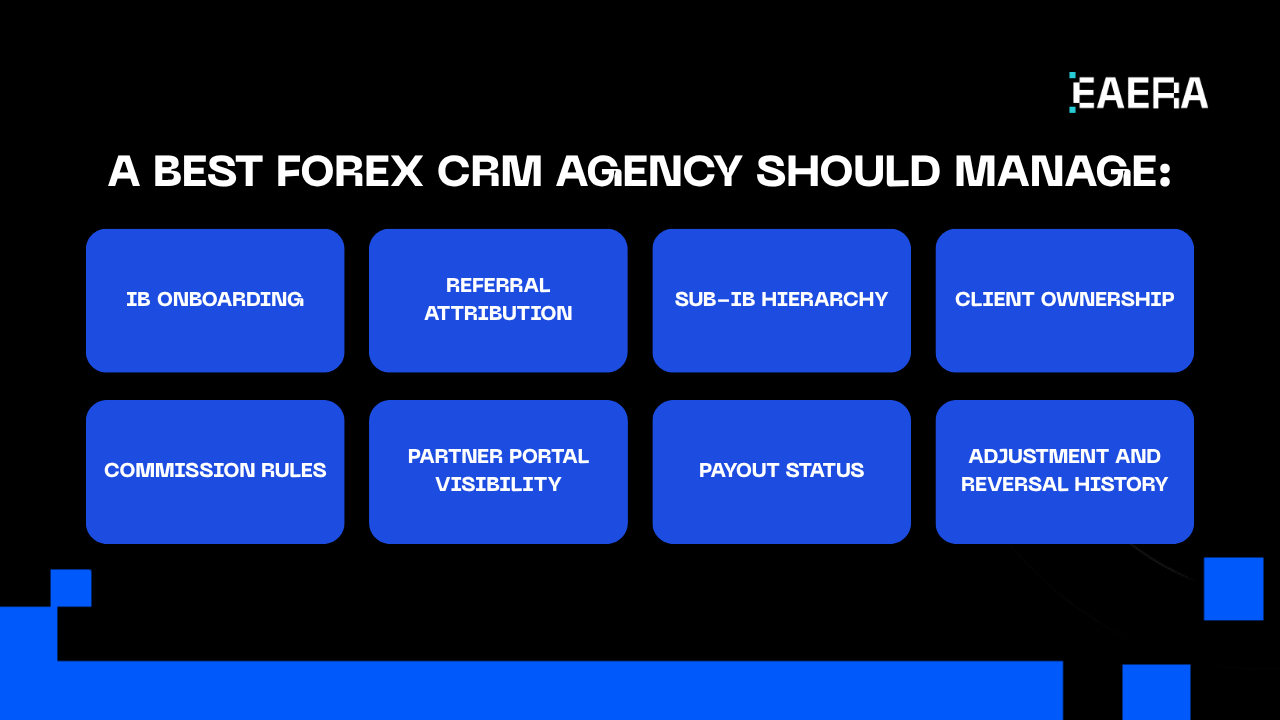
This helps brokers reduce partner disputes and improve payout control.
Partner management is not just about tracking who referred to who. Brokers must know which partners bring in registrations, which partners bring in funded clients, and which partners bring in active traders.
The agency should also help connect partner performance to real client value. What this means is linking partner attribution to KYC completion, deposits, trading volume, retention and revenue contribution.
A best forex CRM agency should help brokers set up partner workflows that are visible to IBs and manageable by internal teams. Partners should be able to view performance data that matters to them, and brokers should be able to control commission rules, approval workflows, and payout status.
Growth Area 6: Reporting, Automation, and Scalable Operations
The sixth area of growth is management visibility and workflow automation. Broker leaders need to know where clients fall off, which partners deliver, which payment methods convert, and which teams need to be actioned.
The best forex CRM agency should help brokers build reporting across:
- Lead response time
- Registration-to-KYC conversion
- KYC-to-deposit conversion
- Deposit-to-first-trade activation
- Active versus dormant clients
- Revenue by segment
- IB performance
- Payment method success rate
- Retention campaign performance
Reporting must not simply mirror historical results. It should help teams to act. If verified clients are not depositing, the gap should be displayed in CRM.
EAERA provides CRM, client portal, back office, funding, affiliate management, reporting, alerts and workflow automation, all connected to support the operations of the broker.
The best forex CRM agency should be able to help brokers build a scalable operating system, not just install a CRM tool.