



In 2026, demand is not the problem. Evaluations can be sold by many companies. Creating a prop trading program that remains reliable and profitable as volume increases is challenging. Sustainability entails predictable economics for the company and predictable results for traders. Rules, enforcement, payouts, fraud controls, and the operating cadence that maintains the model’s stability are the main topics of the useful build blueprint that follows.
Related articles:
- Why Smart Prop Trading Needs Automation?
- Smart Prop Trader: How To Choose a Prop Firm That Fits Your Lifestyle and Goals
Define “Sustainable” for a Prop Trading Program
When a prop trading program generates healthy cohorts over time rather than just occasional revenue spikes, it is considered sustainable. Growth – more checkouts, affiliates, and traffic – is frequently mistaken for sustainability by operators. These may be early indicators, but they do not ensure that the program will withstand the second and third order effects of scale, which include payment-provider limitations, payout pressure, and disputes.
There are two aspects to sustainability. For traders, this means that payouts are predictable, the dashboard is clear, and the rules are easy to understand. After accounting for refunds, chargebacks, support expenses, and fraud losses, cohorts continue to be profitable for the company. A sustainable prop trading program is not “cheap to buy.” It is “stable to operate” and “reliable to participate in.”
Five indicators that a prop trading program is sustainable:
- Cohort profitability stays positive after refunds and support cost
- Payout ratio remains within a predictable band by cohort and program type
- Dispute rate trends down as volume grows, rather than up
- Repeat participation rises (retention and upsell), not just new purchases
- Operational throughput scales without linear headcount growth
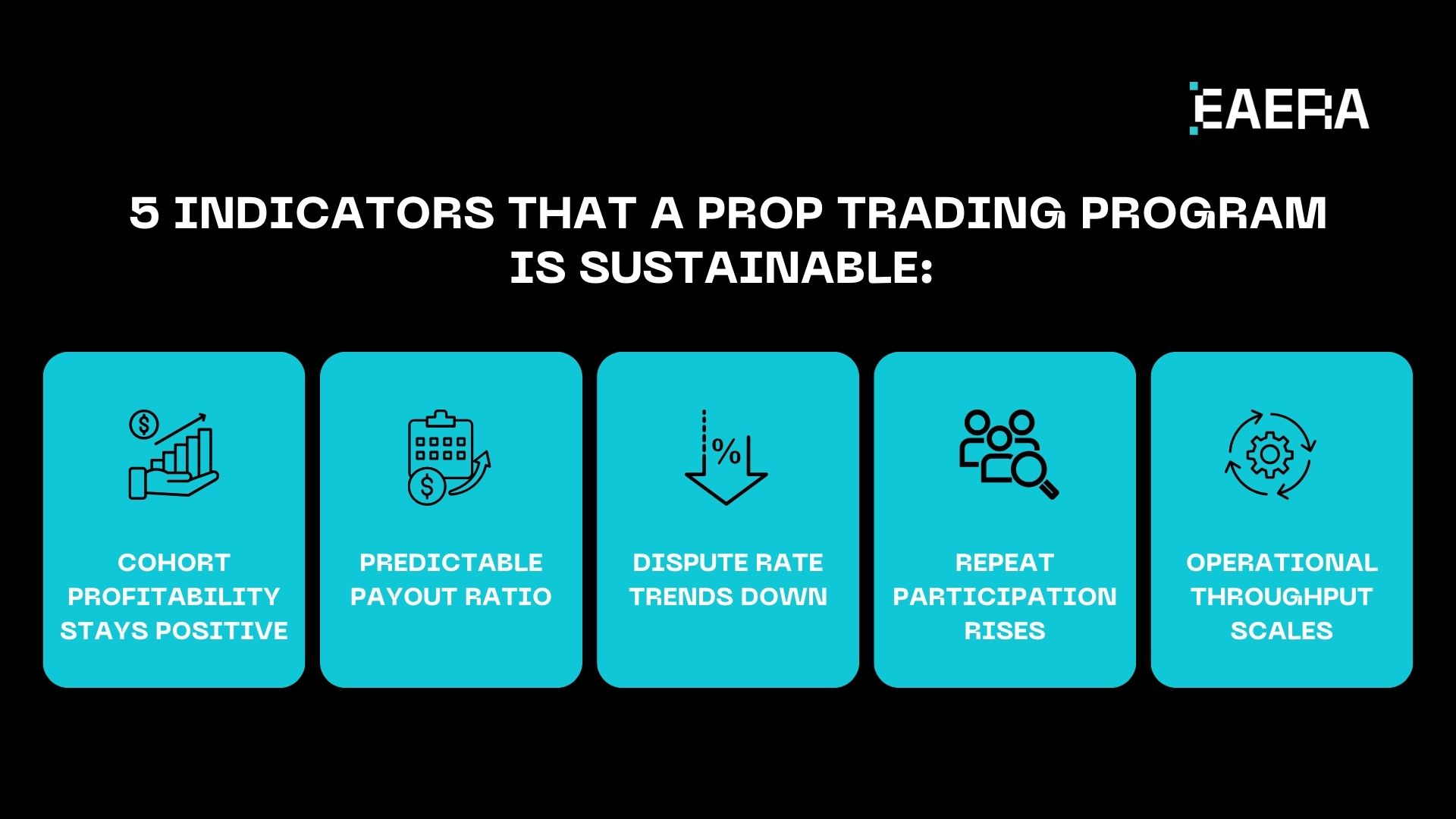
If these indicators are not tracked weekly, sustainability becomes guesswork.
Design the Offer: Rules, Phases, and Trader Psychology
The offer is the intersection of trader psychology and your business model. A prop trading program can be set up as an instant funding approach, a two-step evaluation, or a one-step evaluation. No one is “best” all the time. Your risk tolerance, conversion objectives, and preferred method of striking a balance between speed and filtering will determine the best fit.
Because it feels quicker and easier, a one-step structure can increase conversion. Because it necessitates greater consistency, a two-step structure can enhance filtering and lower payout volatility. Strong acquisition can be facilitated by instant models, but to prevent abuse and churn, sophisticated controls are needed.
Creating rules that are technically enforceable but emotionally viewed as unfair is the biggest error that businesses make. Perceptions of fairness are not marketing gibberish. Refunds, the number of disputes, and long-term reputation are all directly impacted. With definitions and examples that eliminate uncertainty, a sustainable prop trading program approaches rule design as product design.
Rules that must be explicitly defined in every prop trading program:
- How drawdown is calculated (equity vs balance, peak-to-trough logic)
- Daily loss limits and when they reset
- Profit target measurement and what counts toward it
- Minimum trading days and what qualifies as a “day”
- News, weekend, and restricted trading conditions (if any)
- Time limits, resets, and add-on effects (what changes, what stays)
- Pass/fail evaluation moment (real-time breach vs end-of-day review)
If you cannot explain each rule in plain language with a simple example, the rule will become a ticket generator.

Build Risk Enforcement and Transparency into the Core
Transparent evidence and consistent enforcement foster trust. This is your prop trading program’s control layer. Disputes become the primary operating expense if your enforcement is sluggish, inconsistent, or hard to prove.
Sustainable operations require:
- Real-time monitoring of limits and targets
- Deterministic breach detection and state transitions
- Proactive warnings before limits are breached
- Rule versioning so decisions are tied to the rules in effect at the time
- Evidence logs and an event timeline to settle disputes quickly
Additional analytics are not what makes a dashboard strong. It involves displaying in real time the few numbers a trader needs to prevent unintentional failure. Spreadsheets shouldn’t be necessary for traders to determine their safety in a sound prop trading program.
Rules, dashboards, and workflow control are all part of an integrated stack that is positioned by solutions such as EAERA. The engineering and operational overhead required to construct the enforcement and evidence layer of a long-term prop trading program can be decreased in practice by using an integrated approach.
Payout Governance: The Trust Engine of Any Prop Trading Program
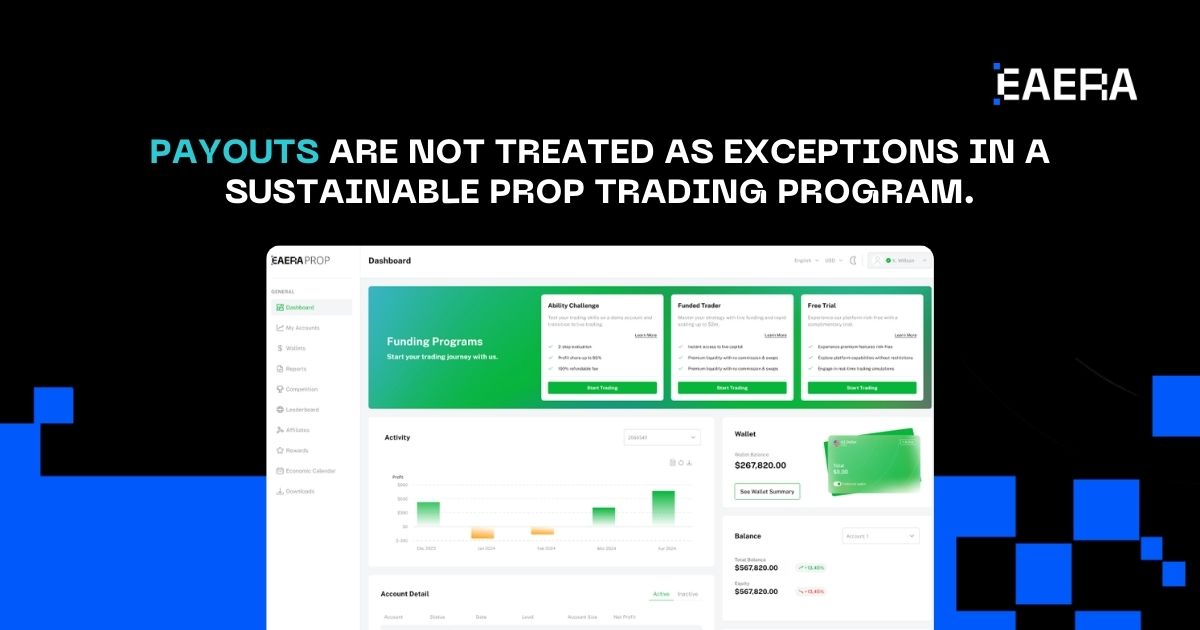
Trust is established through payouts. A lot of programs have the ability to sell challenges. Fewer can reliably run payouts at scale. Payouts are not treated as exceptions in a sustainable prop trading program. They are managed as a controlled process with auditable approvals, predictable processing times, and defined eligibility.
Payout governance starts with clarity:
- Eligibility rules must be explicit and consistently applied
- Payout schedules must be stable and visible
- Processing steps should be trackable by the trader, not only internally
Then you need operational controls that prevent “random outcomes”:
- Approval routing with clear responsibility
- Maker-checker for sensitive actions (especially payout execution)
- Audit logs that capture who approved, what changed, and why
- SLA targets for processing time and escalation paths
- Reconciliation outputs so finance can close the loop cleanly
Inconsistent exceptions are the quickest way to undermine a prop trading program. Even if both situations were legal, the program fosters public mistrust if one trader receives an expedited payout while another waits inexplicably. Improvisation is inferior to predictability.
Fraud Controls Without Killing Legit Traders
Abuse occurs in all prop trading programs. Payout manipulation, collusion, multi-accounting, and copy-trading exploitation are all constantly changing. “Zero fraud at any cost” is not the objective. False positives are caused by over-blocking, and they can harm a person’s reputation more than the fraud loss.
The sustainable posture is governed detection:
- Automate flagging and queuing, not instant bans
- Require evidence and review paths for irreversible actions
- Keep policies consistent and explainable
Fraud system must-haves in a sustainable prop trading program:
- Risk signals that combine account behavior with identity-level patterns
- Review queues with prioritization and SLA
- Clear outcomes: warn, restrict, investigate, terminate, with evidence logs
- Monitoring of false-positive rates and appeal outcomes
- Consistent policy communication to traders
Fraud controls should protect economics while preserving fairness perception.
Operations and Metrics: How to Run and Improve a Sustainable Prop Trading Program
Through operations, sustainability is preserved. Without a cadence for governance, monitoring, and adjustments, even a well-designed prop trading program will falter. Automating repeatable processes, measuring results, and iterating based on data rather than community noise are the objectives.
Operational automation map for a sustainable prop trading program:
- Provisioning automation (purchase to account delivery)
- Risk enforcement automation (monitoring, warnings, deterministic actions)
- Payout workflow automation (eligibility calculation, routing, tracking)
- Support workflows linked to evidence (faster resolution, fewer escalations)
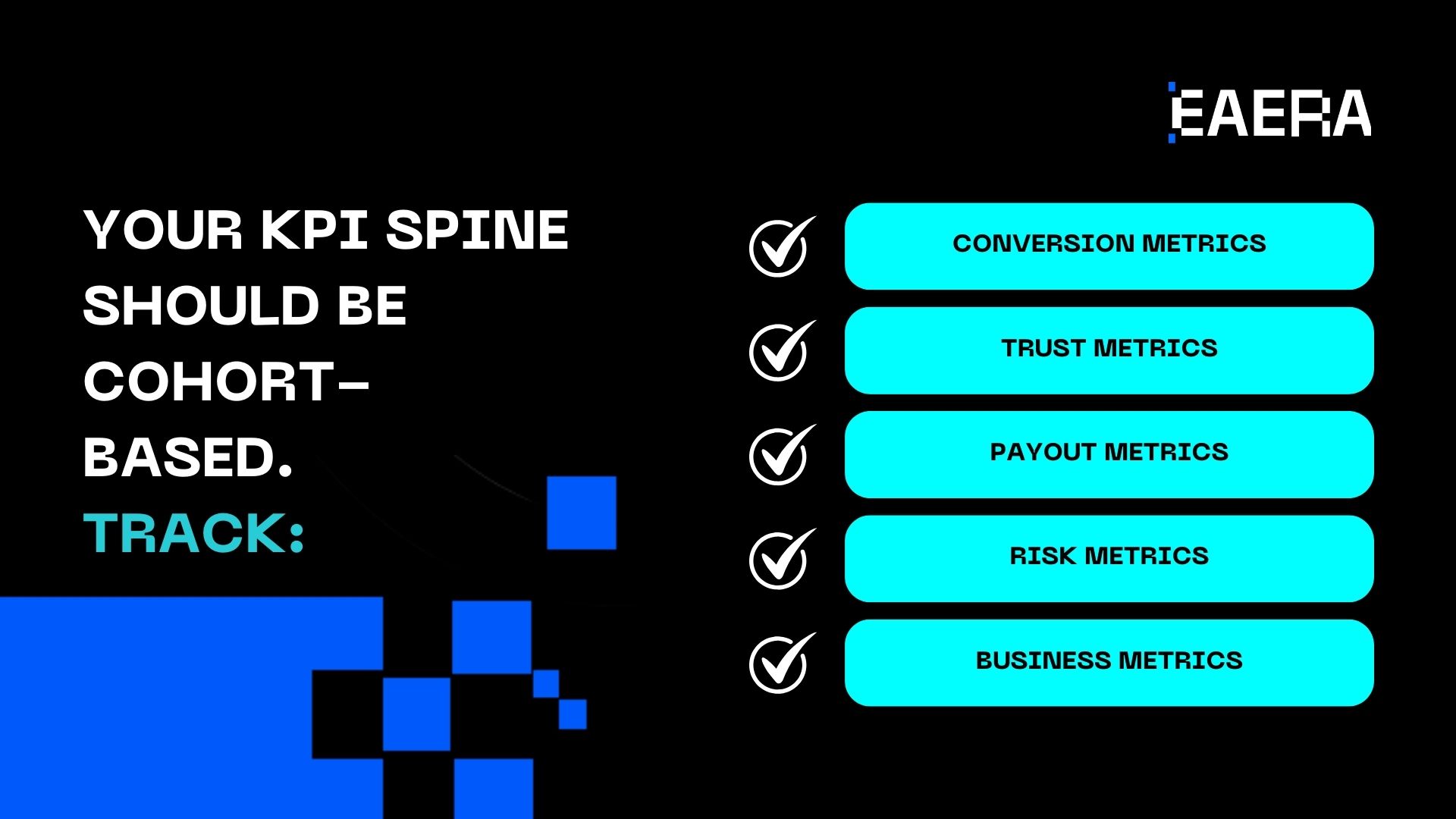
Your KPI spine should be cohort-based, not vanity-based. Track:
- Conversion metrics: purchase to first trade time, activation rate
- Trust metrics: dispute rate per 1,000 traders, refund and chargeback rates
- Payout metrics: payout cycle time, payout failure rate, exception rate
- Risk metrics: breach reason distribution, fraud flag hit rate, false positives
- Business metrics: cohort profitability, repeat participation, lifetime value
EAERA is a platform that can be used to build a governed workflow stack more quickly than a fully custom build if you want to expedite implementation. This is especially true for dashboards, operational workflows, and reporting for a long-term prop trading program.
A program for trading sustainable props is designed, not promoted. A stable foundation is produced by clear regulations, real-time enforcement, transparent dashboards, predictable payout governance, and fraud controls with few false positives. Run it like a system by automating processes, enforcing consistency, measuring cohort economics, and iterating methodically.