



A new way for traders to obtain capital without risking their own money has been made possible by the growth of prop trading firms. However, the model is frequently misinterpreted. Although it is a structured system based on stringent regulations, risk controls, and well-thought-out economics, many perceive it as a simple shortcut to funded trading.
Related articles:
The key to long-term success and repeated failure is knowing how it really operates.
What Are Prop Trading Firms and Why They Exist?
Prop trading firms are essentially businesses that give traders access to capital in return for a portion of the profits. Traders go through an assessment process to demonstrate their abilities rather than depositing personal funds.
Prop trading firms use a different business model than traditional brokers, who make money from commissions and spreads. They are not simply intermediaries—they are capital allocators with strict performance filters.
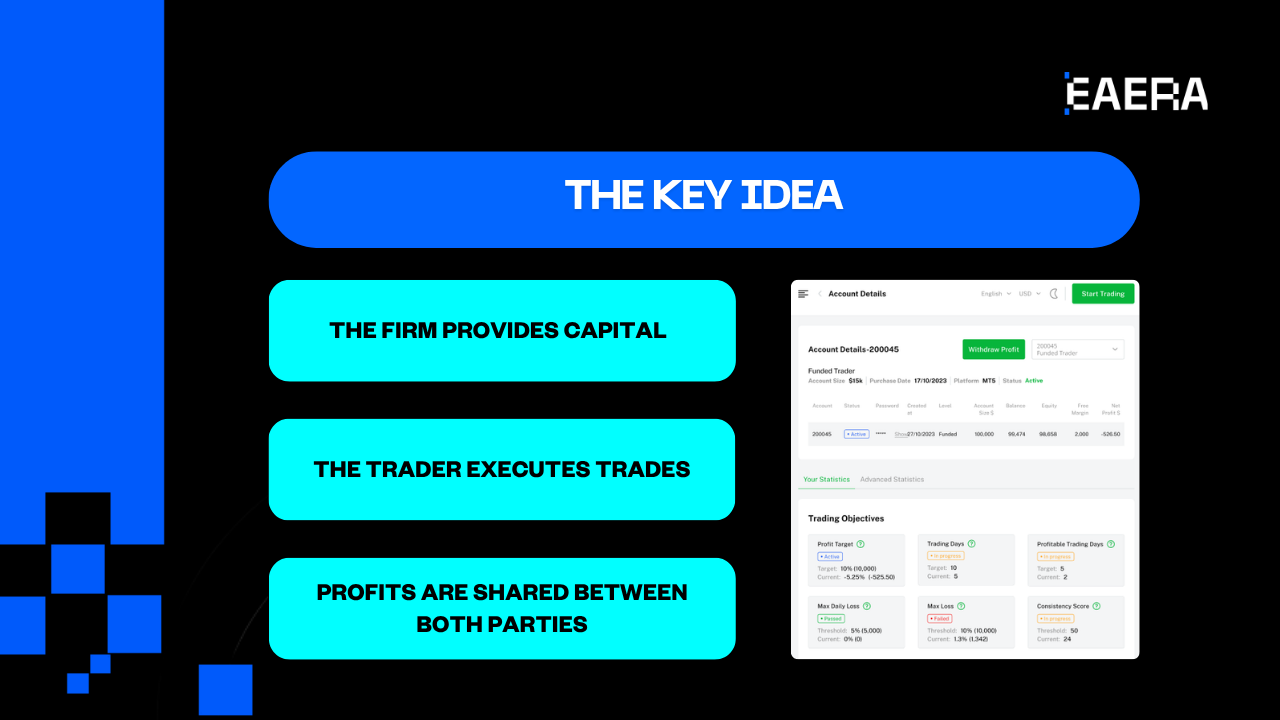
The key idea is simple:
- The firm provides capital
- The trader executes trades
- Profits are shared between both parties
This does not, however, imply that businesses are taking on unlimited risk. Actually, minimizing exposure while optimizing structured revenue streams is the foundation of their whole business.
How Prop Trading Firms Actually Make Money?
Prop trading firms’ business model is frequently misinterpreted. Profit sharing is a component of it, but it is not the main source of income.
Evaluation programs are the first significant element. Traders usually must pay a fee to get into a challenging phase where they must reach predetermined goals. Evaluation fees are a reliable source of income because a sizable portion of participants fail at this point.
Profit sharing is the second element. A portion of profits, typically between 70% and 90%, can be earned by traders who pass the evaluation and get funded accounts. Only a tiny percentage of traders regularly make it to this point.
Risk management is an additional crucial layer. Strict drawdown restrictions and daily loss caps are enforced by firms to guarantee that even funded traders stay within predetermined bounds. As a result, the company’s financial risk is greatly decreased.
The execution model comes last. While some companies simulate trades internally (B-book) or employ a hybrid strategy, others route trades to actual markets (A-book). Particularly in the beginning, traders frequently do not immediately trade real capital.
The truth is evident: The model is a structured system that combines evaluation fees, controlled risk, and selective capital deployment; it is not just about trading profits.
The Evaluation Process Explained Step-by-Step
Traders must pass a multi-step evaluation process intended to assess both skill and discipline to obtain funding.
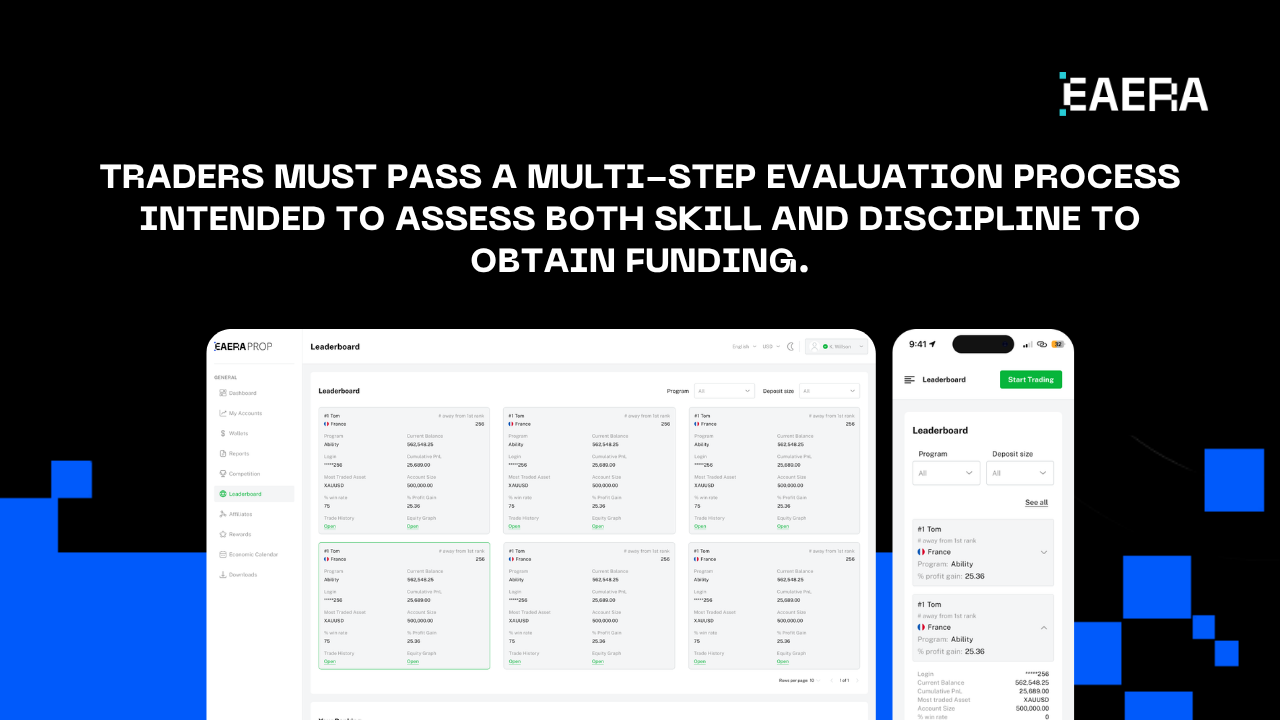
It typically begins with registration and fee payment, which grants access to a trading account under specific conditions.
The challenge phase follows, during which traders must adhere to stringent regulations while hitting a profit target, typically between 8 and 10%. These regulations typically include minimum trading days, maximum daily loss, and overall drawdown limits.
If traders are successful, they proceed to the verification phase, which typically has stricter consistency requirements but lower profit targets. This phase makes sure that performance isn’t dependent on chance or risky behavior.
After completing both phases, traders are given a funded account in which they can engage in real-world trading and withdraw profits in accordance with predetermined payout guidelines.
This is the most crucial realization: Most traders fail due to rule violations, particularly drawdown limits, rather than bad strategy.

Risk Management Systems Behind Prop Firms
The foundation of prop trading firms is risk management. The model wouldn’t be viable without it. Real-time monitoring systems are used by modern businesses to keep tabs on every trade, position, and degree of exposure. Rules like maximum permitted losses and position sizing limits are automatically enforced by these systems.
At a deeper level, firms implement:
- Exposure caps per asset or symbol
- Automated stop mechanisms when limits are breached
- Behavioral tracking to identify risky trading patterns
Here, infrastructure is crucial. Platforms such as EAERA offer sophisticated tools for real-time trader behavior analysis, risk management, and execution monitoring.
This is a strategic advantage rather than merely a technical layer. While weaker systems frequently result in inconsistent performance or operational risk, companies with robust infrastructure can scale sustainably.
Who Should Join Prop Trading Firms?
This model is not appropriate for all traders. Success is more dependent on discipline and following the rules than it is on forecasting the market.
Traders who tend to perform well usually have:
- A structured trading plan
- Strong risk management habits
- Consistency over time rather than short-term gains
On the other hand, this model is not suitable for:
- Traders who rely on high-risk strategies
- Those expecting fast profits without process
- Beginners without a tested system
One of the biggest misconceptions is that skill alone guarantees success. Behavioral control and rule compliance are far more important.
This is a system designed to filter traders—not to accommodate every trading style.
Key Factors to Evaluate Before Choosing a Prop Firm
A strategic approach is necessary when selecting a company. Not all prop trading firms operate in the same way, and even minor variations in regulations can have a significant effect on results.
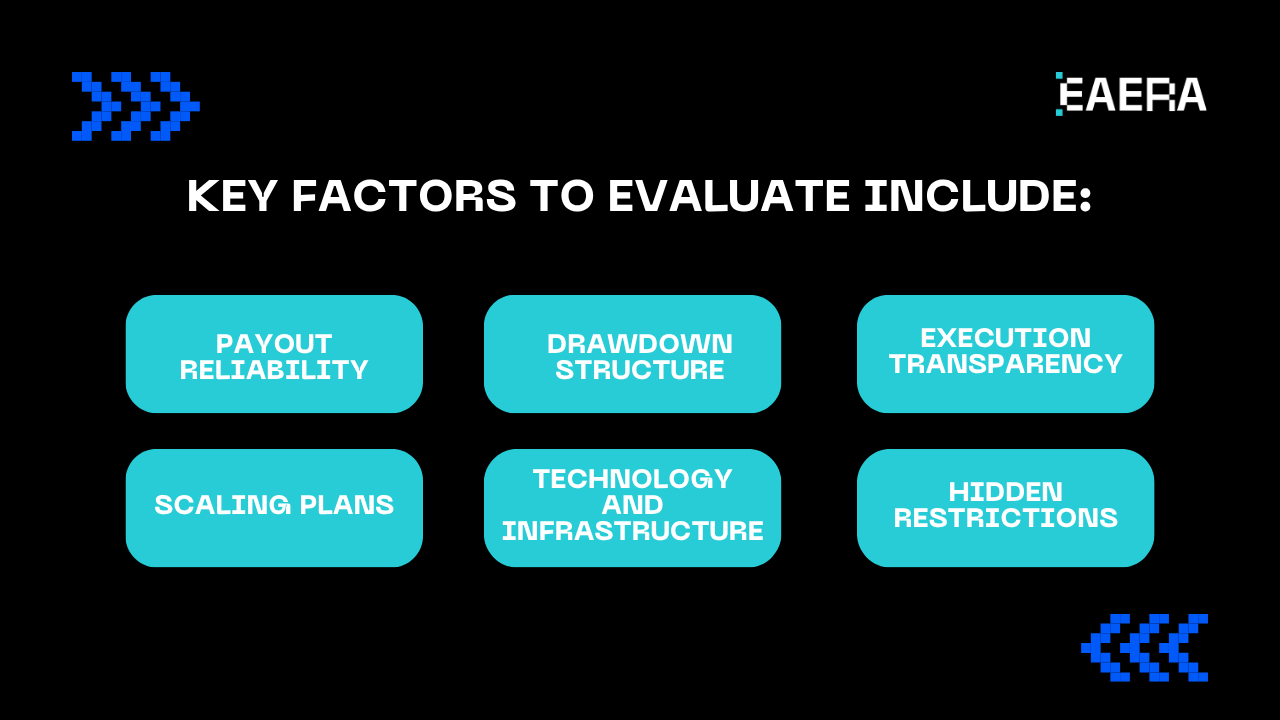
Key factors to evaluate include:
- Payout reliability: Are withdrawals consistent and transparent?
- Drawdown structure: Static drawdown is generally more sustainable than trailing drawdown
- Execution transparency: Is the trading environment clearly defined?
- Scaling plans: Are there realistic pathways to increase capital?
- Technology and infrastructure: Does the platform support real-time monitoring and stability?
- Hidden restrictions: Are there rules that indirectly increase failure probability?
The fact that the highest profit split isn’t always the best choice is a crucial realization. It may be more difficult to succeed in companies with appealing percentages but stringent regulations.
Evaluating the system as a whole, rather than just the headline figures, is the wiser course of action. Although they offer traders an organized means of obtaining capital, prop trading firms are not quick fixes for success. These systems are based on regulations, self-control, and risk management.
The only traders who can successfully use the model are those who comprehend how these companies function, particularly the significance of risk management and rule compliance. Approach it as a long-term framework, not a quick opportunity.