



2026 is less forgiving. Payment companies tighten risk controls; traders demand immediate transparency, and volatility spikes. Failure for prop trading firms is typically caused by an operating model that is not scalable, rather than a single marketing error. The patterns that kill businesses, the metrics that identify them early, and workable solutions are listed below.
Related articles:
- Why Smart Prop Trading Needs Automation?
- Smart Prop Trader: How To Choose a Prop Firm That Fits Your Lifestyle and Goals
- Smart Prop Trader Journey Explained
The 2026 Reality: Why prop trading firms are more fragile than they look
The model appears straightforward: sell assessments, enforce regulations, compensate successful traders, and so on. Prop trading firms operate on a precarious triangle made up of payments, operational throughput, and trust. The entire structure sways when one side becomes weaker.
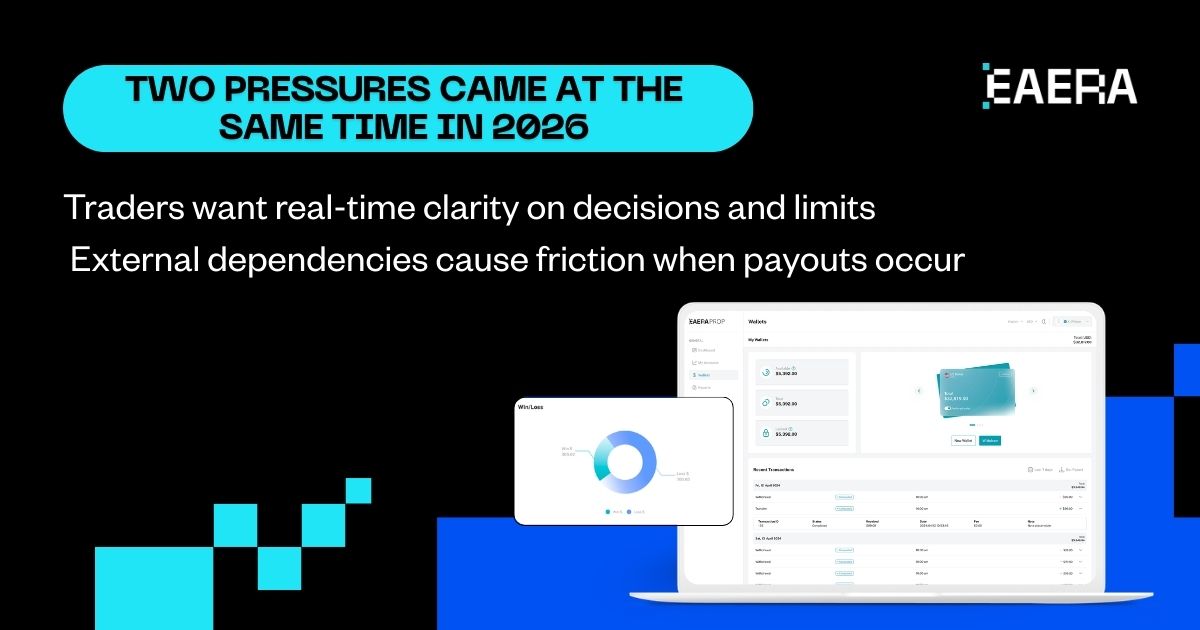
Two pressures came at the same time in 2026: traders want real-time clarity on decisions and limits, and external dependencies (compliance and payments) cause friction when payouts occur. That is why prop trading firms can appear healthy until the moment scale exposes the cracks.
Structural pressures you should assume are always on:
- Higher dispute sensitivity because traders compare firms publicly
- More payout scrutiny from users and payment providers
- Higher cost-to-serve when support must explain unclear rules
- Faster reputation swings from community sentiment
Broken economics inside prop trading firms
Growing unprofitably is the quickest way for prop trading firms to fail. Aggressive affiliate payouts and discount wars can destroy margins while producing volume that appears impressive. The business becomes a treadmill when acquisition costs increase, and retention remains unchanged.
Three common manifestations of broken economics are: fees are priced as though refunds don’t exist; payout ratios fluctuate wildly by cohort; and add-ons turn into a band-aid rather than a strategy. One common mistake is to use significant discounts to optimize checkout conversion, only to find that the “win” is erased by refunds, disputes, and payment fees.
Another trap is relying on resets and ruling out add-ons as the primary revenue driver; it can work short-term, but it trains your market to buy only when the offer is distorted.
When you assess economics, avoid vanity totals. For prop trading firms, the only numbers that matter are cohort-based and repeatable.
Three metrics that reveal economic fragility:
- CAC payback period by channel (including refund leakage)
- Cohort LTV split by program type
- Net payout ratio compared with fee revenue for the same cohort
Sustainable firms design pricing and rules so payout exposure is bounded, and they monitor profitability by cohort rather than by month.

Trust collapse in prop trading firms
Most prop trading firms don’t go away quietly. Through the breakdown of trust, they pass away loudly and in public. When trust is lacking, refunds, chargebacks, and bad reviews rise, which negatively impacts partner performance and conversion.
Inconsistency is the main motivator. Traders believe the system is set up to fail when they believe results are dependent on interpretation or unspoken rules. Prop trading firms rely on deterministic enforcement and transparent dashboards.
Top dispute triggers to watch:
- Surprise breaches because limits were not visible in real time
- Confusing rule definitions (equity vs balance, trailing drawdown mechanics)
- Policy changes without versioning or effective dates
- Payout eligibility that is unclear or enforced inconsistently
- Support answers that differ by agent
Weak operations across prop trading firms
If operations aren’t scalable, even successful programs fail. Because it feels controlled, prop trading firms frequently begin with manual provisioning, manual breach of review, and manual payout approvals. It becomes sluggish, erratic, and prone to mistakes on scale.
Missing evidence and throughput bottlenecks are signs of weak operations. Payout integrity cannot be preserved, or disputes cannot be promptly resolved when it is impossible to determine who approved what and why. Only when automation is controlled and auditable can it be beneficial.
Early warning signs your ops will break:
- Provisioning time varies widely for the same program
- Pass/fail outcomes require frequent manual review
- Payout requests sit in queues without a visible SLA
- Decisions live in chat logs instead of system records
- Edge cases are handled differently across team members
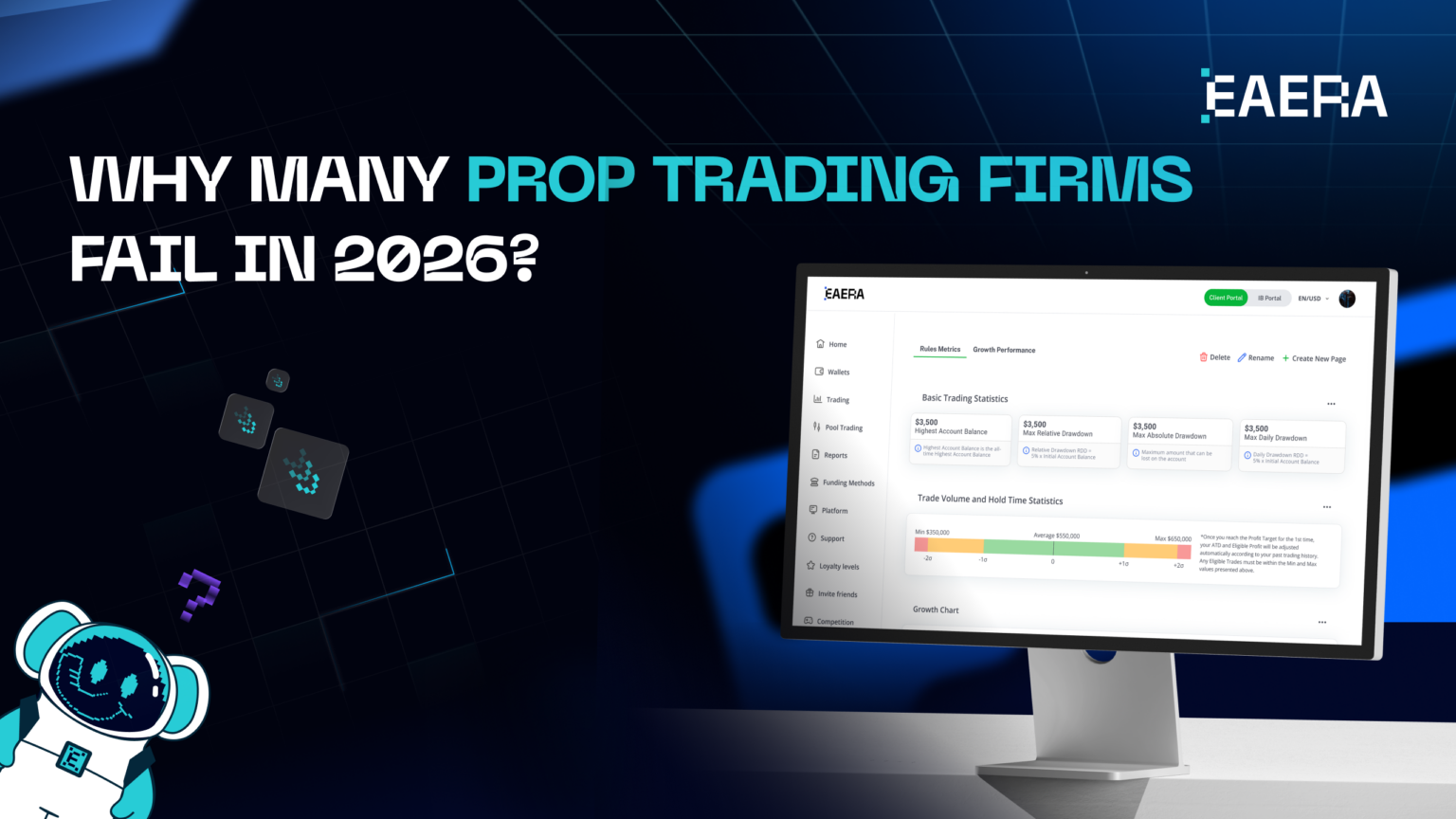
Treating workflows as a product surface—defining states, defining owners, and recording each transition—is one useful strategy. This workflow-driven operating model is positioned by platforms such as EAERA to enhance traceability for prop operations and decrease manual friction.
Compliance and payments friction for prop trading firms
In 2026, otherwise compelling offers may be destroyed by payment and compliance issues. When chargebacks increase or payout patterns appear out of the ordinary, many prop trading firms underestimate how quickly payment providers tighten regulations. Because it feels like a moving goalpost, late-stage KYC that is only implemented at payout time is frequently a trust-breaker.
Transparency and expectation management are crucial. If you require verification, let people know as soon as possible and provide a clear status update. Publicize processing times and typical failure causes if you accept a variety of payout methods to prevent traders from mistaking delays for avoidance.
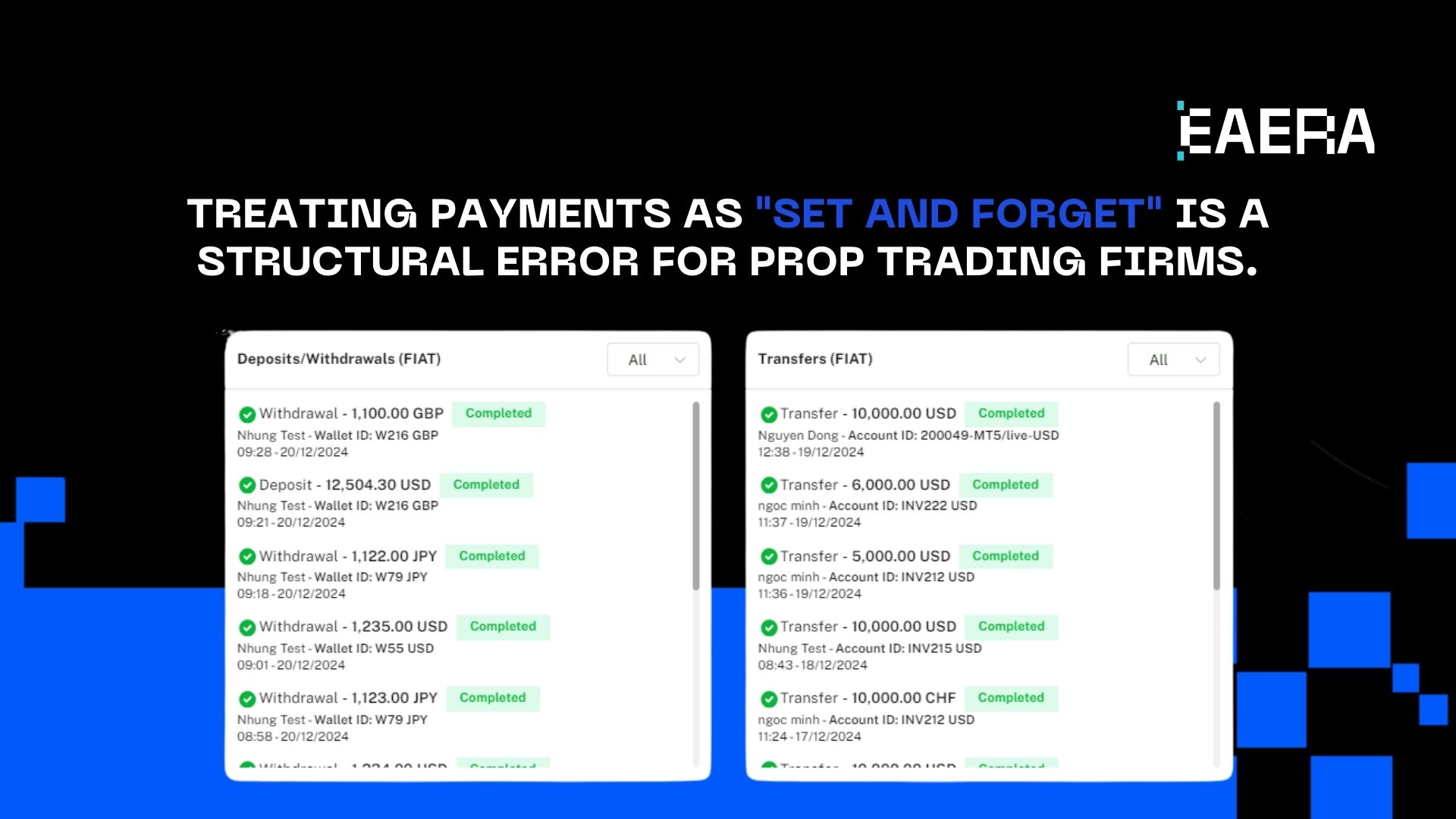
Payment-provider de-risking is a second level of risk. Your conversion and payout throughput may suddenly decrease if a provider lowers limits, raises reserves, or blocks specific regions. Redundancy in both deposit and payout methods is designed by experienced operators, who then monitor decline rates and payout failure rates as superior metrics. Treating payments as “set and forget” is a structural error for prop trading firms.
Controls that reduce failure risk:
- Clear KYC timing policy with visible status
- Payout SLAs and a status tracker per request
- Evidence logs for approvals and reversals
- Chargeback monitoring with dispute playbooks
Fraud arms race and no long-term product loop
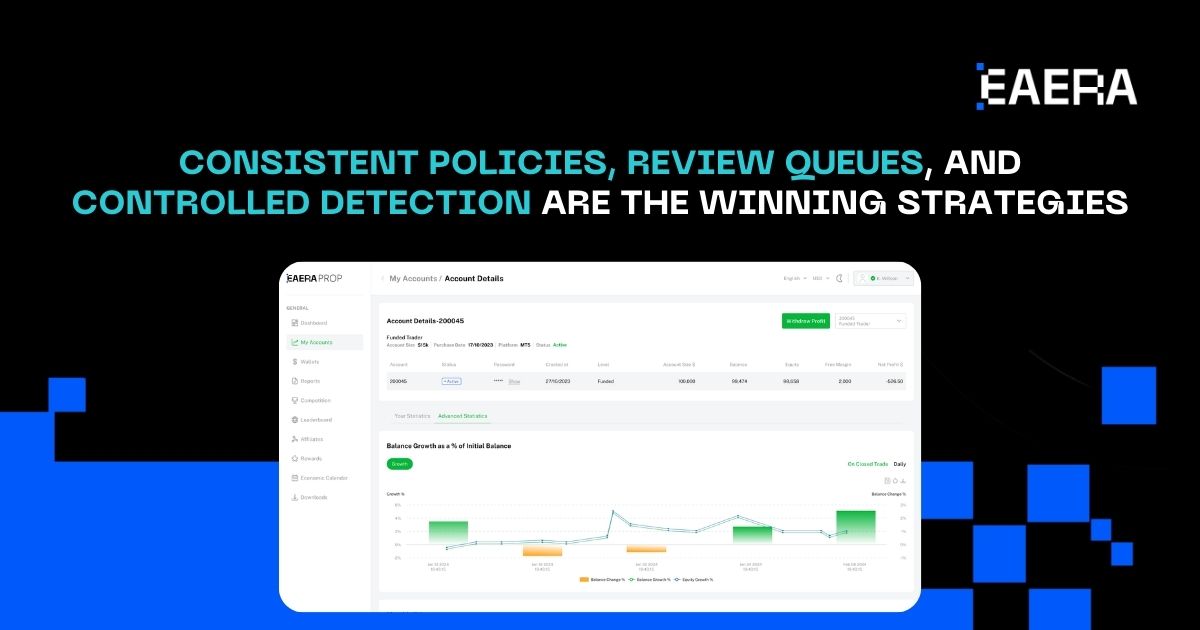
Prop trading firms are constantly under pressure from fraud. Payout exploitation, copy trading abuse, collusion, and multi-accounting are all constantly changing. Because false positives provoke public outrage, over-blocking is also risky. Consistent policies, review queues, and controlled detection are the winning strategies.
The lack of a retention loop is the second silent killer. Instead of creating a path for disciplined traders to stay, scale, and compound value, many prop trading firms rely on ongoing new challenge sales. Revenue plummets when acquisition slows down because there is no flywheel.
Gimmicks are not necessary for a retention loop; instead, it requires a consistent funded experience, well-defined scaling milestones, and communication that maintains trust in the face of platform or market incidents. Prop trading firms that build this loop typically see lower dispute rates and higher repeat participation.
What resilient firms do differently:
- Make every decision explainable with rule versioning and evidence
- Build dashboards that prevent surprise outcomes
- Treat payouts as a workflow with SLAs and clear statuses
- Use fraud signals to prioritize review, not to auto-punish blindly
- Design scaling paths that reward discipline and reduce churn
- Measure cohort economics weekly, not just revenue monthly
Because it presents an integrated approach across rules, dashboards, and operational workflows, EAERA is frequently assessed in this context.
Rather than a single poor campaign, most prop trading firms fail due to compounding trust and operations issues. Remove payout surprises, automate workflows with governance, enforce rules consistently, and fix economics with cohort discipline.