




Due to a lack of demand, the majority of prop companies do not face difficulties. Growth reveals operational flaws, such as uneven rule enforcement, payout friction, ticket overload, and “surprise fails,” which is why they struggle. By standardizing the entire trader lifecycle, a prop firm CRM transforms growth from “more volume” into repeatable results. A useful framework that focuses on capabilities, governance, selection criteria, and implementation steps that increase numbers is provided below.
Related articles:
What “Real Growth” Means for a Prop Firm?
Purchasing more challenges is not the only way to achieve true prop growth. It’s long-lasting trust and predictable economics. Cohorts—who purchases, who passes, who remains funded, who asks for payouts, and who returns—are optimized by the best operators.
Because a prop firm CRM integrates all stages of the lifecycle into a single system, it becomes the lever. Without that, teams rely on spreadsheets, manual reviews, and ad-hoc decisions. Those don’t scale. They create inconsistencies, which create disputes, which create refunds, which create reputational drag.
Real growth usually looks like:
- More traders reaching first trade quickly after purchase
- Lower dispute and refund rates even as volume grows
- Stable payout operations with clear processing times
- Higher repeat participation and funded retention
- Cleaner partner and finance operations with fewer exceptions
Five growth blockers a prop firm CRM should eliminate:
- Manual provisioning that delays activation
- Inconsistent pass/fail decisions driven by human interpretation
- Payout queues that depend on “who is available”
- Support tickets caused by unclear rule tracking
- Reporting that cannot explain what happened and why
If your growth relies on human heroic, it is not growth. It is operational debt.

Prop Firm CRM vs Generic CRM: The Non-Negotiable Differences
Contacts, notes, and sales stages are all tracked by a generic CRM. A prop firm CRM needs to manage a money-adjacent, rules-driven business with proof. For this reason, once disputes, payouts, and fraud appear at scale, the idea that “we’ll just use a standard CRM and add fields” tends to fall apart.
Operational truth, including evaluation states, risk thresholds, breach of events, payout eligibility, and audit logs, is owned by a prop firm CRM. Teams are usually forced to use spreadsheets and internal tools because a generic CRM is unable to represent those objects natively.
Comparison table: Generic CRM vs Prop Firm CRM
| Capability | Generic CRM | prop firm CRM |
| Evaluation lifecycle states | Not native | Built-in states and transitions |
| Rule enforcement context | Manual notes | Rule engine + versioning + evidence |
| Payout eligibility and workflow | Not supported | Eligibility + approvals + history |
| Dispute resolution | Email-driven | Event timeline and audit logs |
| Fraud signals and review queues | DIY | Signals, flags, review workflows |
| Operator reporting | Sales metrics only | Cohorts, payout ratio, dispute reasons |
You don’t have a prop firm CRM if your system is unable to generate a timeline of “what rule triggered, when, and why.” A sales database is in your possession.
Core Capabilities of a High-Performance Prop Firm CRM
An operating system, not a collection of features, should be used to assess a high-performance prop firm CRM. The clean way to assess it is:
Capability → what it standardizes → which KPI it moves.
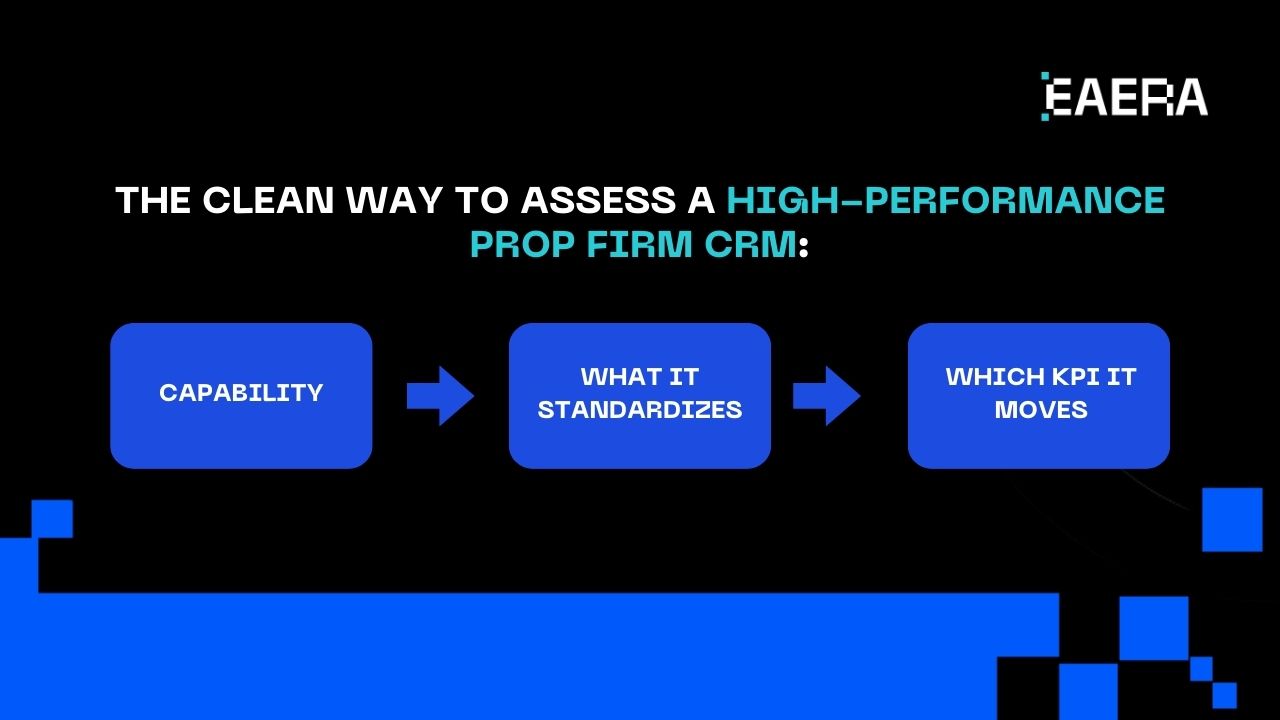
This framing keeps the discussion focused on business results and avoids “feature shopping.”
1) Program configuration and rule governance (versioned rules)
You can run several programs without constantly rewriting logic with a robust prop firm CRM. More significantly, it modifies regulations so that results can be later justified.
- Standardizes: program setup, rule definitions, rule changes over time
- Moves KPIs: time-to-launch, dispute rate, pass-rate stability
2) Real-time limit tracking and breach prevention
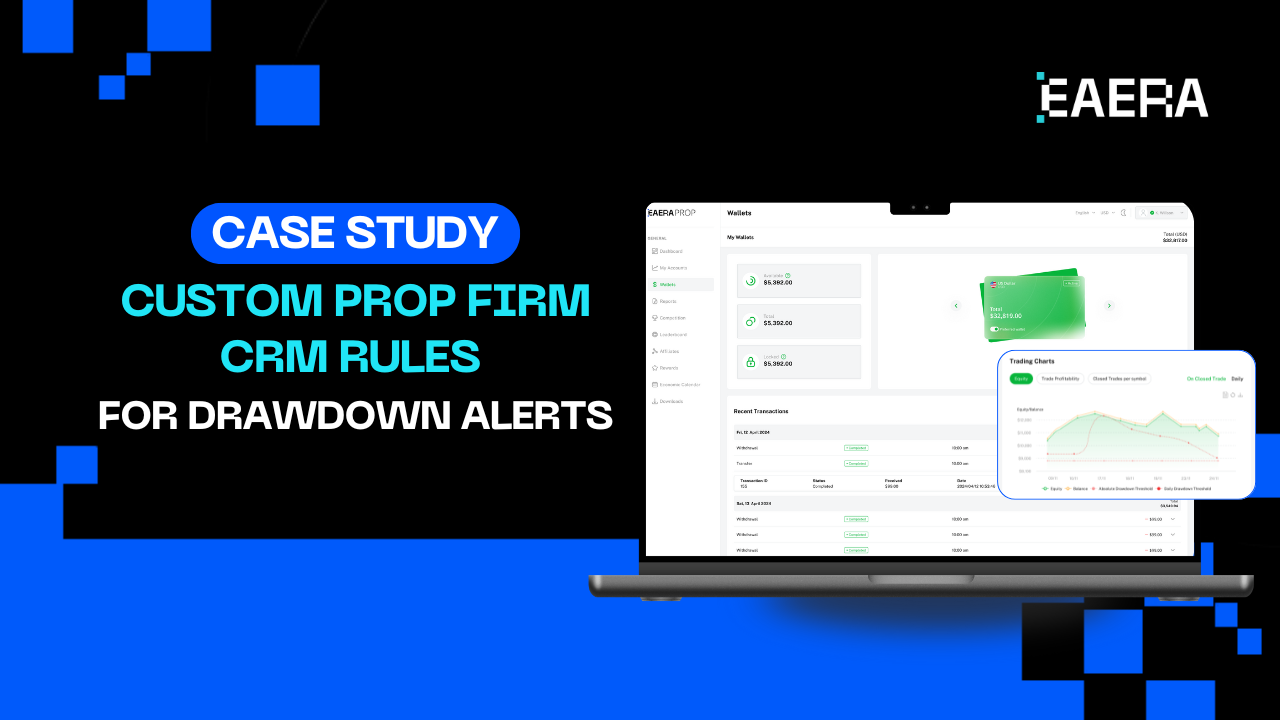
Risk is not an end-of-day audit in a contemporary prop firm CRM. Accidental breaches are decreased by proactive warnings and ongoing monitoring.
- Standardizes: drawdown tracking, daily loss buffers, alerts and warnings
- Moves KPIs: disputes per 1,000 traders, refunds, “near-breach” frequency
3) Trader lifecycle state machine (evaluation to funded and beyond)
When each team interprets “passed,” “failed,” “paused,” or “eligible” differently, growth breaks. A deterministic lifecycle must be enforced by a prop firm CRM.
- Standardizes: state transitions, eligibility states, exceptions handling
- Moves KPIs: manual review rate, cycle time for status changes, retention
4) Payout operations as a governed workflow
The engine of trust is payouts. Payouts are never a manual exception in a sustainable prop firm CRM; rather, they are handled like a process with approvals, evidence, and reconciliation.
- Standardizes: eligibility checks, approval routing, payout history, reconciliation outputs
- Moves KPIs: payout cycle time, payout failure rate, payout dispute rate
5) Dispute resolution with evidence, not opinions
Making every important result understandable is the quickest way to lessen support load. Instead of arguing over screenshots, support should open an event timeline to resolve cases.
- Standardizes: ticket context, evidence attachments, event timelines, resolution paths
- Moves KPIs: time-to-resolve disputes, repeat ticket rate, chargeback rate
6) Fraud and abuse controls with review queues
Unit economics must be safeguarded by fraud controls without causing false-positive reactions. Flag-and-queue with governed decisions is the ideal model.
- Standardizes: signal detection, review workflow, enforcement outcomes with audit trail
- Moves KPIs: fraud loss events, false-positive rate, payout clawbacks
7) Cohort analytics and profitability reporting
You can’t improve performance if you can’t see it by cohort. Instead of focusing only on totals, the reporting spine should address “which program and channel is actually profitable.”
- Standardizes: cohort views, payout ratios, conversion funnels, retention tracking
- Moves KPIs: cohort profitability, LTV, conversion by program, repeat participation
Must-have evidence logs in a prop firm CRM:
- Order and equity snapshots relevant to rule calculation
- Breach events with rule name, threshold, measured value, timestamp
- Rule version applied and effective date
- Status transitions with actor (system or user) and reason
- Payout eligibility calculation record and approval history
This is how a prop firm CRM turns trust into a system output.
Automation With Governance: Scaling Without Trust Collapse
Automation is necessary, but it can be risky if it is not governed. A prop firm CRM should automate procedures while maintaining auditable and controlled judgment. Simply put, automate coordination rather than accountability.
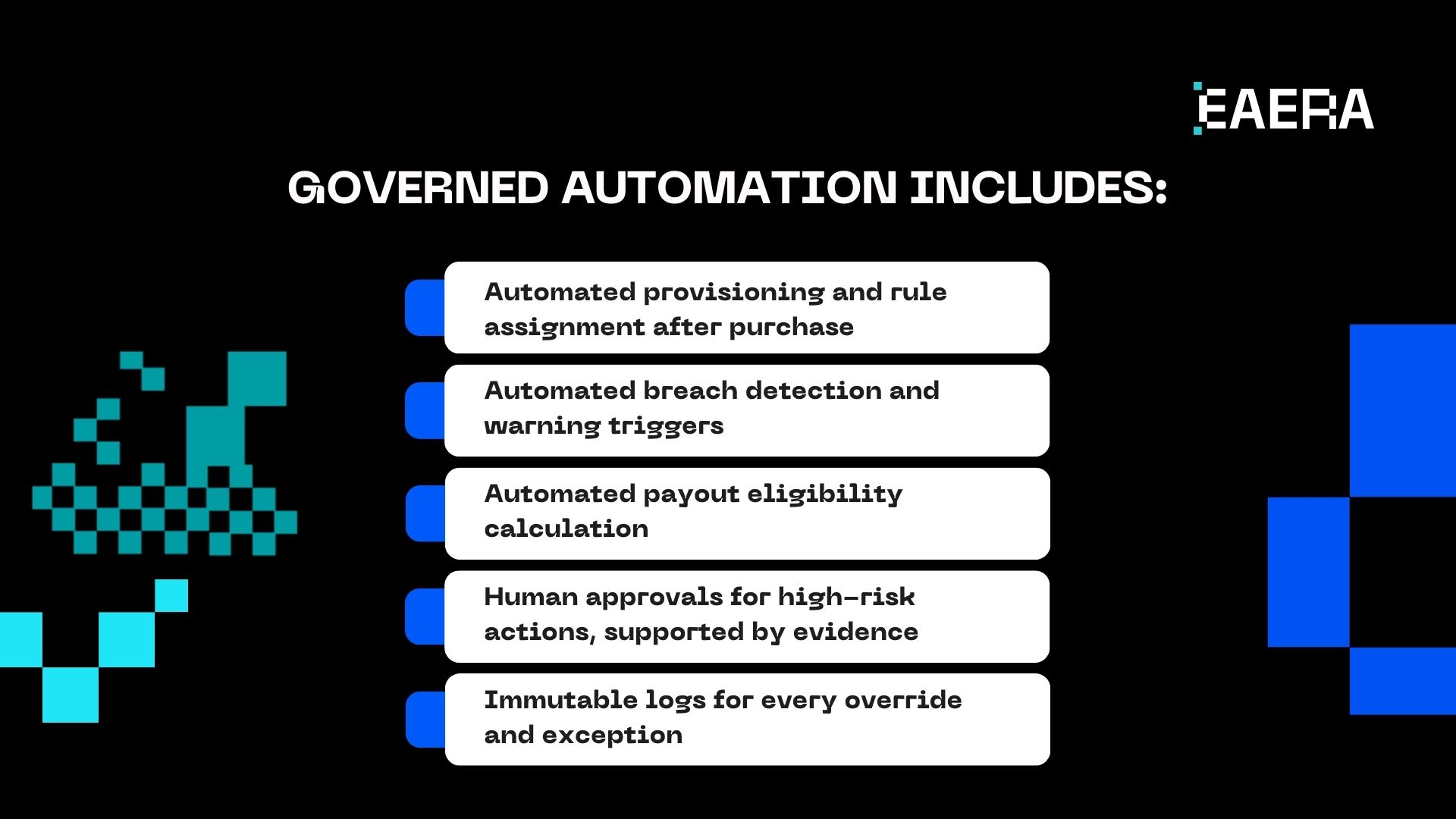
In practice, governed automation includes:
- Automated provisioning and rule assignment after purchase
- Automated breach detection and warning triggers
- Automated payout eligibility calculation
- Human approvals for high-risk actions, supported by evidence
- Immutable logs for every override and exception
Maker-checker is a fundamental control mechanism. Your operation becomes vulnerable if a single user can silently alter results. Sensitive actions are visible, reversible (when appropriate), and traceable with a robust prop firm CRM.
Automation should lessen conflict rather than foster mistrust.
How to Choose the Right Prop Firm CRM?
Choosing a prop firm CRM is similar to choosing your operating system. Instead of slides, you need a scorecard and a demo script that requires proof.
Selection criteria that matter:
- Lifecycle coverage: onboarding, evaluation, funded, payouts, disputes
- Auditability: event logs, rule versioning, approval trails
- Integrations: trading platform, payments, identity checks, analytics
- Scalability: can it handle volume without manual workarounds
- Reporting: cohort views, payout ratio, dispute drivers, retention
- Vendor support and change management posture
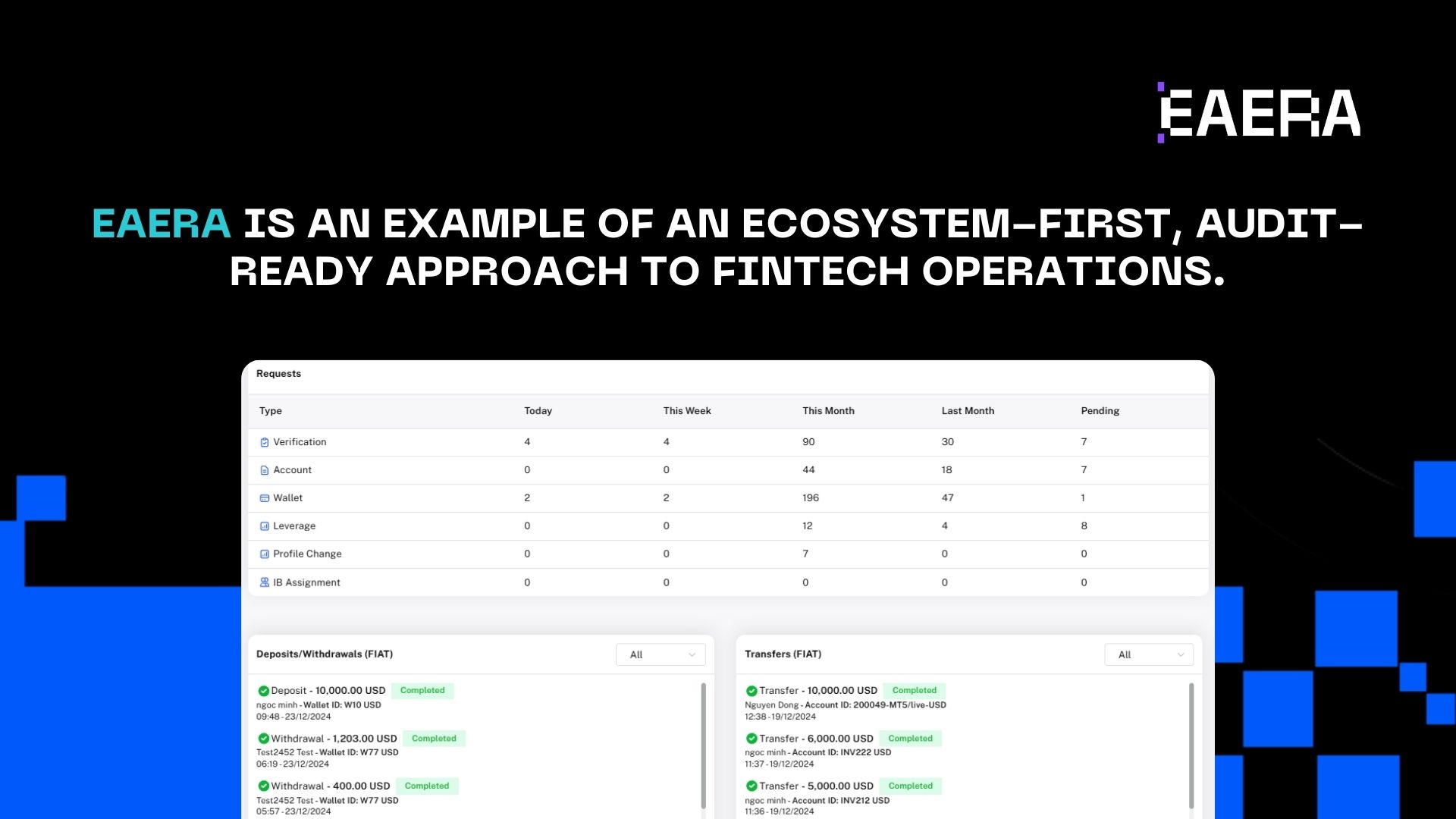
A modern prop firm CRM should provide consistent workflows, governance, and evidence. EAERA is an example of an ecosystem-first, audit-ready approach to fintech operations.
Because it makes operations consistent and defendable, a prop firm CRM is a growth engine. Clarity, proof, steady payouts, and automation with governance are the keys to true growth.