



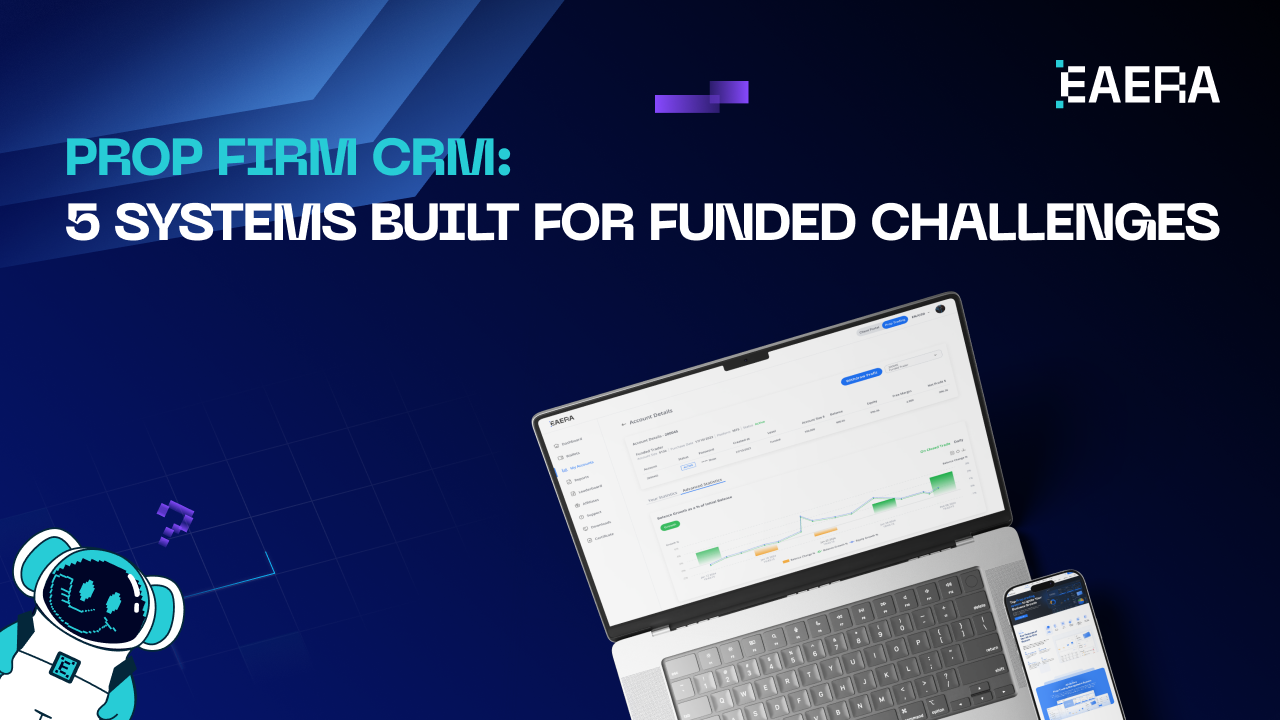
A modern prop firm CRM is not just a trader database or a support tool anymore. In 2026, prop firms are operating complex ecosystems including challenge management, account provisioning, risk monitoring, retention flows, payouts, and operational analytics.
Related articles:
- Forex CRM Provider in 2026: 4 Non-Negotiable Features
- 8 Features in Forex CRM System That Separate Winners
The funded trading industry continues to grow, and a lot of firms are very focused on acquisition but having a hard time scaling operation. Basic CRM systems will not be able to efficiently handle challenges like high trader volume, multi-stage evaluations, and real-time trading rules.
This is why successful firms are turning to integrated prop firm CRM infrastructure built especially for funded challenge operations. A good system allows companies to automate workflows, enhance trader experience, reduce operational friction, and support scalable growth.
Why Prop Firms Need Specialized CRM Infrastructure?
Prop firms operate very differently from traditional brokers.
Prop firms do not only onboard traders into live trading environments, but they also manage evaluation programs, fund account life cycles, payout operations and challenge rules simultaneously.
This creates a much more operationally complex environment.
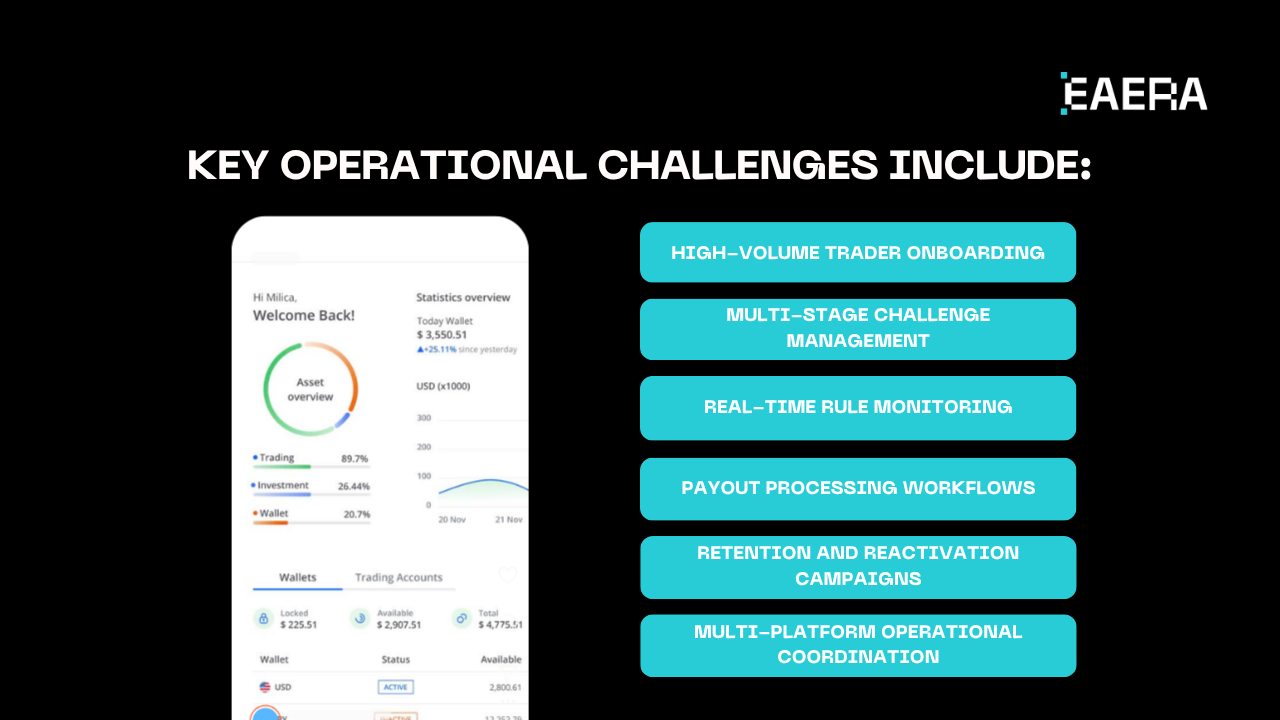
Key operational challenges include:
- High-volume trader onboarding
- Multi-stage challenge management
- Real-time rule monitoring
- Payout processing workflows
- Retention and reactivation campaigns
- Multi-platform operational coordination
As competition in the prop trading industry increases, trader experience and operational efficiency are becoming the key differentiators between firms.
Basic CRM systems do not always have the infrastructure to handle these workflows efficiently. Manual processes can work in the short term at a small scale, but operational complexity increases exponentially with the number of traders.
A specialized prop CRM allows firms to centralize operations, automate repetitive workflows and improve scalability without adding a significant operational overhead.
System 1: Trader Onboarding and Challenge Management
The first two vital elements of a modern prop firm CRM are Onboarding and Challenge Lifecycle Management.
For businesses that rely on a funding model, the problem is that they have a heavy dependency on fast and seamless onboarding experiences. If it takes too long to register or to set up a challenge, your conversion rates will drop.
A strong CRM system supports:
- Registration workflows
- Challenge purchases
- Account provisioning
- Challenge phase tracking
- Automated status updates
- Account lifecycle visibility

Faster Challenge Activation
Automation of workflows allows traders to go from registration to active participation in a challenge much faster.
This improves:
- Conversion efficiency
- Operational consistency
- User experience
Real-time visibility of challenges also helps traders more clearly track progress, reducing support requests and increasing engagement throughout the evaluation process.
Multi-Stage Challenge Tracking
Modern prop firms often offer multiple evaluation phases.
A capable prop firm CRM should track:
- Phase progression
- Account status
- Trading metrics
- Rule compliance
- Evaluation milestones
This reduces manual operational effort and increases visibility for traders and internal teams alike.
Risk Monitoring and Trader Retention Automation
Prop firms have some of the most important operational areas in risk management and retention.
System 2: Real-Time Risk and Rule Monitoring
Funded challenge models depend on strict rule enforcement.
A modern prop firm CRM should support visibility into:
- Daily drawdown limits
- Maximum drawdown
- Trading violations
- Account status updates
- Rule breach alerts
Real-time monitoring reduces delays in operations and enables companies to maintain better control over challenge integrity over a large trader volume.
Automated monitoring reduces manual review processes, enabling improved operational scalability.
System 3: Retention and Engagement Workflows
Many prop firms focus heavily on acquisition while overlooking long-term trader engagement.
Retention-focused workflows help firms maintain trader activity through:
- Trigger-based email campaigns
- Reactivation workflows
- Challenge reminders
- Community engagement
- Behavior-driven communication
The objective is not just to attract traders, but to keep them engaged over multiple cycles of challenges.
Retention workflows can also help increase lifetime trader value by incentivizing repeat participation and stronger platform engagement over time.
Top prop CRM platforms combine trader engagement infrastructure and operational automation.
Payout Operations and Multi-System Integration
As firms scale, payout processing and system integration become increasingly important.
System 4: Payout and Wallet Management
Payout workflows are critical operational components within funded challenge businesses.
A modern CRM system should support:
- Withdrawal requests
- Approval workflows
- Wallet visibility
- Transaction tracking
- Operational reporting
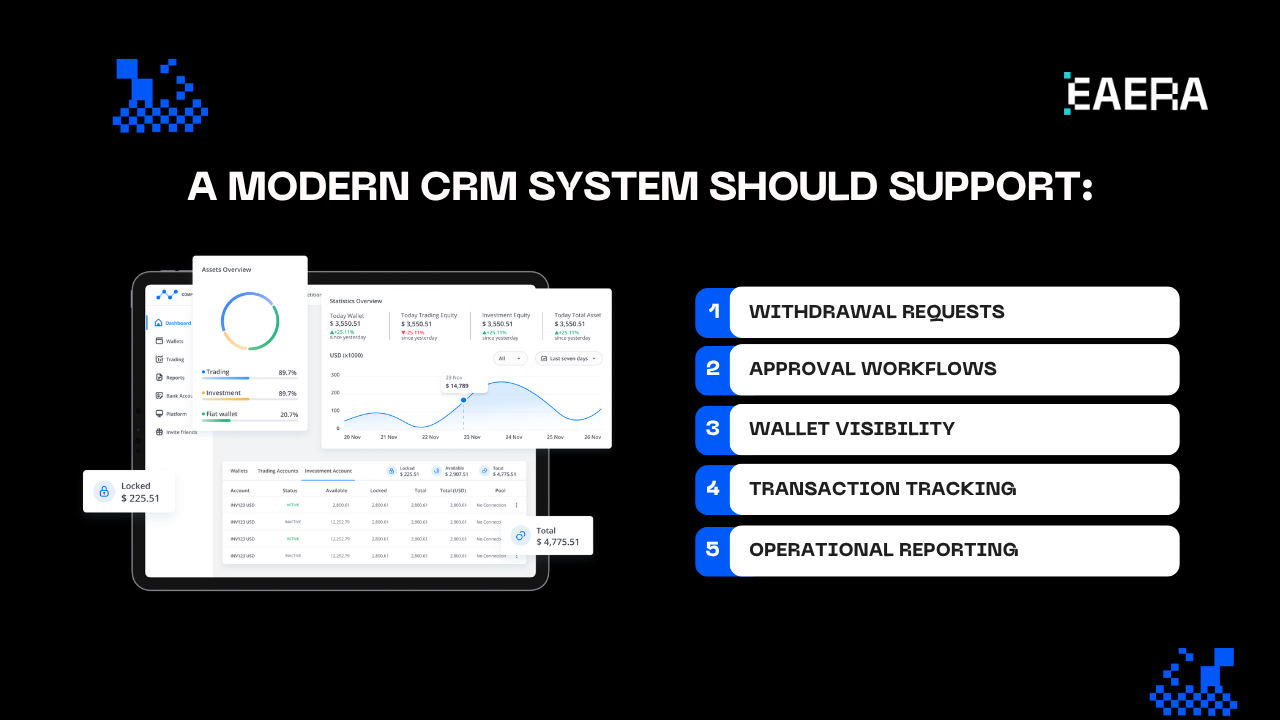
Smooth payout process helps in building a trader’s trust and less operational friction.
Centralized payout visibility also enables finance and operations teams to better manage workflows across large user bases.
System 5: Trading Platform and Operational Integration
Disconnected systems result in operational inefficiencies and an inconsistent trader experience.
The best prop firm CRM solutions integrate directly with:
- Trading platforms
- Wallet infrastructure
- Support systems
- Affiliate management systems
- Analytics tools
- Communication platforms
Integrated operational ecosystems eliminate double work and improve the coordination of workflows between departments.
Solutions like EAERA show how integrated infrastructure can help support operational scalability for funded trading businesses.
Prop Firm CRM Comparison: Basic CRM vs Operational Ecosystem
Not all CRM systems are designed for funded challenge operations.
| Area | Basic CRM | Advanced Prop Firm CRM |
| Challenge Tracking | Manual-heavy workflows | Automated lifecycle management |
| Risk Monitoring | Limited visibility | Real-time rule tracking |
| Payouts | External/manual handling | Integrated operational workflows |
| Retention | Generic communication | Behaviour-driven engagement |
| Integration | Limited systems | Unified operational ecosystem |
| Scalability | Small-scale support | High-volume challenge operations |
The prop firms that win aren’t just focused on marketing and on acquisition, they’re also focused on operational efficiency and trader experience.
The higher the level of participation in the challenge, the more important operational consistency becomes for maintaining trader trust and internal efficiency.
Funded challenge environments such as EAERA integrate automation, operational visibility and scalable infrastructure into unified CRM ecosystems.
What Prop Firms Should Prioritize in a CRM Platform?
When choosing the right prop firm CRM, don’t just look at the front-end features. The long-term operational scalability and growth potential of a platform are factors that firms need to consider.
Important evaluation areas include:
- Automation depth
- Challenge lifecycle support
- Risk monitoring visibility
- Integration flexibility
- Scalability
- Reporting quality
- Trader experience
Flexibility in customization is also important, particularly for firms with multiple challenge models, operational structures, or regional workflows.
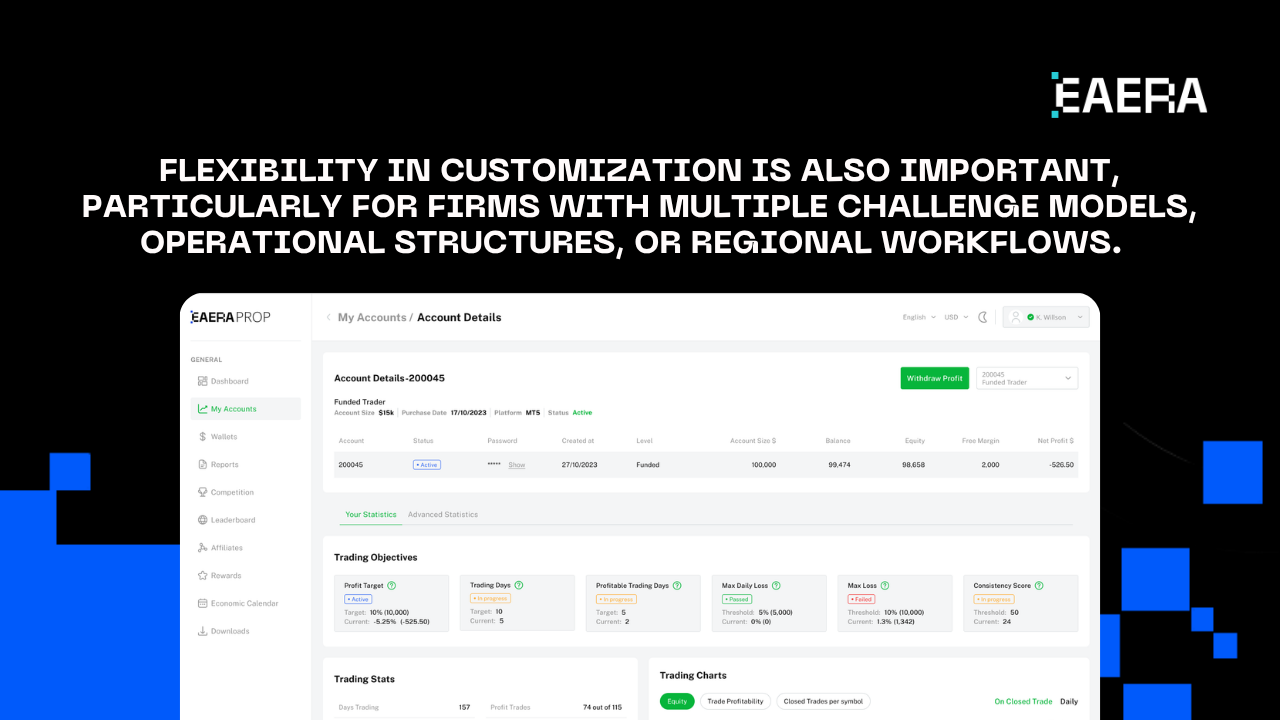
The best CRM systems don’t just serve as trader databases but support the entire operational lifecycle of funded challenge businesses.
The funded challenge industry is still exploding, and operational infrastructure is becoming one of the biggest competitive advantages for prop firms.
A modern prop firm CRM helps firms automate onboarding, manage challenge lifecycles, monitor trading rules, improve retention and streamline payout operations. These systems are no longer just operational tools; they are evolving to be core infrastructure for scalable funded trading business.