



Many brokers don’t lose clients because they have a weak sales team. It’s broken. They lose customers. Slow onboarding, disconnected payment flows, poor lead tracking, delayed KYC, weak client segmentation and manual back-office work generate friction across the entire trader lifecycle.
The best forex CRM should not only keep client data. It should house sales, onboarding, compliance, trading accounts, payments, IB management, reporting, and retention within one operational ecosystem.
Related articles:
- Prop Firm CRM: 5 Systems Built for Funded Challenges
- 8 Features in Forex CRM System That Separate Winners
Here we look at how to pick a Forex CRM, why it’s important to pick the right system to stop client leakage before it becomes revenue loss, and what brokers should consider before deciding.
What Makes a Forex CRM “Broken”?
Not every broken Forex CRM is visible. The interface might still work. The sales team might still log calls. Managers still might receive basic reports. But behind the scenes, the broker may be losing leads, deposits, trading activity and retention because the system is not able to support real business operations.
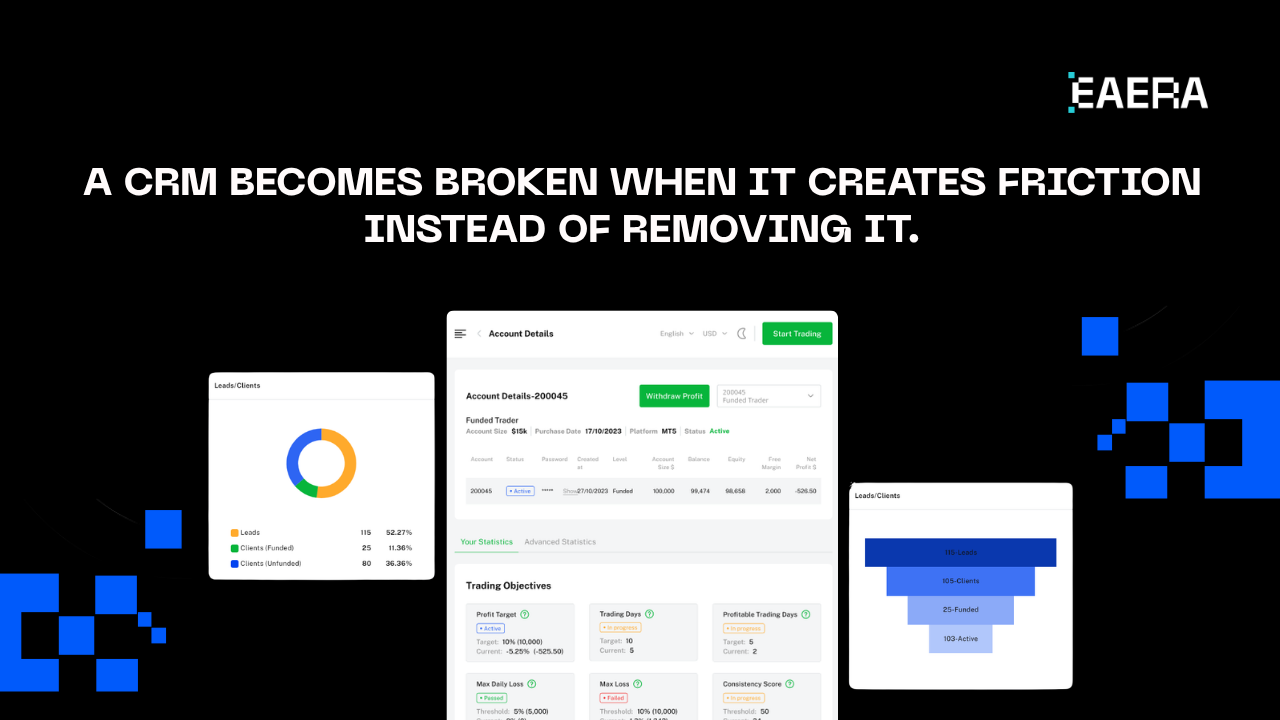
A CRM becomes broken when it creates friction instead of removing it.
Common signs include:
- Leads are not assigned fast enough
- Sales teams cannot see full client history
- KYC status is unclear or delayed
- Deposits and withdrawals are disconnected from client records
- IB and affiliate commissions require manual checks
- Client segmentation is too basic
- Retention teams cannot identify inactive or high-value clients
- Reports are delayed, incomplete, or inconsistent
- Teams rely on spreadsheets to fix missing CRM logic
A broken Forex CRM is any system that hampers brokers from efficiently converting, onboarding, servicing, monitoring, and retaining clients.
The best forex CRM should provide brokers with complete visibility across the client journey. If teams must hop between multiple tools just to get a sense of one client’s status, the CRM is not doing its job.
Why the Best Forex CRM Must Manage the Full Client Lifecycle?
A Forex CRM should not be treated as a contact database. That mindset is outdated.
Brokerage operations are driven by lifecycle. Just because a client registered doesn’t mean they are valuable. They become valuable individuals once they are onboarded, verified, deposited funds, opened a trading account, trade actively, and stay engaged over a period.
The best forex CRM eliminates friction at each step. If the system only helps the sales team and does not integrate with onboarding, payments, trading accounts or back-office workflows, the broker will still lose clients post-conversion.
Client leakage often happens between stages. Lead can be registered but never complete KYC. Deposit can be missed by verified client. A client who puts money in may never actually trade. Retention teams were not notified on time. Active traders are lost for inactivity.
EAERA views its forex CRM as only one component of a larger broker technology ecosystem that also includes CRM, client portal, back office, funding, affiliate management, reporting, alerts and workflow automation. This is the kind of connected infrastructure that brokers care about because growth is more than lead capture. It depends on life cycle control.

Core Features Brokers Should Expect from the Best Forex CRM
The perfect forex CRM platform needs to bring together commercial, operational, and compliance functions into one integrated system. A long list of features is not enough. The real question is whether the CRM enables teams to move faster, reduces manual work, and protects revenue.
Lead and Sales Management
Lead management is the first revenue gate.
A robust CRM should help with lead capture, tracking lead sources, assigning sales, seeing the sales pipeline, making call notes, setting up follow-up reminders, and keeping a log of client interactions. Sales teams want to know where a lead came from, who owns it, what has been done with it, and what is the next step.
Without this, leads go cold. Response times slow down. Sales teams duplicate work. Managers lose visibility.
Client Onboarding and KYC
Onboarding is where many brokers lose potential clients.
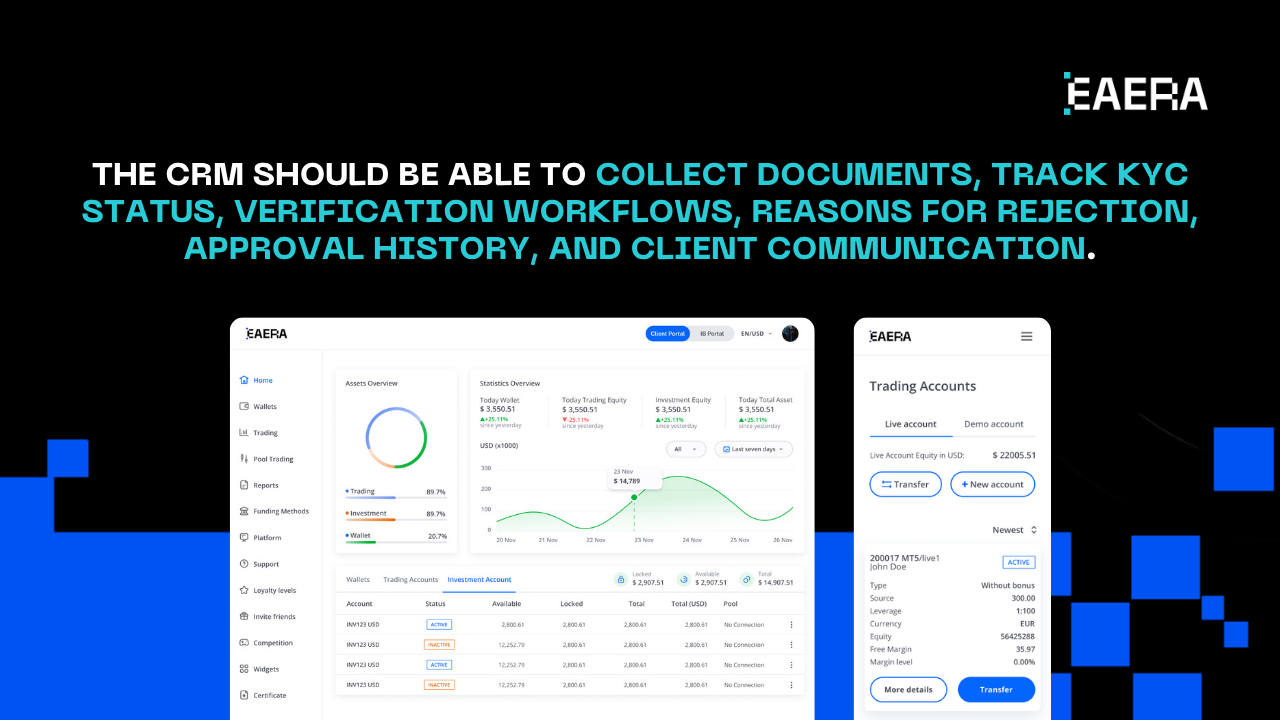
The CRM should be able to collect documents, track KYC status, verification workflows, reasons for rejection, approval history, and client communication. A client should not be lost due to a missing document or delayed verification.
The system should make the next required action clear for both the client and the internal team.
Payment and Wallet Management
The deposits and withdrawals are important moments in the life cycle of the client.
The CRM must display wallet balances, deposit requests, withdrawal requests, transaction status, payment history, failed payments, and internal transfer activity. Support and finance teams should not have to look into different systems to see what happened.
A payment issue not acted upon quickly can be a lost client.
Trading Account Management
The CRM should attach client profiles to trading accounts.
Teams should be able to view account type, account status, server, leverage, balance, equity, trading activity, and account creation history. The core requirement for brokers that work on platforms like MT4, MT5, or web trading infrastructure is the ability to view trading accounts.
A disconnected CRM creates blind spots between client management and trading behavior.
IB and Affiliate Management
Many brokers rely on IBs, affiliates, and partner networks for growth.
The CRM should enable tracking referrals, partner hierarchy, commission rules, payout workflows, visibility of sub-partners, and network performance analytics. Disputes cannot be avoided without correct attribution and commission logic.
Partner trust is a revenue infrastructure. CRM can’t handle it then the broker is exposed.
Reporting and Analytics
Management needs the right information to make decisions.
The CRM should provide dashboards for sales conversions, KYC status, deposits and withdrawals, trading activity, client segmentation, IB performance, and revenue trends.
The best forex CRM does not make managers wait for manual reports. Data needs to be believable, accessible, and actionable.
How a Weak CRM Causes Client Leakage?
Client leakage is not perceived as such a big problem. It’s usually a small failure along the way.
A lead waits too long to initiate first contact. A client cannot successfully onboard. A payment is missed, and no one chases it up. Inactivity means that the trader doesn’t take any retention action. An IB disputes commission because of unclear attribution.
Each issue can seem small. Together they add up to lost revenue.
Common leakage points include:
- Leads abandoned before sales contact
- Registration drop-off due to unclear onboarding
- KYC delays blocking first deposit
- Failed payments without follow-up
- Missing visibility into client intent
- Support teams lacking transaction context
- IB attribution errors
- Inactive traders not flagged early
- Managers unable to identify funnel drop-offs
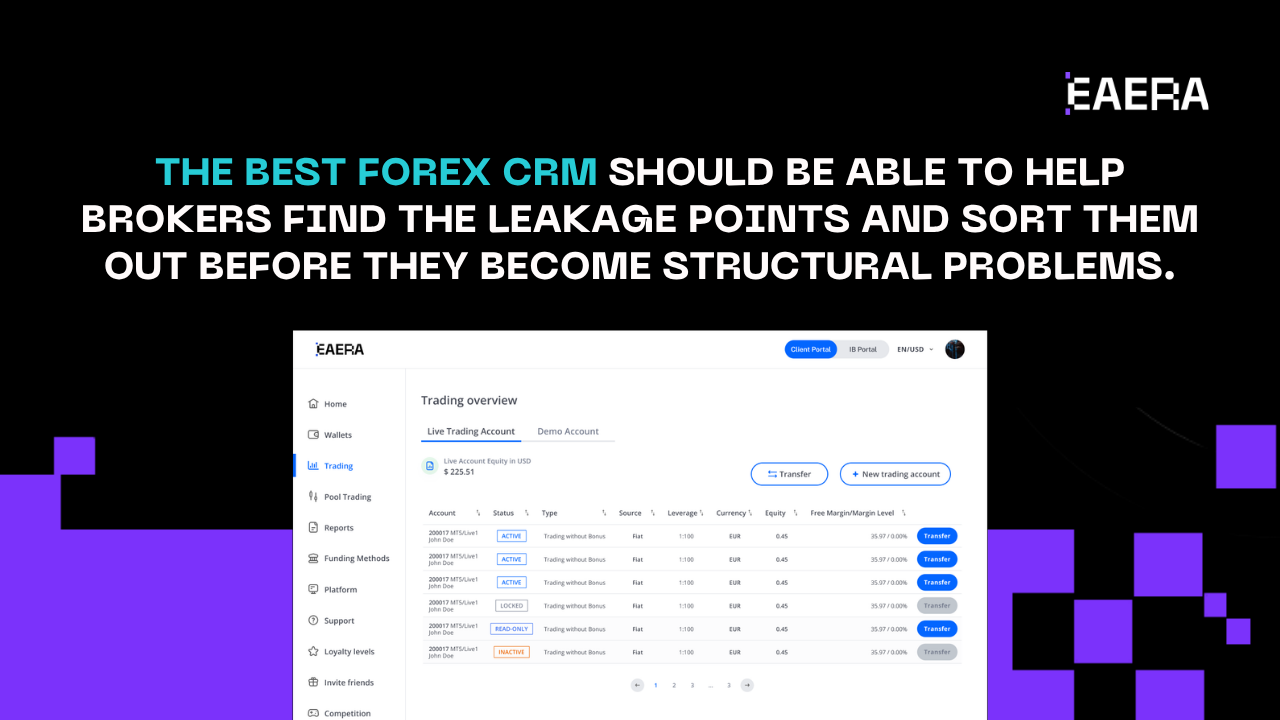
The best forex CRM should be able to help brokers find the leakage points and sort them out before they become structural problems.
Fragmented systems mean manual workarounds. Teams start working with spreadsheets, chat messages, screenshots, and disconnected reports. This might work when the broker is small, but this does not scale.
As volume grows, manual processes get slower riskier and more expensive. The company needs more control, and the broker slows down.