



One dramatic moment when forex brokers lose clients is rare. They lose them through small operational leaks: slow follow-up, delayed onboarding, unclear KYC status, failed deposits, inactive trading accounts, bad retention timing, and disconnected partner attribution.
Related articles:
The best forex CRM is not the one with the most features. It’s the system that helps brokers identify where clients are leaking, why they are leaking, and how teams should act before revenue is lost.
Client Leakage Is Not a Sales Problem Alone
Client leakage is often blamed on the sales team. That is too narrow.
Weak conversions aren’t always the result of poor sales performance or bad leads. In many brokerages, sales is only one part of the leak chain. The sales team may be contacting the lead on time, but the client can still walk away due to delayed KYC, confusing funding, or poor processing of account activation.
Client leakage in forex brokerage is the loss of potential revenue from broken handoffs between sales, onboarding, compliance, payments, trading, support and retention.
The best forex CRM should expose these handoff failures instead of hiding them inside disparate tools.
Even with a successful sales team, a broker can lose clients if the rest of the lifecycle is broken up. If the CRM only stores contact info, revenue is unprotected. It must be linked throughout the entire client journey, and every drop-off must be visible.
The Hidden Cost of Broken Client Handoffs
Client leakage is expensive because brokers have already paid for the opportunity.
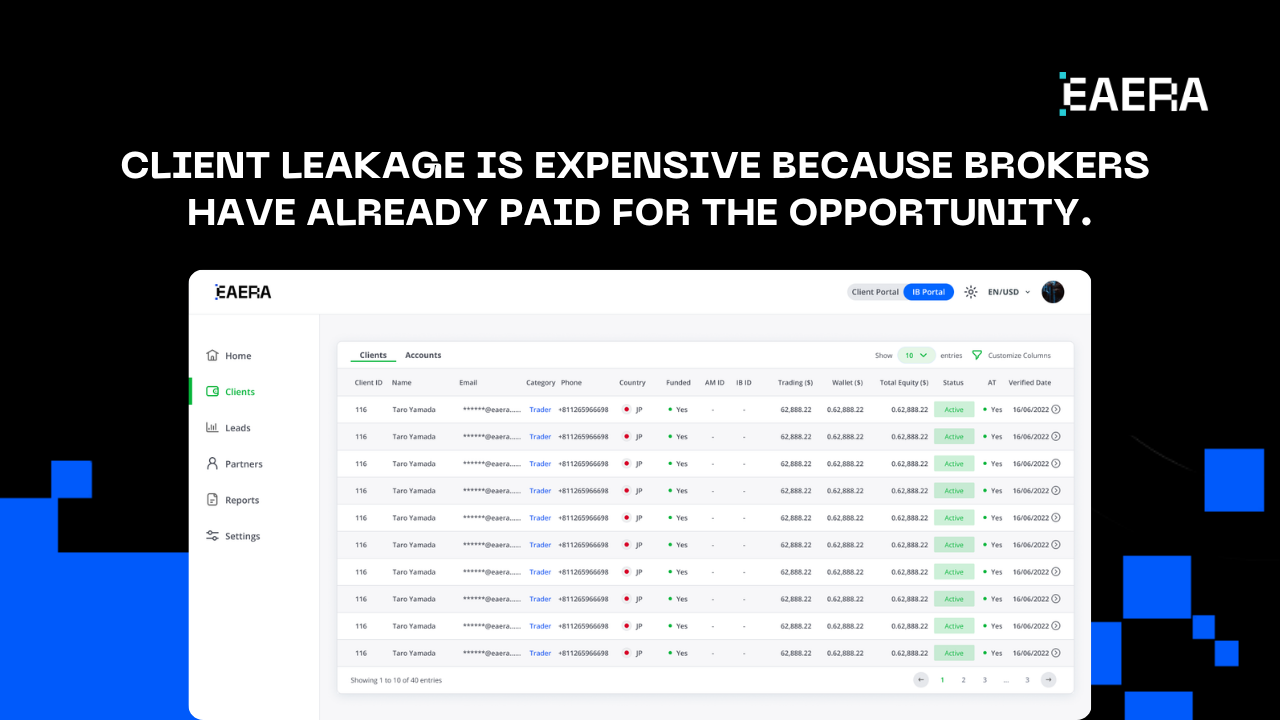
When that client leaves, the broker loses more than one account. It costs the acquisition, possible deposit, trading activity, retention opportunity, and maybe even the partner relationship behind that client.
The hidden cost appears across several stages.
Lead Leakage
Marketing gets the leads, but slow assignments or poor follow-up kills them. A lead that sits too long is more likely to go with another broker or lose intent altogether.
Onboarding Leakage
Clients sign up and drop out because KYC, documents or approval steps are not clear. If the client doesn’t know what to do next, the journey ends.
Funding Leakage
Clients do not deposit because payment options are confusing, transaction statuses are unclear, or failed payments are not recovered quickly.
Trading Leakage
Clients only deposit, not create or activate a trading account. Here the broker has brought the client close to revenue but has not yet turned the client into an active trader.
Retention Leakage
Active traders are not flagged in time and become inactive. Before the team notices, the trader may have already migrated to another platform.
Partner Leakage
If attribution or commission visibility is unclear, IBs and affiliates will lose trust. Disputes between partners can damage the acquisition of a broker.
The ideal forex CRM should not only count leads and accounts but also help brokers measure leakage at each lifecycle stage.

Where Clients Leak in a Forex Brokerage Lifecycle?
Brokers need to know where leakage occurs to prevent it. Client lifecycle should be mapped as a series of business-critical handoffs.
-
Lead to First Contact
Leads generated through campaigns, referrals, landing pages, affiliates, or sales outreach. If not assigned, prioritized, and contacted quickly, the opportunity weakens.
-
Registration to KYC
A lead can register but not complete verification. This usually occurs if there is confusion over the document requirements; the verification process takes too long, or the client is not given regular reminders.
-
KYC to First Deposit
A verified client is not a revenue-generating client yet. If the funding is difficult, unclear, or unsupported, the client may walk away before the first deposit.
-
Deposit to Trading Account
Some clients deposit but do not begin trading due to a delay in account creation or unclear next steps. This is a huge leak point because the client has already shown intent to fund.
-
First Trade to Active Trader
A client who trades only once is not a retained client. Brokers need to understand if the client is developing a trading habit or is experimenting with the platform.
-
Active Trader to Dormant Client
Inactivity often starts silently. A trader slows down, stops logging in, stops depositing, or stops opening positions. If the team realizes this too late, reactivation gets harder.
-
Referred Client to Partner Revenue
The broker risks partner disputes if it fails to correctly attribute a referred client. This can erode trust with IBs and affiliates.
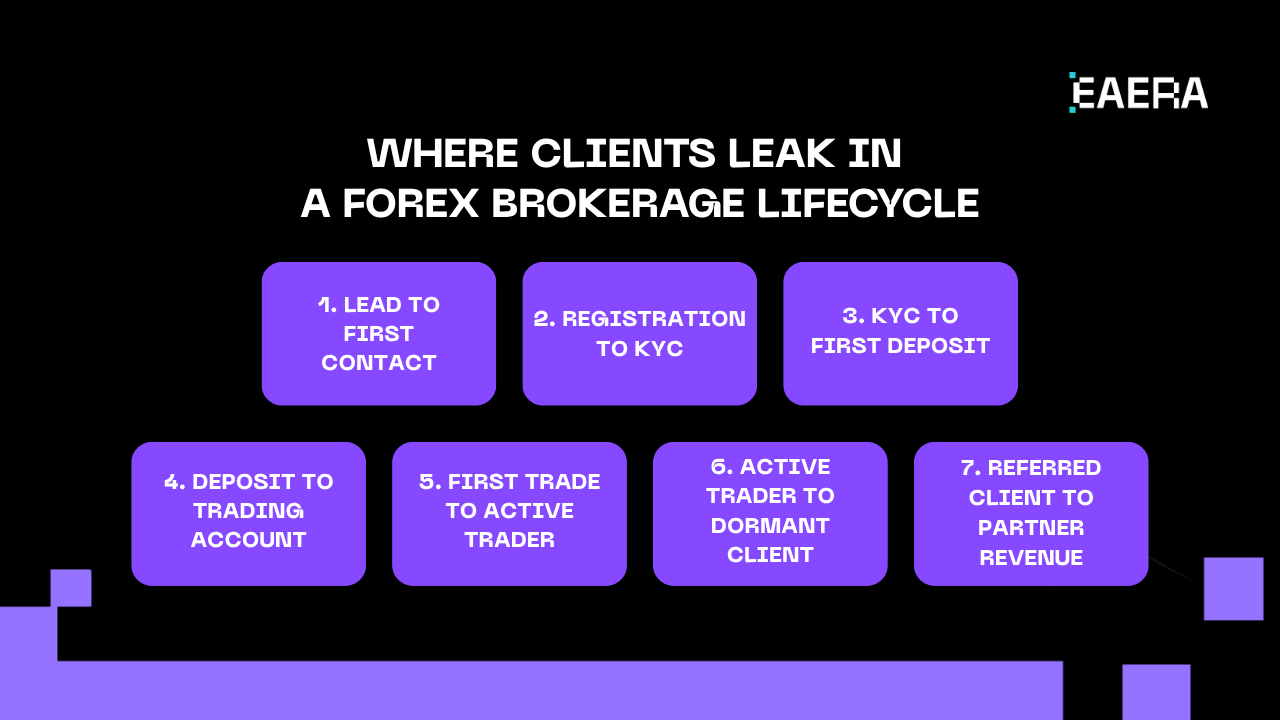
A best forex CRM candidate should make each leakage point visible, measurable, and actionable.
Why Spreadsheets and Disconnected Tools Make Leakage Worse?
Many brokers attempt to solve leakage with spreadsheets, chat messages, manual reports, and one-off integrations. That could work for a while, but it gets dangerous as the business scales.
Spreadsheets don’t allow you to see the lifecycle in real-time. They don’t automatically lead to follow-ups. They do not always link sales, KYC, payment, trading, support, and partner data. They also create dependency on individual staff members who “know where things are.”
Disconnected tools create several problems:
- No single source of truth
- Duplicated client records
- Slow internal escalation
- Poor visibility across teams
- Manual commission checks
- Delayed reporting
- Inconsistent client statuses
- Higher compliance and audit risk
- More dependency on staff knowledge
The best forex CRM should replace manual patchwork with connected workflows, shared client visibility, and automated alerts.
As brokers scale across regions, account types, products, payment methods, sales teams, IB networks and client segments, leakage increases. What is manageable at a small scale is operational chaos at a larger scale.
A broker cannot scale revenue on top of fragmented visibility.
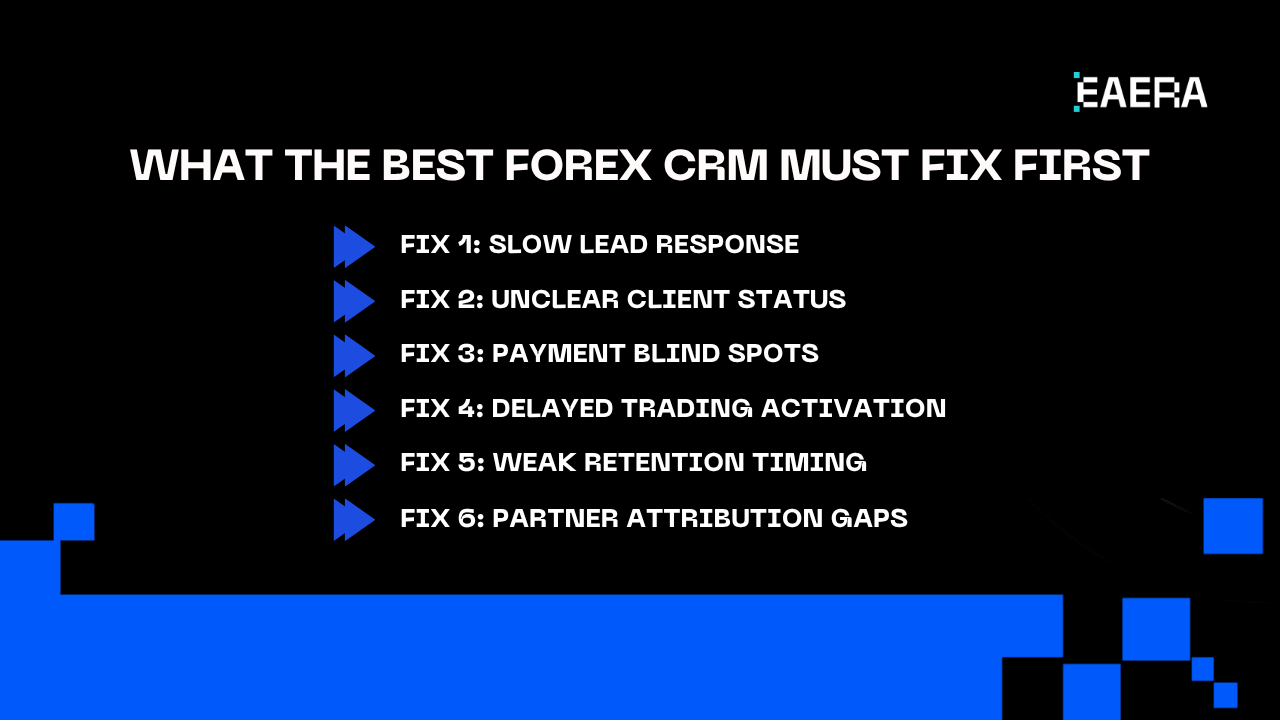
What the Best Forex CRM Must Fix First?
The best forex CRM should be geared towards plugging the operational holes that directly lead to client leakages. Having a long feature list is not enough. The CRM must solve the problems that hinder conversion, activation, and retention.
Fix 1: Slow Lead Response
The CRM should automate lead assignment, ownership, source tracking, and follow-up reminders. Every lead should have an owner, status, and next action.
Fix 2: Unclear Client Status
Teams need to be able to see at a glance if a client is new, registered, KYC pending, verified, funded, active, inactive or blocked. Teams are time-wasting asking basic questions with no clear logic for status.
Fix 3: Payment Blind Spots
The client profile should show deposits, withdrawals, failed transactions, wallet status, and funding source activity. Payment friction demands operational action, not a retreat into a separate system.
Fix 4: Delayed Trading Activation
The CRM must connect the onboarding and trading account workflows so that funded users can trade faster. A funded client with no trading account is a leakage that can be prevented.
Fix 5: Weak Retention Timing
The system needs to generate alerts when a client is inactive, activity, or high value behavior. The client must be fully disengaged after retention.
Fix 6: Partner Attribution Gaps
Referral sources, IB tree, affiliate campaign, commission logic, and payout status should be transparent. Accurate tracking is essential for partner trust.
EAERA backs the broker’s operations with a connected technology ecosystem that includes CRM, client portal, back office, funding, partner management, reporting, alerts and workflow automation.
The best forex CRM should help brokers spot leakage early, automate follow-up, improve lifecycle visibility, and give teams one source of truth.
In 2026, brokers will have to select CRMs based on the number of features they provide, not how well they prevent revenue loss.