



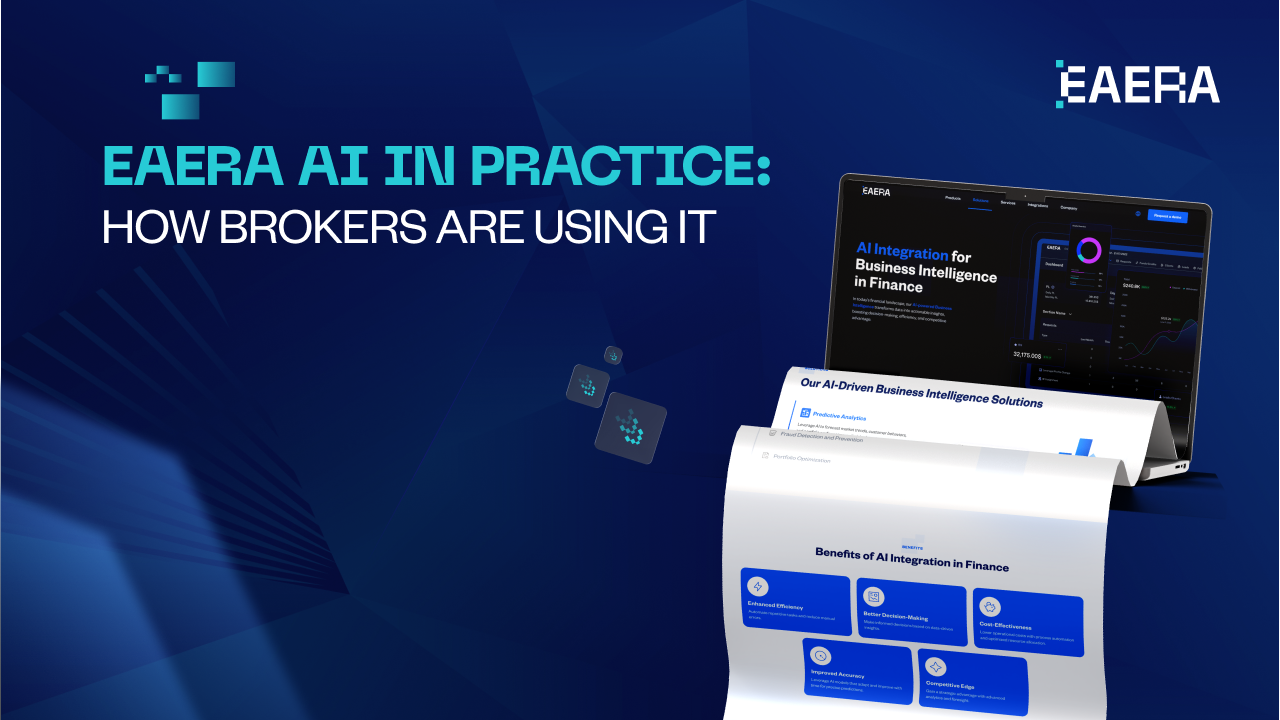
EAERA AI helps brokers transform financial and operational data into actionable business intelligence. Brokers can leverage AI not as a concept but to analyze trading patterns, client behavior, market activity, risk signals, reporting and operational performance.
For brokerages, AI is helpful if it can help make decisions day-to-day: which clients follow-up, where risk is increasing, which campaigns convert to active traders and how teams can avoid manual analysis. This article discusses how brokers are implementing EAERA AI in decision making, reporting, risk, customer analytics, and operations.
Why Brokers Need AI for Business Intelligence
Traditional reporting often is about what happened in the past. AI-powered business intelligence gives brokers visibility into what’s happening now and what may happen next. This matters for brokers who need to make decisions faster in sales, retention, risk, finance, and management.
EAERA AI helps brokers find hidden insights, recognize trends, automate complex processes, improve decision-making, and enhance risk management.
By applying AI to business intelligence, brokers can turn data into predictions, alerts, dashboards, and recommended actions.
By applying AI to business intelligence, brokers can turn data into predictions, alerts, dashboards, and recommended actions.
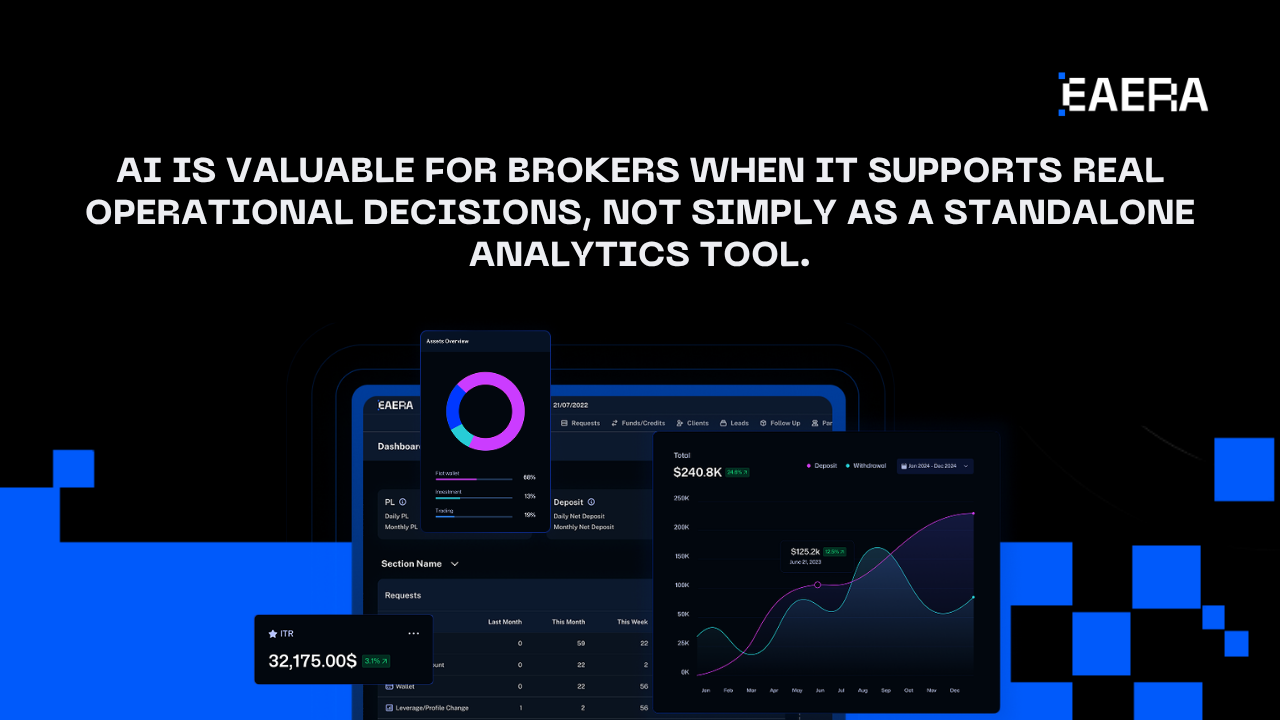
AI is valuable for brokers when it supports real operational decisions, not simply as a standalone analytics tool.
Use Case 1: Predictive Analytics for Market, Client, and Portfolio Insights
One of the most practical AI use cases for brokers is predictive analytics. It aids teams in going from historical reports to forecast future trends.
EAERA AI gives brokers the power to use predictive analytics to predict market trends, customer behavior, and portfolio performance. It can also support simulations and scenario analysis, helping firms review possible outcomes before making strategic decisions.
For brokers, predictive analytics can support:
- Client behavior forecasting
- Deposit and activity trend analysis
- Trading volume prediction
- Campaign performance forecasting
- Portfolio performance insight
- Market movement scenario analysis
- Revenue and retention planning
- Segment-level growth opportunities
A broker can use predictive analytics to identify clients likely to become inactive; segments likely to increase their trading volume or campaigns likely to result in better funded accounts. Risk teams may employ scenario analysis as a technique to review exposure under different market conditions. Management teams can use forecasts to plan sales, support, and retention capacity.
This is particularly useful when a broker has many client segments, multiple regions, different products, and huge volumes of transactions. A manual review can show how you’re doing overall, but predictive analytics can help you see patterns sooner.
The value of EAERA AI is not only prediction. It is helping broker teams act before problems appear in end-of-month reports.
Use Case 2: Real-Time Data Processing and Trading Activity Monitoring
Real-time data processing allows brokers to follow financial data streams as they happen. For brokers, this can be a trading volume, market movement, client activity, account behavior, operational signals, etc.
A brokerage team can’t always wait for daily or weekly reports. Some signals need a quicker response. Business opportunities or risks include a sudden downturn in trading activity, a sudden upswing in volume, a campaign that produces registrations but no deposits, or a funded client who never makes a first trade.
EAERA AI can help brokers connect real-time data with operational action.
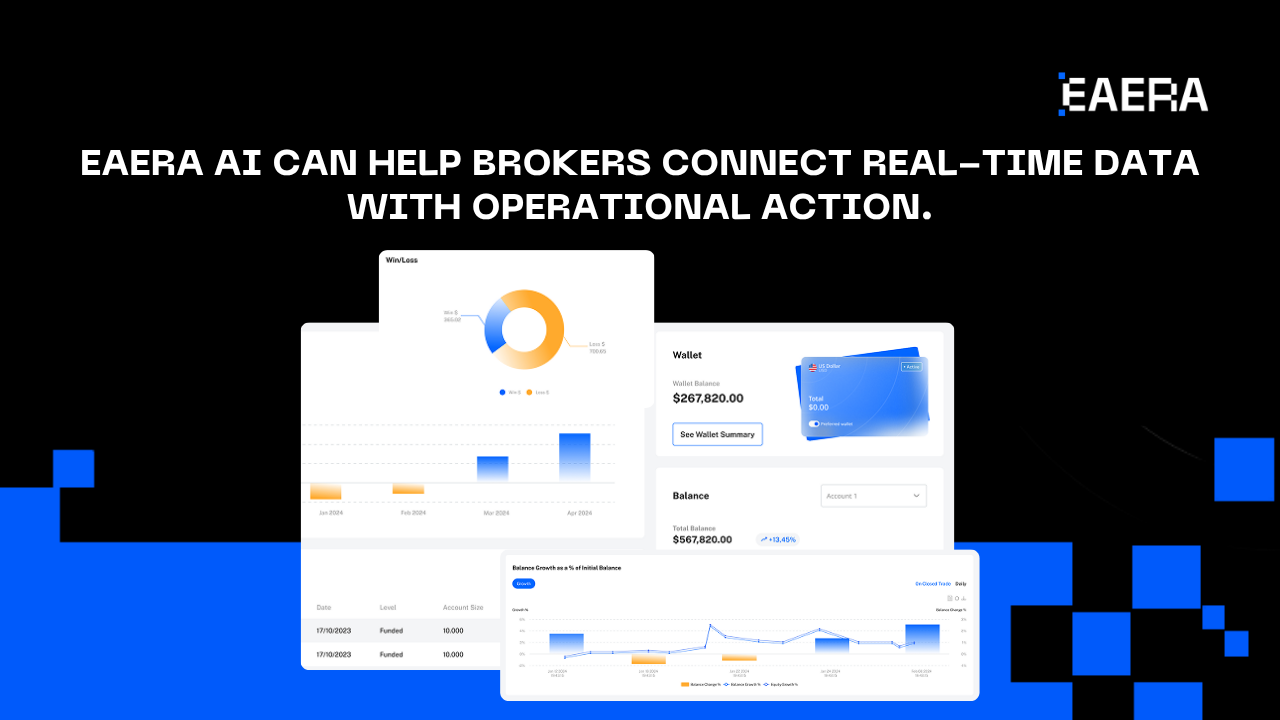
Broker teams can use real-time intelligence to monitor:
- Trading volume changes
- Market movement impact
- Active and inactive clients
- Sudden activity spikes
- Funding-to-trading behavior
- Client lifecycle progress
- Platform activity signals
- Segment-level trading trends
Real-time processing helps brokers reduce decision delays and respond while the signal is still relevant.
Use Case 3: Customer Analytics, Segmentation, and Personalization
Customer analytics gives brokers insight into customers beyond simple profile data. Brokers can segment clients by behavior, activity, value, product interest, lifecycle stage and support needs, rather than treating all clients the same.
With EAERA AI, brokers can move from broad client lists to smarter segmentation.
Customer analytics can support:
- Lifecycle segmentation
- High-value trader identification
- Dormant client detection
- Demo-to-live conversion analysis
- Retention campaign targeting
- Product interest mapping
- Client behavior clustering
- Support sentiment review
- Personalized client communication
This is important as different clients need different actions. A new-funded client may need some help with the platform. A dormant high value trader may need a follow up account manager. A demo user may need some education prior to going live. A client with a history of support issues may require a service review before he is given another campaign.
Brokers can also use customer analytics to understand client needs and preferences through segmentation and sentiment analysis. That means better retention strategies and more relevant communication.
Brokers can increase engagement by treating each client differently, not the same across the board. It also helps teams avoid generic campaigns that may not match the client’s actual lifecycle stage.
Use Case 4: Automated Reporting, Efficiency, and AI Adoption Process
One of the most obvious ways AI can cut operational workload is through automated reporting. Broker teams spend too much time preparing reports, exporting data, checking spreadsheets, and updating dashboards manually.
EAERA AI can support automated reporting, regulatory compliance reports, and dynamic KPI dashboards. It helps management teams to monitor the performance and reduces manual reporting efforts.
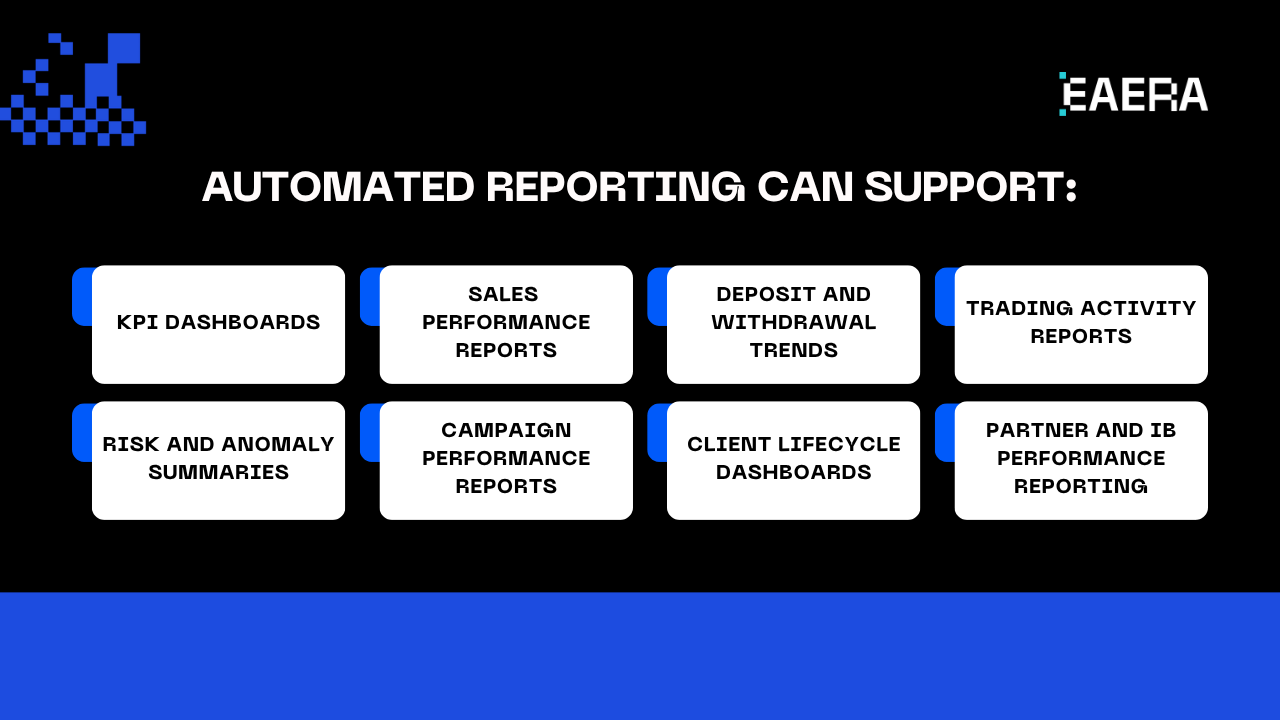
For brokers, automated reporting can support:
- KPI dashboards
- Sales performance reports
- Deposit and withdrawal trends
- Trading activity reports
- Risk and anomaly summaries
- Campaign performance reports
- Client lifecycle dashboards
- Partner and IB performance reporting
AI can cut down on repetitive reporting tasks, allowing teams to focus on decision making rather than manual data preparation. It can also enhance accuracy, cutting out manual errors, and allowing teams to work with more consistent data.
But successful AI adoption must start with business goals and data readiness. First brokers need to decide which area they want AI to improve, whether it’s the speed of reporting, risk visibility, customer segmentation, forecasting, fraud detection or operational efficiency.
The practical value of EAERA AI is turning brokerage data into faster decisions, cleaner reporting, better risk visibility, and more efficient operations.
For brokerages, AI is most valuable when it is connected to daily operations, not used as a separate experiment.