



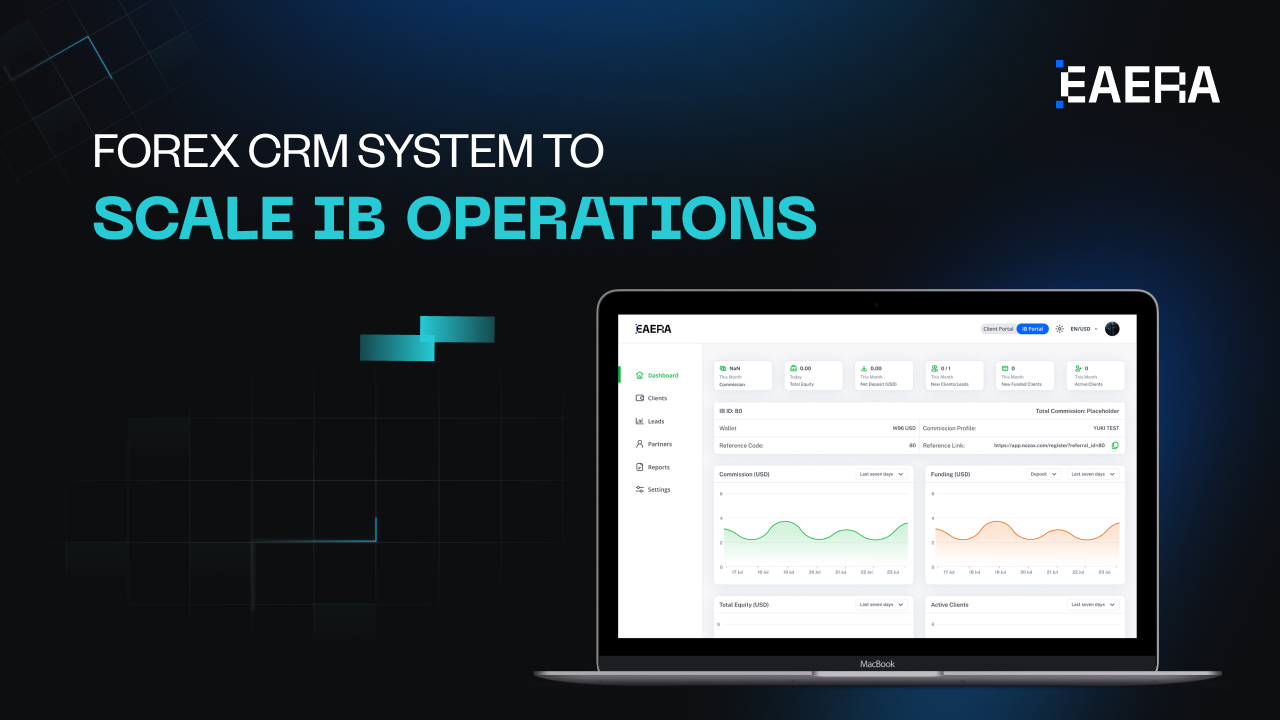
A forex CRM system allows brokers to scale IB operations by combining partner onboarding, client referral tracking, commission validation, payout control, and performance reporting in one workflow.
When IB growth is not organized, it can result in misattributed clients, inconsistent commission rules, finance teams that must do manual checks, and partners that lose trust.
Related articles:
- Unlock Your Brokerage Potential: Top Forex CRM Solutions Revealed!
- Top 10 Forex CRM Best Features Every Broker Needs
Why IB Operations Become Hard to Scale?
When the broker has a few partners, IB operations are easy to run. A small team can manually check referrals, calculate commissions, and answer partner queries. But this approach quickly becomes unworkable as the network expands into more regions, products, types of accounts, sub-IB levels and commission plans.
The problem is not only volume. It is complexity.
A broker may have to handle direct IBs, sub-IBs, master IBs, affiliates, regional partners, and campaign-based referral sources simultaneously. Each partner can have different conditions, different commission rates, and different payout conditions.
Common scaling issues include:
- Too many referral sources to track manually
- Multiple IBs claiming the same client
- Sub-IB hierarchy becoming unclear
- Commission rules differing by account type or symbol group
- Finance teams manually verifying trading volume
IB scaling breaks down when partner growth exceeds the broker’s attribution, commission, payout, and reporting controls.
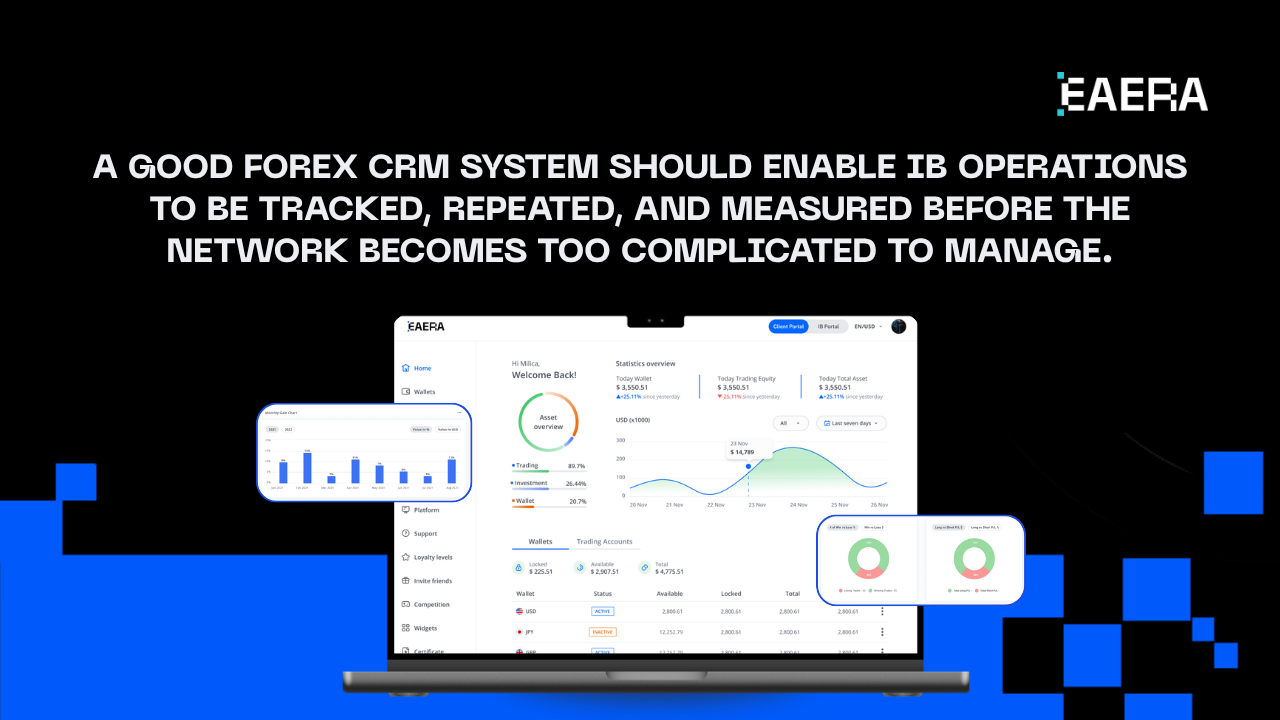
A good forex CRM system should enable IB operations to be tracked, repeated, and measured before the network becomes too complicated to manage.
Build a Clear IB Onboarding Workflow
If partner onboarding is done via scattered emails, spreadsheets, and manual approval notes, a broker cannot scale IB operations.
Each IB should have a structured profile, clear status, assigned partner manager, approved commission plan, and correct portal access. Every step after the onboarding, the setup is a risk: attribution, reporting, commission calculation, and payout.
A forex CRM system should manage the full IB onboarding workflow, including:
- IB registration
- Partner profile
- Agreement status
- KYC or KYB documents, if required
- Approved regions or markets
- Commission plan
- Partner portal access
- Status: pending, approved, rejected, suspended, or inactive
This workflow gives internal teams clear operational visibility. Partner managers know what IBs are active. Compliance teams know what documents they are missing. Finance teams know which commission plan is applicable. Management can see how many partners are approved, inactive, or blocked.
All IB onboarding should be standardized through a forex CRM system, so that each partner is onboarded with the right status, permissions, agreement, and commission setup.
Without this foundation, brokers can expand their partner base but relinquish control over how partners operate.

Control Referral Attribution from Day One
Attribution is the foundation of IB trust. If a broker cannot prove which IB brought to which client, disputes will happen.
A client can sign up through one IB link, then talk to a sales team and then deposit through another campaign. A sub-IB can refer to another client under a master IB. In some cases, the ownership may be changed manually by the sales team. Without clear attribution rules, there’s a risk of multiple parties claiming the same client.
The forex CRM system should track:
- Referral link or campaign source
- IB code
- Client registration source
- First-touch attribution
- Last-touch attribution, if used
- Manual reassignment history
- Sub-IB relationship
- Client ownership status
- Attribution lock or override rules
The system should also define what happens in common edge cases.
For example:
- A client registers under one IB but deposits later through another channel
- A client is referred by a sub-IB under a master IB
- A sales team manually changes client ownership
- An IB agreement becomes inactive or suspended
- Client attribution needs correction after internal review
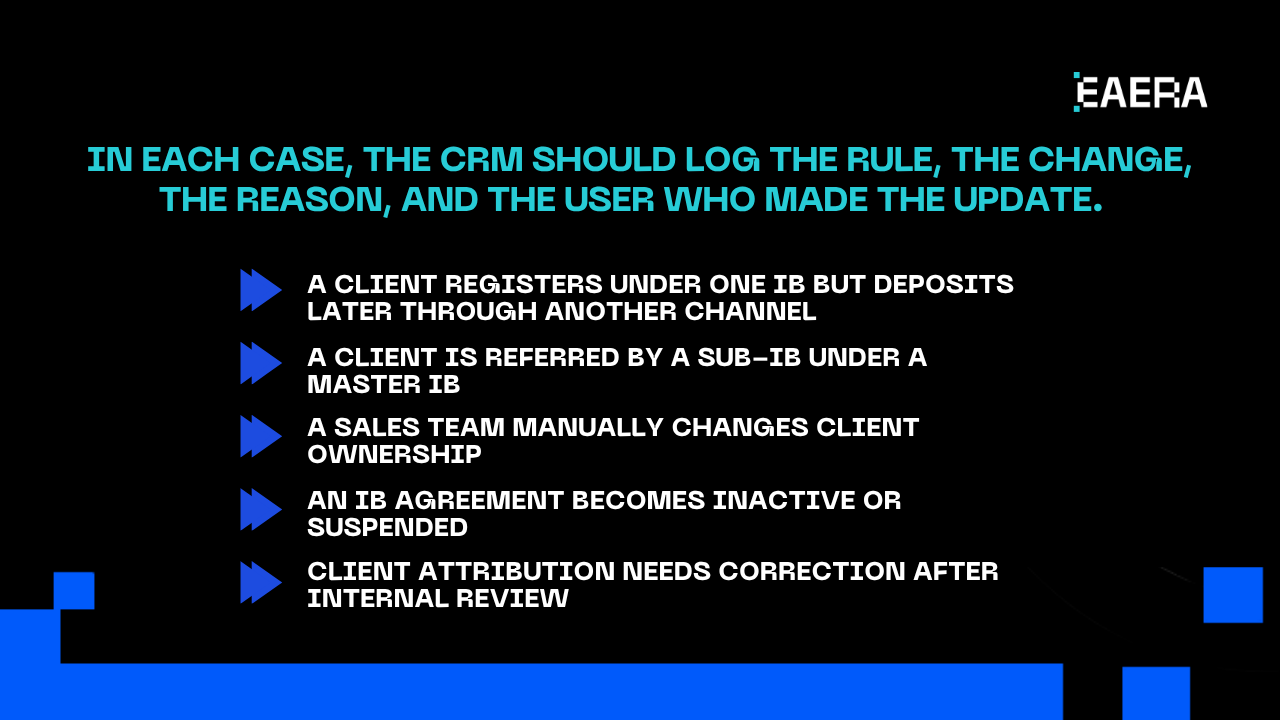
In each case, the CRM should log the rule, the change, the reason, and the user who made the update.
The best forex CRM system should make attribution visible, controlled, and auditable. IB trust assumes clear ownership, not manual interpretation.
Attribution ambiguity undermines partner relationships. If managed, partners have faith in the system, and finance teams can confidently validate commissions.
Automate Commission Rules Without Losing Control
Commission is where IB operations become financially sensitive.
For one simple plan, manual commission calculation might work. But when brokers have multiple products, account types, symbol groups, partner levels and payout conditions, the manual approach falls apart.
A broker may need to support several commission models, such as:
- Lot-based commission
- Revenue share
- CPA
- Markup share
- Rebate
- Multi-tier override
- Campaign-based bonus
- Region-specific commission plan
- Product-specific commission plan
A reliable forex CRM system should be able to automate commission rules based on predefined logic. This reduces manual checking and ensures calculations are consistent across the IB network.
The system should automate:
- Eligible client detection
- Eligible trading account detection
- Eligible symbol or group checks
- Reversal or adjustment handling
- Commission status updates
But automation of commission should not remove financial control. Brokers still require validation, approval, and exception handling.
Each commission record has to show referred client, trading account, volume, applied rule, amount, IB level and payout status and approval history.
A good forex CRM system will automate the calculation but still allow for finance teams to validate, approve, adjust, reject or reverse commissions where needed.
That balance is important. Automation produces speed; control protects the broker.
Give IBs a Partner Portal They Can Trust
A broker can’t grow its IB operations if every partner has to call support to get simple updates. As the IB network grows, so does the support workload.
A partner portal offers IBs visibility into their own network and performance with controlled access. It reduces manual communication and builds trust.
A strong partner portal should show:
- Referred clients
- Registration status
- Funded clients
- Active clients
- Trading volume
- Commission earned
- Pending commission
- Paid commission
- Payout history
- Sub-IB performance
- Marketing links or campaign materials
That doesn’t mean partners should see everything. Visibility must be controlled. IBs should only see what the broker lets them see. The portal should provide sufficient transparency for performance management, while protecting privacy, compliance requirements, and internal broker data.
A forex CRM system should connect the partner portal with the broker’s back office so that partners and internal teams use the same data.
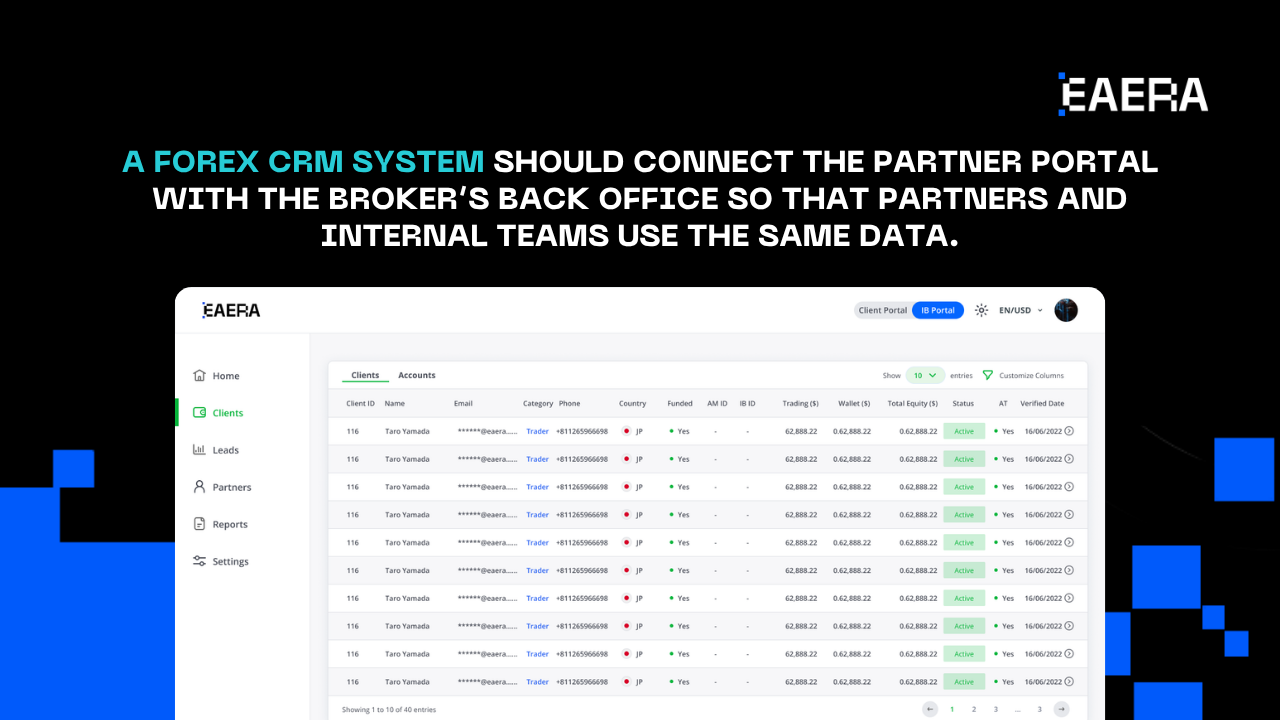
This is important because inconsistent data creates problems. And if the partner portal says one thing and the back office says another commission number, trust immediately goes down.
Use Reporting to Scale the Right IBs
Scaling IB operations is more than just adding partners. It’s about knowing which partners are worth the size.
A good IB network can be large, but not all partners bring good clients. Some partners have high registration numbers and low deposits.
A forex CRM system should help brokers answer questions such as:
- Which IBs bring the most registered clients?
- Which IBs bring funded clients?
- Which IBs bring active traders?
- Which IBs generate volume but low retention?
Reporting should include:
- Referral conversion
- KYC completion
- First deposit conversion
- Trading volume
- Net deposits
- Active clients
- Commission cost
- Revenue contribution
- Payout liability
- Partner quality score
EAERA powers broker operations with connected CRM, client portal, back office, funding, affiliate management, reporting, alerts and workflow automation.
A forex CRM system should help brokers to scale out the right IBs, not just to add more partners.
The aim is not to grow a bigger IB network. The aim is to achieve a more profitable, transparent, and manageable IB network.